





Human Rights Defense Center v. Board of County Commissioners for Jefferson County, CO, Complaint, Censorship, 2025
Download original document:
Document text
Document text
This text is machine-read, and may contain errors. Check the original document to verify accuracy.
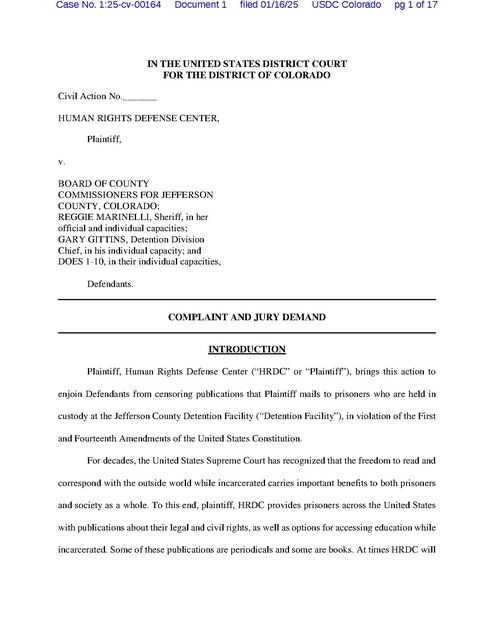
Case No. 1:25-cv-00164

Document 1

filed 01/16/25

USDC Colorado

pg 1 of 17

IN THE UNITED STATES DISTRICT COURT
FOR THE DISTRICT OF COLORADO
Civil Action No._______
HUMAN RIGHTS DEFENSE CENTER,
Plaintiff,
v.
BOARD OF COUNTY
COMMISSIONERS FOR JEFFERSON
COUNTY, COLORADO;
REGGIE MARINELLI, Sheriff, in her
official and individual capacities;
GARY GITTINS, Detention Division
Chief, in his individual capacity; and
DOES 1-10, in their individual capacities,
Defendants.

COMPLAINT AND JURY DEMAND
INTRODUCTION
Plaintiff, Human Rights Defense Center (“HRDC” or “Plaintiff”), brings this action to
enjoin Defendants from censoring publications that Plaintiff mails to prisoners who are held in
custody at the Jefferson County Detention Facility (“Detention Facility”), in violation of the First
and Fourteenth Amendments of the United States Constitution.
For decades, the United States Supreme Court has recognized that the freedom to read and
correspond with the outside world while incarcerated carries important benefits to both prisoners
and society as a whole. To this end, plaintiff, HRDC provides prisoners across the United States
with publications about their legal and civil rights, as well as options for accessing education while
incarcerated. Some of these publications are periodicals and some are books. At times HRDC will

Case No. 1:25-cv-00164

Document 1

filed 01/16/25

USDC Colorado

pg 2 of 17

send information that is requested by prisoners, and at other times HRDC will send information
unsolicited to assist prisoners and in furtherance of its mission to educate prisoners.
Defendants have adopted and implemented mail policies and practices prohibiting
delivery of written speech from HRDC. Defendants’ actions violate HRDC’s rights under the First
and the Fourteenth Amendments of the United States Constitution. HRDC thus brings this action,
pursuant to 42 U.S.C. § 1983, seeking injunctive and declaratory relief and damages to be proven
at trial.
JURISDICTION AND VENUE
1.

This action is brought pursuant to 28 U.S.C. § 1331, as it arises under the

Constitution and laws of the United States, and pursuant to 28 U.S.C. § 1343, as it seeks redress
for civil rights violations under 42 U.S.C. § 1983.
2.

Venue is proper under 28 U.S.C. § 1391(b). At least one Defendant resides within

this judicial district, and the events giving rise to the claims asserted herein occurred within this
judicial district.
3.

HRDC’s claims for relief are predicated upon 42 U.S.C. § 1983, which authorizes

actions to redress the deprivation, under color of state law, of rights, privileges, and immunities
secured to Plaintiff by the First and Fourteenth Amendments of the U.S. Constitution and laws of
the United States.
4.

This Court has jurisdiction over claims seeking declaratory and injunctive relief

pursuant to 28 U.S.C. §§ 2201 and 2202, as well as claims seeking nominal and compensatory
damages against all Defendants.

2

Case No. 1:25-cv-00164

5.

Document 1

filed 01/16/25

USDC Colorado

pg 3 of 17

HRDC’s request for attorneys’ fees and costs is predicated upon 42 U.S.C. § 1988,

which authorizes the award of attorneys’ fees and costs to prevailing plaintiffs in actions brought
pursuant to 42 U.S.C. § 1983.
PARTIES
6.

HRDC is a not-for-profit charitable organization recognized under § 501(c)(3) of

the Internal Revenue Code, incorporated in the state of Washington and with principal offices in
Boynton Beach, Florida.
7.

Defendant Board of County Commissioners for Jefferson County (“Jefferson

County”) is the governing body for Jefferson County, Colorado, a formally constituted political
subdivision of the state of Colorado. Jefferson County has delegated its authority for the operation
of the Detention Facility to Sheriff Reggie Marinelli.
8.

Defendant Reggie Marinelli (“Marinelli”) is the elected Sheriff of Jefferson

County, Colorado, to whom Jefferson County has delegated the operation of the Detention Facility.
Sheriff Marinelli is responsible for overseeing the management and operations of the Detention
Facility, and for the hiring, screening, training, retention, supervision, discipline, counseling, and
control of the personnel of the Detention Facility who interpret and apply the mail policy to
prisoners. As Sheriff, Marinelli is a final policymaker for the Detention Facility with respect all
of its operations, including for policies governing incoming mail for prisoners. She is sued in both
her official 1 and her individual capacities.
9.

Defendant Gary Gittins (“Gittins”) is the Detention Division Chief of the

Jefferson County Sheriff’s Office. Gittins is employed by and is an agent of Defendants Jefferson
County and Marinelli. As Chief of the Detention Division, Gittins is responsible for overseeing

1

In lieu of naming the Jefferson County Sherriff’s Office as a Defendant.
3

Case No. 1:25-cv-00164

Document 1

filed 01/16/25

USDC Colorado

pg 4 of 17

the management and operations of the Detention Facility, and for the hiring, screening, training,
retention, supervision, discipline, counseling, and control of the personnel of the Detention Facility
who interpret and apply the mail policy for prisoners. He is sued in his individual capacity.
10.

The true names and identities of Defendants DOES 1 through 10 are presently

unknown to HRDC. Each of DOES 1 through 10 are or were employed by and are or were agents
of the Detention Facility when some or all of the challenged mail policies and practices at the
Detention Facility were adopted and/or implemented. Each of DOES 1 through 10 are or were
personally involved in the adoption and/or implementation of the Detention Facility’s mail policies
for prisoners, and/or are or were responsible for the hiring, screening, training, retention,
supervision, discipline, counseling, and/or control of the Detention Facility staff who interpret and
implement these mail policies. DOES 1 through 10 are sued in their individual and official
capacities. HRDC will seek to amend this Complaint when the true names and identities of DOES
1 through 10 have been ascertained.
11.

At all times material to this Complaint, the actions of all Defendants as alleged

herein were taken under the authority and color of state law.
FACTUAL ALLEGATIONS
I.

HRDC’s Publications
12.

For more than 34 years, the focus of HRDC’s mission has been public education,

advocacy and outreach on behalf of, and for the purpose of assisting, prisoners who seek legal
redress for infringements of their constitutionally guaranteed and other basic human rights.
HRDC’s mission, if realized, has a salutary effect on public safety.
13.

To accomplish its mission, HRDC publishes and distributes books, magazines, and

other information containing news and analysis about prisons, jails and other detention facilities,

4

Case No. 1:25-cv-00164

Document 1

filed 01/16/25

USDC Colorado

pg 5 of 17

prisoners’ rights, court rulings, management of prison facilities, prison conditions and other
matters pertaining to the rights and/or interests of incarcerated individuals.
14.

HRDC publishes and distributes an award-winning monthly magazine titled

Prison Legal News: Dedicated to Protecting Human Rights (“Prison Legal News”), which contains
news and analysis about correctional facilities, the rights of prisoners, court opinions, prison and
jail conditions, excessive force, and religious freedom. In 2013, Prison Legal News received the
First Amendment Award from the Society of Professional Journalists. Prison Legal News is
published on newsprint bound by two small staples, and is 72 pages long.
15.

HRDC also publishes and distributes a second monthly magazine titled Criminal

Legal News, which contains news and analysis about individual rights, court rulings, and other
criminal legal-related issues. Criminal Legal News is also published on newsprint bound by two
small staples, and is 56 pages long.
16.

HRDC also publishes and/or distributes several different soft-cover books on

criminal justice, health, and legal issues that are of interest to prisoners and others. HRDC
publishes and distributes the Prisoners’ Guerilla Handbook: A Guide to Correspondence
Programs in the United States and Canada (“Prisoners’ Handbook”), which provides information
on enrolling at accredited higher educational, vocational and training schools. HRDC does not
publish, but is the sole national distributor of Protecting Your Health and Safety (“PYHS”), which
describes the rights, protections and legal remedies available to persons concerning their health
and safety while they are incarcerated.
17.

In addition to its publications, HRDC also communicates with prisoners through

the United States Postal Service by mailing them: (a) informational brochure packets, which
contain a brochure and subscription order form, a book list, and a published books brochure (each

5

Case No. 1:25-cv-00164

Document 1

filed 01/16/25

USDC Colorado

pg 6 of 17

of which is a single page); (b) copies of judicial opinions of import to prisoners, which are marked
“Court Ruling;” and (c) letters that provide pertinent information about HRDC’s publications and
related topics and subscription renewal letters.

HRDC encloses a self-addressed, stamped

envelope with its informational brochure packets and subscription renewal letters, but does not
enclose extra envelopes or stamps with the informational brochure packets, judicial opinions, or
other letters that it mails to prisoners.
18.

HRDC has thousands of subscribers to its monthly magazines in the United States

and abroad, including prisoners, attorneys, judges, journalists, libraries, and members of the public.
Since its creation in 1990, HRDC has sent its publications to prisoners and law librarians in more
than 3,000 correctional facilities across the United States, including death row units and
institutions within the Federal Bureau of Prisons, such as the federal Administrative Maximum
Facility (“ADX” or “Supermax”) in Florence, Colorado—the most secure prison in the United
States. Prison Legal News is distributed to prisons and jails within the correctional systems of all
50 states, including to dozens of prisoners housed in facilities in the State of Colorado.
19.

HRDC has been attempting to send these important publications to persons

incarcerated at the Detention Facility. Yet Defendants maintain mail policies or practices that
unconstitutionally prevent HRDC from sending these materials to individuals incarcerated at the
Detention Facility.
II.

Defendants’ Mail Policies and Practices
20.

The Detention Facility’s mail policy (the “Mail Policy”) is available on the public

website of the Jefferson County Sheriff’s Office at https://www.jeffco.us/661/Inmate-Mail (last
visited January 16, 2025). In pertinent part, the Mail Policy provides:
Effective February 15, 2024, all personal mail must be addressed in the following
manner:
6

Case No. 1:25-cv-00164

Document 1

filed 01/16/25

USDC Colorado

pg 7 of 17

Inmate Name and ID #
c/o Securus Digital Mail Center - Jefferson County Jail
PO Box 25938
Tampa, FL 33622
•

Full name and address of sender must be written in return address

•

Failure to properly address the envelope will result in the mail being
returned to sender

•

Once the mail is received at the Securus Digital Mail Center, it will be
digitally scanned and available to the inmate, to be viewed on module
kiosks and tablets. This includes all personal mail from family and friends
such as letters, pictures, and drawings.

•

Any person sending any personal mail that wishes to have it returned to
them must include a self-addressed, stamped envelope included with the
original mail

•

Inmate to inmate mail is not permitted

•

All correspondence will be scanned and inspected for contraband, except
mail that is clearly marked “Legal Mail”

…
We do not allow recreational books to be sent to inmates in our facility. Only preapproved legal or religious books/publications will be allowed.
21.

In addition, the Mail Policy contains the following list of “restricted materials”

including:
•

Plans for the introduction of contraband or other criminal activity, including
escape or unauthorized entry.

•

Threats of blackmail and/or extortion.

•

Instruction for the manufacture of weapons, drugs, drug paraphernalia,
alcoholic beverages, or explosives or incendiary devices.

•

Codes not understood by the scanner, to include gang graffiti or tagging.

•

Plans for activities in violation of facility rules.

•

Information, which if communicated, would create danger, interpersonal
discord, violence and/or harm to any person.

•

Mail that contains potentially infectious and/or offensive materials (e.g., bodily
fluids).

•

Sexually explicit photographs, articles, or materials depicting sexual activity or
displaying male/female genitalia or breasts.

7

Case No. 1:25-cv-00164

Document 1

filed 01/16/25

USDC Colorado

pg 8 of 17

•

Any item which promotes racial conflict or discrimination, including illegal
gang materials.

•

Material that would, if communicated, disrupt the operation and/or safety and
security of the facility.

•

Items not authorized for retention (e.g. stickers, postage stamps, envelopes,
blank paper, laminated items, plastic or cardboard items, newspaper/magazine
clippings, recorded musical cards, cards larger than 8”x11”, drawings or
writings made with crayons, Polaroid pictures, stationary items, business cards,
lottery tickets, lipstick, glitter, perfumes, ribbons, beads, string, oils, chemicals,
liquids, foreign substances, batteries, electronic devices, glue, etc.).

•

Food items received in the mail will be returned to the sender.

•

Inmate to inmate mail without pre-approval.

•

Funds sent, other than the allowable US Postal or international postal money
orders, checks from other law enforcement agencies, cashier's checks, or
certified funds will be returned to the sender.

•

Books are prohibited, unless pre-approved by a detention watch commander, or
designee.

•

Parcels/packages are prohibited, unless pre-approved by a detention watch
commander, or designee.

•

Three-way or third-party mail.

•

Misrepresentation of privileged/legal mail.

•

Items, whether original or photocopies:
credit card(s) and/or account numbers, bank account numbers, checks,
deposit slips or any financial statement
o

personal identification numbers or security codes for any financial
transaction or device
o

o

social security card, number or statement

driver’s license, passport, passport card, consulate card, tribal
identification card
o

III.

o

birth certificates, death certificates, or mortuary documents

o

real estate or property tax documents

Defendants’ Censorship of HRDC’s Mail
22.

Between June 2023 and December 2024, HRDC sent books, magazines,

informational brochures, and correspondence to individuals confined at the Detention Facility.
During that time period, ninety-three (93) of those items were returned to HRDC by the Detention
8

Case No. 1:25-cv-00164

Document 1

filed 01/16/25

USDC Colorado

pg 9 of 17

Facility. The items returned were addressed to individuals confirmed to still be in custody of the
Detention Facility on the day HRDC received the returned mail.

23.

The ninety-three (93) returned items consisted of: twenty-eight (28) issues

of Prison Legal News; twenty-eight (28) issues of Criminal Legal News; nineteen (19)
copies of PYHS; nine (9) copies of Prisoners’ Handbook; five (5) informational brochures;
three (3) follow-up letters; and one (1) renewal letter.
24.

Many of the rejected items were returned to HRDC marked in various ways,

including “VIOLATES DOC MAIL RULE,” “RETURN TO SENDER,” “REJECTED,”
AND “RTS.”
25.

Because of Defendants’ actions as described above, HRDC has suffered

damages, and will continue to suffer damages, including, but not limited to: the suppression
of HRDC’s speech; the impediment of HRDC’s ability to disseminate its message;
frustration of HRDC’s non-profit organizational mission; the loss of potential subscribers
and customers; and, the inability to recruit new subscribers and supporters.
26.

Defendants, and other agents of the Detention Facility, are responsible for or

personally participated in, creating and implementing these unconstitutional polices,
practices, and customs, or for ratifying and adopting them. Further, Defendants are
responsible for training and supervising the employees of the Detention Facility, whose
conduct has injured and continues to injure HRDC.
27.

Defendants’ actions and inactions were and are impermissibly motivated,

and were and are all committed under color of state law with deliberate indifference to
HRDC’s rights.
9

Case No. 1:25-cv-00164

28.

Document 1

filed 01/16/25

USDC Colorado

pg 10 of 17

Plaintiff will continue to send its books and magazines to subscribers,

customers, and other individuals imprisoned at the Detention Facility.
29.

Defendants’ unconstitutional policy, practices, and customs continue to

violate HRDC’s rights, and they were and are the moving force behind the injuries HRDC
suffered as a direct result of the constitutional violations. As a result, HRDC has no
adequate remedy at law.
30.

Without relief from this Court HRDC will suffer irreparable injury, since its

fundamental free speech and due process rights are being denied. The balance of hardship
favors Plaintiff and the public interest will be served by granting injunctive and declaratory
relief.
31.

The accommodation of the free speech and due process rights of HRDC with

respect to written speech protected by the Constitution will not have any significant impact
on the Detention Facility, its staff, prisoners, or the public.
IV.

Defendants’ Failure to Provide Due Process Notice and an Opportunity to
Appeal
23.

To date, Defendants have failed to provide HRDC with sufficient notice of the

reason for the rejection of the magazines, books, and correspondence mailed by HRDC to prisoners
at the Detention Facility.
24.

Further, Defendants have failed to provide HRDC with an opportunity to appeal

these censorship decisions before the items were rejected and returned to HRDC at HRDC’s
expense.

10

Case No. 1:25-cv-00164

V.

Document 1

filed 01/16/25

USDC Colorado

pg 11 of 17

Defendants’ Unconstitutional Mail Policies and Practices Are Causing HRDC
Ongoing and Irreparable Harm.
25.

Due to Defendants’ actions described above, HRDC has suffered damages, and

will continue to suffer damages, including but not limited to: deprivation of its constitutional
rights; frustration of its abilities to disseminate its political message, to recruit new subscribers and
supporters, and to advance its mission as a not-for-profit organization; significant diversion of its
resources, including staff time; loss of potential subscribers and customers; damage to its
reputation; and significant printing, handling, and mailing costs.
26.

Defendants’ actions and omissions were and are all committed under color of law

and with reckless indifference to HRDC’s rights.
27.

Defendants and their agents are responsible for—or personally participated in—

creating and implementing these unconstitutional policies, practices, and customs, and/or ratifying
or adopting them. Further, Defendants Marinelli and Gittins are responsible for training and
supervising employees whose conduct has injured and continues to injure HRDC.
28.

Defendants’ unconstitutional policies, practices, and customs are ongoing, and

continue to violate HRDC’s constitutional rights—causing irreparable harm.

Defendants’

unconstitutional policies, practices, and customs will continue unless enjoined. As such, HRDC
has no adequate remedy at law.
29.

Defendants Marinelli’s and Gittins’s actions – including, but not limited to, their

implementation and arbitrary enforcement of an official mail policy – are in violation of clearly
established law in this jurisdiction that makes it unlawful for governmental officials to deny
persons the right to communicate, via the U.S. Mail, with incarcerated prisoners, absent a
legitimate penological justification and without providing notice and an opportunity to the mail
sender to challenge any such denial.
11

Case No. 1:25-cv-00164

30.

Document 1

filed 01/16/25

USDC Colorado

pg 12 of 17

In addition to damages, HRDC is entitled to injunctive relief prohibiting

Defendants from unconstitutionally censoring and refusing to deliver HRDC’s mailings and
depriving HRDC of due process of law.
CAUSES OF ACTION
FIRST CLAIM FOR RELIEF
Violation of the First Amendment Right to Free Speech and Communication
Under 42 U.S.C. § 1983
(Brought Against All Defendants)
31.

HRDC repeats and re-alleges each and every allegation set forth above, and

incorporates them herein by reference.
32.

The acts described above constitute violations of HRDC’s rights under the First

Amendment of the U.S. Constitution, as incorporated and applicable to the Defendants under the
Fourteenth Amendment.
33.

HRDC has a constitutionally protected liberty interest in communicating with

incarcerated individuals by sending its materials, including the magazines Prison Legal News and
Criminal Legal News, to them via U.S. Mail. Defendants’ unconstitutional censorship violates
HRDC’s clearly established right to communicate with these individuals.
34.

None of the content in any of the Plaintiff’s publications that Defendants have

rejected violates the Detention Facility’s posted mail policy. Nor is there any other non-stated
legitimate penological interest justifying Defendants’ unconstitutional censorship.
35.

Moreover, Defendants’ apparent requirement that prisoners seek prior approval of

published materials before they can be delivered to their intended recipients, supra ¶ 19, serves as
a prior restraint on speech, abridging HRDC’s First Amendment rights.
36.

Defendants’ conduct is objectively unreasonable and was undertaken recklessly,

intentionally, willfully, with malice, and with deliberate indifference to the rights of others.
12

Case No. 1:25-cv-00164

37.

Document 1

filed 01/16/25

USDC Colorado

pg 13 of 17

HRDC’s injuries and the violations of its constitutional rights were directly and

proximately caused by Defendants’ policies and practices; and those policies and practices were
the moving force behind the violations.
38.

The acts described above have caused HRDC to suffer damages, and if not

enjoined, will continue to cause HRDC to suffer damages.
39.

HRDC seeks declaratory and injunctive relief against all Defendants, and nominal

and compensatory damages against the individual Defendants. HRDC seeks punitive damages
against the individual Defendants in their individual capacities.
SECOND CLAIM FOR RELIEF
Violation of the Fourteenth Amendment Right to Notice and Due Process
Under 42 U.S.C. § 1983
(Brought Against All Defendants)
40.

HRDC repeats and re-alleges each and every allegation set forth above, and

incorporates them herein by reference.
41.

The acts described above constitute violations of HRDC’s rights, the rights of

other correspondents who have attempted to or intend to correspond with persons incarcerated in
the Detention Facility, and the rights of persons incarcerated in the Detention Facility, under the
Fourteenth Amendment of the U.S. Constitution.
42.

HRDC has a clearly established right under the Due Process Clause of the

Fourteenth Amendment to receive notice and an opportunity to object and/or appeal Defendants’
decisions to prevent Plaintiff’s mail from reaching prisoners held in the Detention Facility.
43.

Defendants’ policy and practice of censoring HRDC’s publications fails to provide

Plaintiff with individualized notice of the censorship or an opportunity to be heard. Defendants
did not provide constitutionally adequate notice of the basis for censorship of HRDC’s magazines
nor did Defendants provide HRDC an opportunity to appeal the censorship decision with a party
13

Case No. 1:25-cv-00164

Document 1

filed 01/16/25

USDC Colorado

pg 14 of 17

not involved in that original decision. Thus, Defendants violated HRDC’s clearly established right
to due process.
44.

Defendants’ conduct is objectively unreasonable and was undertaken recklessly,

intentionally, willfully, with malice, and with deliberate indifference to the rights of others.
45.

HRDC’s injuries and the violations of its constitutional rights were directly and

proximately caused by Defendants’ policies and practices; and those policies and practices were
the moving force behind the violations.
46.

The acts described above have caused HRDC to suffer damages, and if not

enjoined, will continue to cause HRDC to suffer damages.
47.

HRDC seeks declaratory and injunctive relief against all Defendants, and nominal

and compensatory damages against the individual Defendants. HRDC seeks punitive damages
against the individual Defendants in their individual capacities.
THIRD CLAIM FOR RELIEF
Violation of Article II, Section 10 of the Colorado Constitution -- Free Speech
Under C.R.S. 13-21-131
(Brought Against All Individual Defendants)
48.

HRDC repeats and re-alleges each and every allegation set forth above, and

incorporates them herein by reference.
49.

At all relevant times, all Individual Defendants to this claim were acting under the

color of state law, and each was a peace officer as defined by Colo. Rev. Stat. § 24-31-901(3).
50.

The acts described above constitute violations of HRDC’s rights under Article II,

Section 10 of the Colorado Constitution, which provides in relevant part that “No law shall be
passed impairing the freedom of speech; every person shall be free to speak, write or publish
whatever he will on any subject, being responsible for all abuse of that liberty.”

14

Case No. 1:25-cv-00164

51.

Document 1

filed 01/16/25

USDC Colorado

pg 15 of 17

HRDC has a liberty interest, protected by the Colorado Constitution, in

communicating with incarcerated individuals by sending its materials, including the magazines
Prison Legal News and Criminal Legal News, to them via U.S. Mail. Defendants’ unconstitutional
censorship violates HRDC’s clearly established right to communicate with these individuals.
52.

None of the content in any of the Plaintiff’s publications that Defendants have

rejected violates the Detention Facility’s posted mail policy. Nor is there any other non-stated
legitimate penological interest justifying Defendants’ unconstitutional censorship.
53.

Moreover, Defendants’ apparent requirement that prisoners seek prior approval of

published materials before they can be delivered to their intended recipients, supra ¶ 19, serves as
a prior restraint on speech, abridging HRDC’s Colorado Constitutional right to free speech and
communication.
54.

Defendants’ conduct is objectively unreasonable and was undertaken recklessly,

intentionally, willfully, with malice, and with deliberate indifference to the rights of others.
55.

HRDC’s injuries and the violations of its Colorado constitutional rights were

directly and proximately caused by Defendants’ policies and practices; and those policies and
practices were the moving force behind the violations.
56.

The acts described above have caused HRDC to suffer damages, and if not

enjoined, will continue to cause HRDC to suffer damages.
57.

HRDC seeks declaratory and injunctive relief against all Defendants, and nominal

and compensatory damages against the individual Defendants. HRDC seeks punitive damages
against the individual Defendants in their individual capacities.
REQUEST FOR RELIEF
WHEREFORE, Plaintiff respectfully requests relief as follows:

15

Case No. 1:25-cv-00164

1.

Document 1

filed 01/16/25

USDC Colorado

pg 16 of 17

A declaration that Defendants’ policies and practices violate the First and
Fourteenth Amendments of the U.S. Constitution, as well as Article II,
Section 10 of the Colorado Constitution, facially and as applied;

2.

Preliminary and permanent injunctions preventing Defendants from
continuing to violate the First and Fourteenth Amendments of the U.S.
Constitution, as well as Article II, Section 10 of the Colorado Constitution,
and providing other equitable relief;

3.

Nominal damages for each violation of HRDC’s rights by the Individual
Defendants;

4.

Compensatory damages against the Individual Defendants in an amount to
be proved at trial;

5.

Punitive damages against the Individual Defendants in their individual
capacities, in an amount to be proved at trial;

6.

An award of costs, including reasonable attorneys’ fees, under 42 U.S.C.
§ 1988, C.R.S. 13-21-131(3), and other applicable law; and

7.

Such further and additional relief as this Court may deem just and equitable.
JURY DEMAND

Plaintiff Human Rights Defense Center hereby demands a trial by jury pursuant to Federal
Rule of Civil Procedure 38(b) on all issues so triable.

16

Case No. 1:25-cv-00164

Document 1

filed 01/16/25

Dated: January 16, 2025

USDC Colorado

pg 17 of 17

Respectfully submitted,
KILLMER LANE, LLP
s/ Darold Killmer
Darold Killmer
Reid Allison
1543 Champa Street, Ste. 400
Denver, CO 80202
Telephone: (303) 571-1000
Fax: (303) 571-1001
dkillmer@killmerlane.com
rallison@killmerlane.com
Jonathan P. Picard*
HUMAN RIGHTS DEFENSE CENTER
P.O. Box 1151
Lake Worth, FL 33460
Telephone: (561) 360-2523
Fax: (561) 828-8166
jpicard@humanrightsdefensecenter.org
Attorneys for Plaintiff Human Rights Defense
Center
*Admission pending.

17