





Federal Habeas Quick Reference Guide for Federal Prisoners
Download original document:
Document text
Document text
This text is machine-read, and may contain errors. Check the original document to verify accuracy.
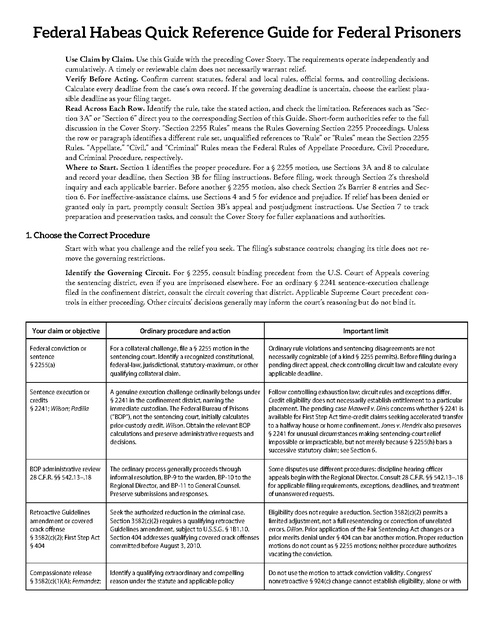
Federal Habeas Quick Reference Guide for Federal Prisoners Use Claim by Claim. Use this Guide with the preceding Cover Story. The requirements operate independently and cumulatively. A timely or reviewable claim does not necessarily warrant relief. Verify Before Acting. Confirm current statutes, federal and local rules, official forms, and controlling decisions. Calculate every deadline from the case’s own record. If the governing deadline is uncertain, choose the earliest plausible deadline as your filing target. Read Across Each Row. Identify the rule, take the stated action, and check the limitation. References such as “Section 3A” or “Section 6” direct you to the corresponding Section of this Guide. Short-form authorities refer to the full discussion in the Cover Story. “Section 2255 Rules” means the Rules Governing Section 2255 Proceedings. Unless the row or paragraph identifies a different rule set, unqualified references to “Rule” or “Rules” mean the Section 2255 Rules. “Appellate,” “Civil,” and “Criminal” Rules mean the Federal Rules of Appellate Procedure, Civil Procedure, and Criminal Procedure, respectively. Where to Start. Section 1 identifies the proper procedure. For a § 2255 motion, use Sections 3A and 8 to calculate and record your deadline, then Section 3B for filing instructions. Before filing, work through Section 2’s threshold inquiry and each applicable barrier. Before another § 2255 motion, also check Section 2’s Barrier 8 entries and Section 6. For ineffective-assistance claims, use Sections 4 and 5 for evidence and prejudice. If relief has been denied or granted only in part, promptly consult Section 3B’s appeal and postjudgment instructions. Use Section 7 to track preparation and preservation tasks, and consult the Cover Story for fuller explanations and authorities. 1. Choose the Correct Procedure Start with what you challenge and the relief you seek. The filing’s substance controls; changing its title does not remove the governing restrictions. Identify the Governing Circuit. For § 2255, consult binding precedent from the U.S. Court of Appeals covering the sentencing district, even if you are imprisoned elsewhere. For an ordinary § 2241 sentence-execution challenge filed in the confinement district, consult the circuit covering that district. Applicable Supreme Court precedent controls in either proceeding. Other circuits’ decisions generally may inform the court’s reasoning but do not bind it. Your claim or objective Ordinary procedure and action Important limit Federal conviction or sentence § 2255(a) For a collateral challenge, file a § 2255 motion in the sentencing court. Identify a recognized constitutional, federal-law, jurisdictional, statutory-maximum, or other qualifying collateral claim. Ordinary rule violations and sentencing disagreements are not necessarily cognizable (of a kind § 2255 permits). Before filing during a pending direct appeal, check controlling circuit law and calculate every applicable deadline. Sentence execution or credits § 2241; Wilson; Padilla A genuine execution challenge ordinarily belongs under § 2241 in the confinement district, naming the immediate custodian. The Federal Bureau of Prisons (‘‘BOP’’), not the sentencing court, initially calculates prior-custody credit. Wilson. Obtain the relevant BOP calculations and preserve administrative requests and decisions. Follow controlling exhaustion law; circuit rules and exceptions differ. Credit eligibility does not necessarily establish entitlement to a particular placement. The pending case Maxwell v. Dinis concerns whether § 2241 is available for First Step Act time-credit claims seeking accelerated transfer to a halfway house or home confinement. Jones v. Hendrix also preserves § 2241 for unusual circumstances making sentencing-court relief impossible or impracticable, but not merely because § 2255(h) bars a successive statutory claim; see Section 6. BOP administrative review 28 C.F.R. §§ 542.13---.18 The ordinary process generally proceeds through informal resolution, BP-9 to the warden, BP-10 to the Regional Director, and BP-11 to General Counsel. Preserve submissions and responses. Some disputes use different procedures: discipline hearing officer appeals begin with the Regional Director. Consult 28 C.F.R. §§ 542.13---.18 for applicable filing requirements, exceptions, deadlines, and treatment of unanswered requests. Retroactive Guidelines amendment or covered crack offense § 3582(c)(2); First Step Act § 404 Seek the authorized reduction in the criminal case. Section 3582(c)(2) requires a qualifying retroactive Guidelines amendment, subject to U.S.S.G. § 1B1.10. Section 404 addresses qualifying covered crack offenses committed before August 3, 2010. Eligibility does not require a reduction. Section 3582(c)(2) permits a limited adjustment, not a full resentencing or correction of unrelated errors. Dillon. Prior application of the Fair Sentencing Act changes or a prior merits denial under § 404 can bar another motion. Proper reduction motions do not count as § 2255 motions; neither procedure authorizes vacating the conviction. Compassionate release § 3582(c)(1)(A); Fernandez; Identify a qualifying extraordinary and compelling reason under the statute and applicable policy Do not use the motion to attack conviction validity. Congress’ nonretroactive § 924(c) change cannot establish eligibility, alone or with Your claim or objective Ordinary procedure and action Important limit Rutherford statement. Medical, age-related, and family circumstances can remain relevant. other factors. Once an independent qualifying reason exists, a legal change may bear on the reduction’s extent. A qualifying reason does not itself require a reduction; eligibility and the amount of any reduction remain separate determinations. New trial or narrow sentence correction Criminal Rules 33, 35 Rule 33 ordinarily allows three years after the verdict or finding of guilt for newly discovered evidence and 14 days for other grounds, subject to Criminal Rule 45 extensions. Rule 35(a) ordinarily allows 14 days after oral sentencing for arithmetic, technical, or other clear error. Rule 35(b) requires a substantial-assistance motion by the Government, generally within one year after sentencing, with specified later exceptions. Criminal Rule 62 permits limited Rule 35 extensions during a declared Criminal Rules emergency. These are not general reconsideration procedures. After sentencing, a guilty plea can be set aside only on direct appeal or collateral attack. Criminal Rule 11(e). Extraordinary relief when ordinary remedies are unavailable Coram nobis; Morgan Examine fundamental error, absence of another available remedy, sound reasons for not seeking earlier relief, and controlling circuit law. Coram nobis commonly becomes relevant after the sentence expires. The writ is not an automatic substitute for an unavailable § 2255 claim. Custody, diligence, and prior opportunities require circuit-specific analysis. Conditions of confinement or damages Identify an available civil cause of action and the proper defendants. Distinguish prison conditions from the validity or execution of custody. Federal custody itself creates no damages remedy. Egbert sharply limits recognition of new implied constitutional damages claims against federal officers. 2. The Threshold Inquiry and Nine Barriers Apply each relevant checkpoint separately to every ground. These nine barriers differ from the state-prisoner (§ 2254) framework. Checkpoint Court’s question and core rule What you should do Critical trap or limited gateway Threshold: Custody and cognizability § 2255(a) Details: Sections 1 and 6. Are you in custody under the challenged federal sentence and asserting a recognized ground for release? Supervised release qualifies as custody. Identify the judgment, custody, legal defect, facts, and requested remedy. Classify a sentencing error by its source and effect. An expired sentence’s collateral consequences alone ordinarily do not establish custody at filing. A restitution-only claim typically asserts no right to release. Ordinary advisory-Guidelines error is not automatically cognizable. Custody ending after filing does not automatically end the case; continuing consequences can preserve a live controversy. Barrier 1: Plea and waivers Tollett; United States v. White (5th Cir. 2002) Details: Sections 5 and 6. A guilty plea ordinarily forecloses independent challenges to pre-plea defects. Valid direct-appeal and collateral-review waivers relinquish specified claims in their respective proceedings. Analyze the plea and each waiver separately under the agreement and controlling law. Hunter held that a sentence-appeal waiver is unenforceable when enforcement would produce a miscarriage of justice: an error obvious and egregious enough to bring the judicial system into disrepute. Ordinary sentencing-law errors do not qualify. Read the plea and each waiver separately. Identify written exceptions and exceptions recognized by controlling circuit law, including any applicable exception for a sentence exceeding the statutory maximum or based on an impermissible factor such as race. Preserve counsel’s advice, the Criminal Rule 11 colloquy, and the Government’s promises and performance. An exception for ineffective assistance affecting the plea or waiver may exclude sentencing-performance claims. Hunter decided a direct-appeal waiver issue, not collateral-waiver enforceability. Justice Sotomayor’s statement in Jones v. United States (2026), encouraging lower courts to consider Hunter’s reasoning for collateral-review waivers invoked against challenges to a conviction’s validity, is not a holding. Barrier 2: One-year period § 2255(f); Dodd Details: Section 3A. Was each claim filed within one year of its latest applicable statutory starting date, with any independently justified equitable tolling? Test finality, an unlawful governmental impediment, a qualifying newly recognized right, and facts discoverable through diligence. Record proof and a filing target. Another collateral case does not pause the year merely because it is pending. A later retroactivity ruling does not restart the recognition-date clock. Barrier 3: Procedural default Frady; Bousley; Massaro Was a claim omitted at trial or on direct review when it should have been presented? Ordinarily show cause and Identify an external impediment or constitutionally ineffective assistance that caused the omission; prove any Massaro permits ineffective-assistance claims for the first time under § 2255 despite omission on direct appeal. Novelty Checkpoint Court’s question and core rule What you should do Critical trap or limited gateway Details: Section 6. actual prejudice, or factual innocence. ineffective-assistance theory on its own elements. Prove actual prejudice separately. For innocence, address the full record and applicable standard. can establish cause when the claim’s legal basis was not reasonably available to counsel. Reed v. Ross. Adverse precedent alone does not establish cause. Barrier 4: Pleading and preliminary review Rules 2---5; Castro; Civil Rule 15 Details: Section 3B. Do specific facts support relief, and is the filing properly classified? Rule 4 requires dismissal when the motion, exhibits, and prior record plainly show no entitlement. State every ground and supporting facts on AO 243 or the local equivalent; sign under penalty of perjury. Address amendment and timeliness separately. A placeholder does not reserve claims, and the bare statement that counsel was ineffective is not a supporting fact. Recharacterization as a first motion requires Castro safeguards. A later claim does not relate back merely because it attacks the same conviction. Barrier 5: Evidence, hearing, and counsel § 2255(b); Rules 6---8 Details: Section 4. Do the motion, files, and records conclusively show no entitlement? If not, § 2255(b) requires a hearing. Discovery, record expansion, counsel, and services have separate conditions. Identify each material factual dispute, its relevance to relief, and the specific evidence or procedure needed to resolve it. There is no § 2254(e)(2) restriction, but neither discovery nor a hearing follows from conclusory allegations. Counsel’s affidavit does not automatically settle disputed facts. Barrier 6: Prejudice and harmless error Strickland; Hill v. Lockhart; Glover Details: Sections 5 and 6. Does the proven error satisfy the prejudice or harmless-error rule for this claim and procedural posture? Match the showing to trial, plea, lost offer, sentencing, or appeal. Use Section 5’s prejudice table and identify the remedy that would cure the defect. Proof of deficient performance alone is insufficient. Circuit law controls ordinary trial-error harmlessness under § 2255. Relief need not mean release or full resentencing. Barrier 7: Certificate of appealability (‘‘COA’’) § 2253(c); Section 2255 Rule 11; Slack Details: Section 3B. After merits denial, could reasonable jurists debate the constitutional assessment? After procedural denial, could reasonable jurists debate both the constitutional claim’s validity and the procedural ruling? Identify the constitutional right, specific issues, and every independently sufficient ground for denying the claim being appealed. Request a COA from a circuit judge if the District Court denies one; seek expansion under circuit procedures if the certificate omits an issue necessary for relief. File the notice of appeal on time. A COA is not a notice of appeal. You need not prove the appeal will succeed. A statutory claim’s cognizability does not itself support a COA. Partial relief can create a separate criminal appeal. Barrier 8A: Is the filing successive? Castro; Rivers; Gonzalez; Magwood; In re Augustin (6th Cir. 2026) Details: Sections 3B and 6. Classification depends on substance, the judgment challenged, and the earlier proceeding’s disposition --- not document count alone. Check the first disposition, any new criminal judgment, any later event creating the claim, and whether the filing attacks a genuine procedural defect or asserts a merits claim. For later-arising claims, see Section 6. A first motion properly dismissed as untimely counts for successive-motion purposes; a procedural-default denial can also count. After a merits judgment, new claims against the same criminal judgment are generally successive even while an appeal from the § 2255 decision is pending. Rivers; Taylor (11th Cir. 2025). A reduced sentence does not necessarily mean a new judgment; see Section 6. Barrier 8B: Authorization § 2255(h); Rule 9; Bowe Details: Section 6. Before District Court filing, did the Court of Appeals authorize a successive motion under qualifying newly discovered evidence or a qualifying new constitutional rule? Follow the circuit’s authorization procedure and make the required prima facie, or preliminary, showing. Each claim must still satisfy § 2255(h); calculate § 2255(f) timeliness separately. Obtain authorization before filing. The Tenth Circuit treats the requirement as jurisdictional. A Fourth Circuit panel characterized it as nonjurisdictional in Robinson (4th Cir. 2025), while acknowledging earlier circuit decisions using jurisdictional language. Robinson’s certiorari petition remains pending. Bowe adds no third ground. Permission to file establishes neither actual eligibility nor timeliness nor entitlement to relief. Barrier 9: Retroactivity Teague; Edwards; Tyler Details: Sections 3A and 6. Is the rule new, and is it substantive or procedural? New substantive rules generally apply retroactively; new procedural rules ordinarily do not. The former watershed exception is gone. Record finality and announcement dates. Separately test retroactivity, § 2255(f)(3), and, if successive, § 2255(h)(2). A retroactive statutory interpretation on initial review is not a new constitutional rule under § 2255(h)(2). A lower court’s retroactivity conclusion does not satisfy the Supreme Court requirement there. 3. Critical Dates and Filing Mechanics Deadlines at a Glance Ordinary periods only. Read the cited Section’s conditions before relying on an entry. Filing or action Ordinary period Starting event See § 2255 motion 1 year Latest applicable § 2255(f) date, usually finality 3A Criminal appeal (original or new criminal judgment) 14 days Entry of the criminal judgment 3A, 3B Criminal appeal extension, Appellate Rule 4(b)(4) Court may extend to no more than 30 days after the standard deadline End of the 14-day period 3B Certiorari petition (direct review or circuit COA denial) 90 days Entry of appellate judgment or denial order; after timely appellate rehearing, its denial or, if granted, the later judgment 3A, 3B Objections to a magistrate judge’s recommendation 14 days, computed under Civil Rule 6(a), plus any applicable Rule 6(d) addition Service of the recommendation; mail service is complete on mailing 3B Civil Rule 59(e) motion 28 days; no ordinary extension Entry of the § 2255 judgment 3B Notice of appeal from the § 2255 decision 60 days, subject to qualifying postjudgment motions Entry of the appealable judgment or order 3B Civil appeal extension motion, Appellate Rule 4(a)(5) Before, or no later than 30 days after, expiration of the standard appeal period End of the standard appeal period 3B Civil appeal reopening, Appellate Rule 4(a)(6) Motion: earlier of 180 days after entry or 14 days after receiving Civil Rule 77(d) notice. If reopened: 14 days to appeal Judgment/order entry or receipt of notice, as stated; appeal period runs from entry of the reopening order 3B Genuine Civil Rule 60(b) motion Reasonable time; grounds (1)---(3) ordinarily also have a one-year outer limit For the one-year limit: entry of the challenged judgment or order, or date of the proceeding 3B Criminal Rule 33 new-trial motion 3 years (newly discovered evidence); 14 days (other grounds), subject to Rule 45 Verdict or finding of guilt 1 Criminal Rule 35(a) sentence correction 14 days for court correction Oral sentencing 1 If no appeal is filed, finality ordinarily follows expiration of the 14-day criminal appeal period (Section 3A). Count time under the governing rule. Extensions and reopening require their own conditions; check the emergency-rule exceptions in the cited Sections. This table does not extend any deadline. A. Calculate and Protect the One-Year Period Make a separate chronology for each claim. Keep the orders, docket entries, and records supporting every date. Count each period under its governing rule. For periods stated in days, Civil Rule 6(a) excludes the triggering day and counts every following day, including weekends and legal holidays. Section 2255(f)’s year ordinarily ends on the anniversary of the triggering date, even when February 29 intervenes (Marcello). If the calculated last day is a Saturday, Sunday, or legal holiday, continue to the next day that is none of them. Use Appellate Rule 26(a) for appellate periods and Supreme Court Rule 30 for Supreme Court periods. Civil Rule 6(d) adds three days only when a response period runs from service by a specified method. It does not extend § 2255(f)’s filing period, the Rule 59(e) period, or an ordinary notice-of-appeal period. For mailed magistrate recommendations and filing objections from prison, follow the separate service and deposit instructions in Section 3B. Event or issue Rule or period What you should do or preserve Critical trap Direct appeal completed; no certiorari petition § 2255(f)(1); Sup. Ct. R. 13.1, 13.3; Clay Ordinarily one year from finality when the certiorari period expires. The standard 90 days run from the appellate judgment or, after a timely appellate rehearing petition, from rehearing denial or the subsequent judgment if rehearing is granted. Examine the appellate judgment, rehearing history, and certiorari records. Check the current applicable Supreme Court rules. The mandate date does not control. Dismissed appeals, amended judgments, and resentencing require the actual record and circuit law. A sentence reduction alone does not establish a new filing period; see Section 6. Timely certiorari petition on direct review § 2255(f)(1); Clay; Robinson v. United States (7th Cir. 2005) Finality ordinarily occurs when the Supreme Court denies certiorari or affirms on the merits; subsection (f)(1) supplies one year from that finality date. Preserve the Supreme Court order and docket. Identify how direct review ended before calculating the year. A request for rehearing of a certiorari denial does not itself postpone finality. Distinguish that request from rehearing in the Court of Appeals. No direct appeal § 2255(f)(1); Appellate Rules 4(b), 26(a) Finality ordinarily occurs when the criminal appeal period expires, generally 14 days after judgment is entered on the criminal docket. Count intervening weekends and legal holidays; move an ending day falling on a weekend or legal holiday to the next qualifying day. Do not add the 90-day certiorari period to an unappealed judgment. Governmental impediment § 2255(f)(2) The year may begin when an impediment created by governmental action violating the Constitution or federal law is removed, if it prevented the motion. Identify the unlawful action, its dates, how it prevented filing, and when it was removed. Preserve requests, responses, and other proof. An unsupported assertion of obstruction does not establish the statutory conditions. Newly recognized right § 2255(f)(3); Dodd The year starts with the Supreme Court’s initial recognition of the asserted right, if newly recognized and made retroactively applicable on collateral review. Record the initial decision date and establish every statutory condition for the particular claim. A later retroactivity decision does not restart the year. A decision’s announcement alone does not make a claim timely. New supporting facts § 2255(f)(4); Johnson (2005); Whiteside The year may begin when due diligence could have discovered the supporting facts. Notice of predicate-conviction vacatur can qualify if vacatur was diligently pursued after the enhanced federal judgment. Identify the new fact, discovery date, and earlier investigative efforts. Preserve the vacatur order and proof of notice where relevant. A decision changing the legal significance of existing facts is not itself a new fact under the Fourth Circuit’s Whiteside rule. If the predicate conviction was vacated after your initial § 2255 proceeding ended, separately check whether the resulting motion is nonsuccessive under the later-arising-claim rule; see Section 6. Counsel failed to file a requested appeal § 2255(f)(4); Wims; Aron Subsection (f)(4) may supply a later starting date: when reasonable diligence would have disclosed that no notice of appeal was filed. Promptly request counsel’s copy of the filed notice and confirm filing with the district clerk. Keep dated inquiries, responses, discovery information, and proof of obstacles. Late actual discovery does not automatically give you a year from that discovery. The court may find the omission reasonably discoverable earlier, considering your circumstances and confinement conditions. Other proceedings or extension requests Section 2255 has no counterpart to § 2244(d)(2)’s exclusion for pending state collateral review. A request for more time does not itself suspend the deadline. Continue preparing and filing a factually supported motion while a records request, collateral case, or extension request remains pending. Courts disagree about prefiling extension authority. A promise to provide claims later does not reserve them. Missing affidavits do not extend the year. Equitable tolling Holland; Martin; Sosa; Akins Show reasonable diligence and an extraordinary circumstance that prevented timely filing, under controlling circuit law. Keep a dated log and proof of the obstruction’s duration and effect, and of your efforts to prepare and file before, during, and after it. Lack of legal training, ordinary attorney negligence, simple error, or a lockdown allegation alone is insufficient. Connect the circumstance to the actual delay. Actual-innocence gateway McQuiggin; Schlup The demanding gateway uses new reliable evidence showing that, more likely than not, no reasonable juror would have convicted. Circuit law controls its application to federal prisoners. Distinguish factual innocence of the offense from a defective plea record, legal insufficiency, or claimed innocence of a noncapital sentence. Delay bears on reliability. Do not assume a noncapital sentencing claim qualifies. The gateway is distinct from tolling and does not replace § 2255(h). B. File, Respond, Amend, and Preserve Review Identify the ruling or event that starts each period. Different filings can have different deadlines in the same case. Event or filing Rule or period What you should do or preserve Critical trap Initial motion Rules 2---3; AO 243 Use AO 243 or the prescribed local equivalent. State every ground, supporting facts, and relief; sign under penalty of perjury. File separate motions for separate judgments. Substantially follow the national or local form. The clerk may not reject the motion solely because it is not on the prescribed form; the court may require correction. Request the appropriate form from the sentencing court’s clerk; Rule 2(c) requires forms to be available without charge. Do not delay filing past the deadline while waiting for a form. Rule 3 specifies an original and two copies. Verify current local instructions. No filing fee is required. Under Rule 3(b), the clerk delivers or serves the initial motion and notice of filing on the district’s U.S. Attorney. Follow applicable rules and court orders for service of later papers. Legal citations are unnecessary on the national form; supporting facts are essential. Omitted grounds may later be unavailable. Prison deposit of § 2255 papers Section 2255 Rule 3(d) A prisoner’s paper is timely when deposited by the deadline. Use the institution’s legal-mail system when one exists. Keep a dated and signed § 1746 declaration or notarized statement identifying the deposit date and prepaid first-class postage, plus available mail records. A later clerk’s receipt does not replace a properly established deposit date. Keep a copy of the paper and mailing proof. Government’s answer Rules 4---5 Unless preliminary dismissal is required, the judge orders a response or specified action. Rule 5 permits a reply. Address the answer’s factual and procedural assertions within the court’s instructions. Identify referenced briefs or transcripts missing from the record. If the answer refers to an absent brief or transcript, the judge must order the Government to furnish it. An order to respond is not a merits ruling. If the court raises timeliness on its own, check controlling circuit law on notice and opportunity to respond, and on the effect of a deliberate Government waiver. Day; Wood. Address the court’s calculation and your supporting facts promptly. Recharacterization as your first motion Castro Before recharacterizing a pro se filing as a first § 2255 motion, the court must give notice, warn about successive-motion consequences, and allow withdrawal or amendment. Read the notice, consider the first-motion consequences, and preserve objections to missing safeguards. Without these safeguards, the recharacterized filing does not count as the first motion for later successive-motion restrictions. Adding a claim before judgment Civil Rule 15; Mayle Civil Rule 15 permits amendment within specified periods or later with written consent or court leave. An otherwise untimely claim requires an applicable timeliness basis, including relation back where available. For relation back, identify the common core of operative facts shared with a timely claim. Check controlling circuit law applying Mayle to § 2255. Permission to amend does not establish timeliness. Challenging the same conviction is insufficient. For amendments to an authorized successive motion, check circuit law on adding claims beyond the authorization. The Eleventh Circuit requires further Court of Appeals authorization for those claims. Ragland. After denial or dismissal, analyze successive-motion and postjudgment rules. Magistrate judge’s recommendation Section 2255 Rule 8(b); Civil Rules 5(b)(2)(C), 6(a), 6(d) Object within 14 days after service. For mailed service, compute the 14 days from mailing under Civil Rule 6(a), including any ending-day adjustment; then add three days under Rule 6(d) and adjust the last day again if it is a weekend or legal holiday. The District Court decides each properly objected-to portion de novo (independently). Identify each disputed finding or legal conclusion and explain the error. Preserve the service date and specific objections. For objections filed from prison, follow the Section 2255 Rule 3(d) deposit and proof requirements above. Check applicable local rules and court orders. Late or insufficiently specific objections can forfeit appellate review under controlling circuit law. Mail service is complete on mailing, not receipt. Certificate of appealability Section 2255 Rule 11; The District Court grants or denies a COA with the final adverse order. If denied, seek a certificate from a circuit judge. Identify specific constitutional issues and address every independently sufficient ground for denying the claim under the Neither a COA request nor reconsideration of the District Court’s COA denial extends the notice-of-appeal deadline. Event or filing Rule or period § 2253(c) What you should do or preserve Critical trap applicable merits or procedural standard. If a certificate omits an issue needed for relief, request expansion under circuit procedures. File the notice without waiting for the COA. Appeal from denial of § 2255 relief Appellate Rules 4(a), 22(b); Civil Rule 77(d)(2) Ordinarily file the notice within 60 days after entry of the appealable judgment or order because the United States is a party, subject to qualifying postjudgment motions. File the notice of appeal with the clerk of the District Court that entered the decision. Identify the appealed judgment or order and calendar the deadline. Without an express COA request, the notice also constitutes a request. A COA does not replace the timely notice. Missing or delayed judgment notice does not automatically postpone the deadline. Check the separate extension and reopening rows below. Appeal fees and in forma pauperis status § 1915(a); Appellate Rules 3, 24 An appeal from the § 2255 decision ordinarily requires $605 in filing and docketing fees, paid to the district clerk. For notices of appeal filed on or after December 1, 2026, the total is $670. In forma pauperis status permits proceeding without prepayment. The Prison Litigation Reform Act’s mandatory installment-payment requirements do not apply. Check whether prior status continues under Rule 24(a)(3). An initial application belongs in the District Court and requires a financial affidavit, proposed appellate issues, and asserted entitlement to relief. After an adverse District Court ruling, use Rule 24(a)(5). The Cover Story’s ‘‘Notices of Appeal and Postjudgment Deadlines’’ subsection explains the conditions, documents, and filing period. File the notice of appeal on time even while payment or in forma pauperis status remains unresolved. Promptly comply with fee-related instructions. Prior status does not continue automatically in every case, and failure to address fees can result in dismissal. Extend the § 2255 appeal period Appellate Rule 4(a)(5) For excusable neglect or good cause, move in the District Court before the standard appeal period expires or no later than 30 days afterward. The extended deadline may be no later than the later of 30 days after the standard deadline or 14 days after entry of the order granting the extension. The court may allow less time. Filing the motion does not itself extend the deadline. These civil-appeal provisions do not govern a direct criminal appeal. Reopen the § 2255 appeal period Appellate Rule 4(a)(6); Civil Rule 77(d); Parrish; Bowles If you did not receive Civil Rule 77(d) notice within 21 days after entry of the judgment or order, reopening requires a timely motion and no prejudice to another party. Move by the earlier of 180 days after entry or 14 days after receipt of that notice. Keep your address current and preserve envelopes and prison mail records. Move in the District Court. Reopening provides 14 days from entry of the reopening order to appeal. If no adequate notice of appeal was filed, file one within that period. An otherwise adequate notice of appeal filed after the original deadline but before reopening need not be filed again. Parrish. Independently check the statutory 14 days; a mistaken court order allowing longer does not make a later notice timely. Bowles. New criminal judgment after relief Appellate Rule 4(b); Hadden; Clark A defendant’s direct appeal from a new criminal judgment ordinarily has a 14-day notice period after entry. An appeal from denial of other § 2255 claims still requires a COA. File the notice of appeal with the district clerk. Distinguish challenges to the new sentence, denied collateral claims, and remedy choice. For excusable neglect or good cause, Rule 4(b)(4) allows an extension of no more than 30 days after the standard criminal-appeal deadline. The remedy-choice COA issue divides circuits; Hadden does not control everywhere. The civil 60-day period does not govern this criminal appeal. Rule 4(b) has no reopening provision comparable to Rule 4(a)(6). Appeal challenging correction instead of resentencing Clark; McDonald (1st Cir. 2026) Check circuit law on whether a COA is required. Under Clark, show that reasonable jurists could debate whether the remedial choice itself violated a constitutional right. Explain the constitutional defect in the remedial choice. Identify the applicable appeal procedure and deadline under controlling circuit law. The constitutional violation already remedied does not itself support a COA. A claimed misunderstanding of § 2255(b) discretion alone is insufficient. McDonald assumed that a COA was required without resolving the circuit split. Prison deposit of a notice of appeal Appellate Rule 4(c)(1) The prison mailbox rule applies to a notice appealing the § 2255 decision or a new criminal judgment. Deposit it by the applicable deadline, using the designated legal-mail system if available. Include a signed, dated § 1746 declaration stating the deposit date and that first-class postage is being prepaid. Retain the notice and mailing records. Identify whether the civil or criminal appeal period governs. A COA request does not excuse an untimely notice of appeal. Rule 59(e) and qualifying Rule 60 motions Civil Rules 6(b)(2), 59, 60, 87; Appellate Rule 4(a)(4) Rule 59(e) ordinarily requires filing within 28 days after entry of the judgment. A timely Rule 59 motion or qualifying Rule 60 motion filed within the Rule 59 period shifts the civil appeal clock to disposition of the last qualifying motion. Calendar from entry of judgment. Check both substance and timing before relying on a postjudgment motion to change the appeal deadline. Ordinary extensions are prohibited. Rule 87 allows only a limited exception during a Judicial Conference-declared civil-rules emergency and by court order. A merits claim labeled Rule 60 can be successive. Event or filing Rule or period What you should do or preserve Critical trap Rule 60(b)’s own requirements Civil Rules 60(b)---(c), 6(b)(2), 87; Kemp; Coney Island A genuine procedural challenge must be filed within a reasonable time, including a Rule 60(b)(4) motion asserting that the judgment is void. Grounds (1)---(3) ordinarily also have a one-year outer limit after entry of the challenged judgment or order, or the date of the proceeding. Filing within a year can still be unreasonably late. Identify the applicable ground. A judge’s legal error is a mistake under (1). Relief under (6) requires extraordinary circumstances and a basis outside (1)---(5); it cannot be used to evade the one-year limit for (1)---(3). See Section 6 for the distinction between genuine procedural challenges and successive claims. Ordinary extensions are prohibited; Rule 87 permits a limited exception during a Judicial Conference-declared civil-rules emergency and by court order. A motion filed after the time allowed by Rule 59 may satisfy Rule 60’s own limits but does not reset the deadline to appeal the underlying judgment. Circuit COA denial and Supreme Court review Hohn; Sup. Ct. R. 10, 12---13, 39 Certiorari review is discretionary. The petition ordinarily is due within 90 days after entry of the COA denial. A timely appellate rehearing petition moves the start to rehearing denial or the subsequent judgment if rehearing is granted. Check circuit reconsideration or rehearing rules. An unrepresented prisoner seeking in forma pauperis status (permission to proceed without prepaying specified court costs) may file one original petition and motion for leave to proceed in forma pauperis; supporting-paper and service requirements remain. The mandate date does not control. Not every request for further consideration changes the certiorari deadline. Distinguish this review from the notice needed to appeal the District Court’s decision. 4. Obtain and Protect the Evidence You Need Tie every request to a pleaded claim and explain what the material would prove. Discovery, a hearing, counsel, transcripts, and other services require separate showings. Need or procedure What you should request or preserve Governing limit Former counsel’s file and witness evidence Send a dated request identifying needed file materials; retain the response. For omitted witnesses or investigation, identify the lead, expected evidence, and effect on the relevant decision or outcome. Include available sworn support. For an investigation claim, also identify what counsel knew, the available leads, the inquiry made, and why stopping or omitting investigation was unreasonable. File entitlement depends on applicable law and professional rules. If a statement is unavailable, explain known facts and efforts to obtain it. Do not let the missing material cause an avoidable late filing. Presentence report and statement of reasons Request staff-supervised review in the central file and identify relevant portions in the pleading. Optional BOP Form BP-A0757 asks the court to obtain and consider the documents without requiring attachment. BOP Program Statement 1351.05 ordinarily prohibits sentenced prisoners from possessing copies. Preserve and seek access through the permitted procedures. Discovery Rule 6; Bracy Explain good cause with specific allegations. State reasons, include proposed interrogatories or requests for admission, identify documents, and explain their expected proof of a pleaded claim. Discovery requires court authorization. A general desire to search for possible claims does not supply the required connection to facts supporting relief. Record expansion and disputed affidavits Rule 7; Witherspoon Submit relevant letters, records, exhibits, sworn interrogatory answers, or affidavits. Address each material disagreement with counsel’s affidavit using sworn facts and available support; request authentication where needed. The opposing party must have an opportunity to admit or deny correctness. Counsel’s affidavit is not automatically conclusive; disagreement alone does not compel a hearing. Evidentiary hearing § 2255(b); Rule 8 Identify material factual disputes the record does not conclusively resolve and explain how the facts, if proved, would support relief. A hearing is required unless the motion, files, and records conclusively show no entitlement. Plea declarations carry a strong presumption of truth; vague, conclusory, palpably incredible, or conclusively refuted allegations may be rejected. Appointed counsel and services §§ 3006A, 3599; Section 2255 Rules 6(a), 8(c) Establish financial eligibility and why the interests of justice support counsel. For qualifying movants, appointment is required when effective discovery needs counsel or a hearing is warranted. Appointed counsel may seek necessary services under § 3006A(e). There is generally no constitutional right to collateral counsel. Without a constitutional right to counsel in the proceeding, deficient performance by § 2255 counsel does not itself establish a constitutional ineffective-assistance claim. An ordinary omission by § 2255 counsel does not create a ground for authorization under § 2255(h). Section 3599 separately provides counsel and reasonably necessary services for financially unable § 2255 movants challenging death sentences. Services have their own requirements. Need or procedure What you should request or preserve Governing limit Government-paid transcripts § 753(f); MacCollom Establish in forma pauperis status and obtain judicial certification that the proceeding is not frivolous and the transcript is needed to decide the issue. The absence of a § 2255 filing fee does not automatically entitle you to free transcripts. Identify the claim and the needed transcript’s relevance. Attorney-client communications Pinson Identify the communications placed at issue by the ineffective-assistance allegation. Consider claim-specific limits on production and a protective order under controlling circuit law. The claim may imply a privilege waiver. The scope of waiver and protective relief depends on the claim and circuit; do not assume either unlimited disclosure or automatic protection. 5. Match the Claim to the Required Prejudice Showing These standards answer different questions. First establish the violation’s elements; then apply any separate harmless-error rule the claim requires. Claim or posture Required showing or governing rule Proof or distinction that matters Ineffective assistance generally Strickland Ordinarily prove objectively unreasonable representation and a reasonable probability of a different result absent counsel’s error, sufficient to undermine confidence in the outcome. A different result need not be more likely than not. Proof that counsel erred does not by itself prove prejudice. Assess counsel’s conduct from counsel’s perspective at the time, with a strong presumption of professional reasonableness. A strategy label does not excuse an unreasonable failure to investigate. Deficient advice inducing a guilty plea Hill v. Lockhart; Lee Show a reasonable probability that you would have rejected the plea and insisted on trial, and address whether that choice would have been rational. Use contemporaneous evidence; a later assertion alone is insufficient. On Lee’s particular record, the Court found prejudice despite a weak trial defense because the plea decision depended on avoiding deportation. Lost favorable plea offer Frye; Lafler Show a reasonable probability that you would have accepted the offer, the prosecution would not have withdrawn it, the court would have accepted its terms, and the conviction or sentence would have been less severe. Preserve offer terms, expiration, counsel’s communications, and your response. Success does not automatically entitle you to the offered sentence. Ineffective assistance at sentencing Glover Connect deficient performance to a reasonable probability of a shorter prison term. No minimum amount of added imprisonment is necessary, but the connection to a longer sentence still requires proof. Omitted appellate issue Smith v. Robbins Show unreasonable omission of the issue and a reasonable probability of success on appeal. Identify the omitted issue and explain how it could have changed the appeal’s result. Counsel need not raise every nonfrivolous issue. A forfeited appeal presents a different inquiry; see the next row. Forfeited appeal Flores-Ortega; Garza When counsel disregards an instruction to file and forfeits the appeal, Garza presumes prejudice despite a waiver. If deficient performance costs an appeal you otherwise would have taken, the remedy is a renewed opportunity to appeal without proving the appeal would have succeeded. Preserve the instruction and counsel’s response. Consultation is required when counsel has reason to think a rational defendant would want an appeal or you reasonably demonstrated interest. An enforceable waiver still limits appealable issues. Check § 2255(f)(4) timing in Section 3A. Suppressed favorable trial evidence Brady; Bagley; Kyles Materiality requires a reasonable probability of a different result with disclosure. Assess the suppressed evidence collectively. Materiality is part of the constitutional violation. Once a Brady/Bagley violation is established, there is no additional Brecht harmless-error inquiry. Ordinary constitutional trial error Chapman; Brecht; Bentley For preserved error on direct review, the prosecution must establish harmlessness beyond a reasonable doubt. For § 2255 collateral review, identify circuit law; Brecht’s substantial-and-injurious-effect standard has broad circuit acceptance. The circuit decisions the Cover Story describes do not establish a uniform national § 2255 rule. Structural error and an ineffective-assistance claim Weaver A preserved structural error ordinarily receives no harmless-error review. When the claim is counsel’s failure to object, structural classification does not necessarily dispense with prejudice. Weaver did not presume prejudice for the unpreserved public-trial violation there and reserved other structural errors. Timeliness and successive-motion restrictions still apply. 6. Rules and Consequences That Must Not Be Confused Use these comparisons before selecting a remedy, abandoning a claim, or preparing a later filing. Several requirements can apply at once. Rule or issue A Rule or issue B Decisive difference Federal § 2255 review State-prisoner § 2254 review Federal motions do not require state exhaustion or § 2254(d) deference, and do not carry over Pinholster’s state-record restriction or § 2254(e)(2). Federal timing, proof, waiver, default, and successive-motion limits still govern. Guilty plea itself Express waiver of review Class held on direct appeal that the plea alone did not foreclose the constitutional challenge to the statute of conviction presented there. Examine any express waiver separately. For a § 2255 claim, timeliness, default, and other collateral-review requirements still apply. Justice Department waiver policy Judicial enforceability U.S. Department of Justice policy directs prosecutors not to seek ineffective-assistance waivers. For agreements predating October 14, 2014, it directs them to decline enforcement when counsel was prejudicially ineffective or the claim raises a serious debatable issue. Identify the policy when asking the Government not to enforce such a waiver. It does not itself invalidate the waiver or bind the court. Justice Manual § 9-16.330. Claim omitted on direct review Issue already decided on direct appeal An omitted claim may require cause and actual prejudice or an innocence gateway. An issue already decided on direct appeal ordinarily cannot be relitigated under § 2255 without a recognized basis, such as a qualifying intervening change in law. A new label alone is insufficient. A distinct ineffective-assistance claim must establish counsel’s constitutional failure. Check controlling circuit law. Nyhuis; Davis (1974). Direct Fourth Amendment exclusion claim Counsel’s handling of suppression The Cover Story identifies disagreement over applying Stone to § 2255: the Sixth Circuit extends it, while the Eighth Circuit declined to apply the categorical bar to the certified issue before it. A distinct Sixth Amendment ineffective-assistance claim has its own elements. Check circuit law. Does a prior conviction qualify as a federal predicate? Was the prior conviction itself invalid? Predicate qualification concerns the federal sentence. Daniels generally bars § 2255 attacks on state convictions whose sentences expired and that were used for an Armed Career Criminal Act enhancement when available review was not pursued or failed; its failure-to-appoint-counsel exception is subject to default rules. Deficient advice is not that exception. Invalidating the prior conviction ordinarily requires using any review procedure still available for that conviction; a later vacatur does not automatically change the federal sentence. Advisory-Guidelin es mistake Constitutional or statutory-maximu m error Beckles rejects vagueness challenges to advisory Guidelines; Folk’s rejection of a stand-alone advisory career-offender claim does not resolve formerly mandatory Guidelines or independent constitutional claims. Identify the error’s actual source, effect, and controlling circuit rule. Actual-innocence gateway § 2255(h)(1) evidence ground The Schlup gateway uses new reliable evidence and the more-likely-than-not/no-reasonable-juror standard. Section 2255(h)(1) requires newly discovered evidence that, if proved and considered with all the evidence, establishes by clear and convincing evidence that no reasonable factfinder would have found guilt. The federal text does not contain the state provision’s due-diligence and ‘‘but for constitutional error’’ clauses. Factual innocence Legal insufficiency A missing element in the original proceeding does not prove factual innocence; the Government may present admissible evidence outside the plea record, and Bousley requires actual innocence of any more serious charge the Government did not pursue in plea bargaining. Innocence gateway Freestanding innocence claim A gateway permits consideration of a separate claim despite an otherwise applicable procedural bar. A freestanding claim seeks relief because of innocence itself. The Supreme Court has neither recognized nor ruled out that independent ground for collateral relief. Neither label replaces § 2255(h)’s requirements for a successive motion. Proper Civil Rule 59(e) or Civil Rule 60(b) motion Successive merits claim A proper, timely Civil Rule 59(e) motion remains part of the initial proceeding. A genuine Civil Rule 60(b) procedural-defect challenge is distinct from a new claim or attack on a merits determination; the latter is successive. A genuine procedural challenge must still satisfy Rule 60’s requirements; see Section 3B. A request to add a merits claim omitted by collateral counsel ordinarily remains a successive claim, even if labeled a procedural challenge. Apply controlling circuit law. Entry of a new criminal judgment Change to the conviction being challenged Magwood reserved review of undisturbed convictions; consult controlling circuit law. In re Augustin (6th Cir. 2026) recognized a new criminal judgment after § 2255 vacatur and sentence correction, even without full resentencing. The first § 2255 challenge to that judgment could reach unchanged convictions without § 2255(h) authorization. In re Lampton (5th Cir. 2012) found that the unchanged conviction and life sentence remained governed by the original criminal judgment; the later judgment disposed of the civil § 2255 proceeding. Timeliness and other requirements remain separate. Rule or issue A Rule or issue B Decisive difference Later sentence reduction New judgment permitting a fresh collateral challenge A reduction under § 3582(c)(2) or Criminal Rule 35(b) does not restart § 2255(f)(1). White v. United States (7th Cir. 2014) also held that the Guidelines reduction did not remove successive-motion restrictions. Murphy addressed Rule 35(b) finality. Examine the reduction’s authority and circuit law; ‘‘amended judgment’’ alone establishes neither a new filing period nor permission for another motion. Claim created by a later event Later discovery of old evidence or a new statutory interpretation Under the later-arising-claim rule recognized by several circuits, a state-court vacatur entered after the initial § 2255 proceeding ends can create a nonsuccessive claim if the vacated conviction was used to enhance the federal sentence, even though the federal judgment is unchanged. Stewart; In re Jones (6th Cir. 2022). Later discovery of evidence about earlier events or a favorable statutory interpretation does not itself make a motion nonsuccessive. Check controlling circuit law. A nonsuccessive motion needs no § 2255(h) authorization but must satisfy timeliness and the other requirements for relief. New constitutional rule under § 2255(h)(2) New statutory interpretation The constitutional ground requires a previously unavailable rule made retroactive by the Supreme Court. A statutory interpretation, even retroactive on initial collateral review, does not satisfy that ground. Under Jones v. Hendrix, exclusion by § 2255(h) does not authorize the same successive statutory claim under § 2241. Bowe’s removal of the old-claim bar Automatic permission to relitigate Section 2244(b)(1)’s bar on previously presented claims does not govern § 2255. Section 2255(h) still has only two grounds; timeliness remains. Bowe did not resolve potential common-law restrictions on repetitive claims. Bowe permits Supreme Court certiorari review of a federal authorization denial but reserved whether § 2244(b)(3)(E) bars panel or en banc rehearing. Check circuit practice. Appellate authorization Actual eligibility and merits relief Authorization rests on a preliminary showing and permits filing. Bowe explained that § 2255(h) does not incorporate § 2244(b)(4)’s District Court reexamination command; the Eleventh Circuit nevertheless required actual-eligibility review under circuit precedent in In re Bowe (11th Cir. 2026). That order decided neither timeliness nor merits. Relief from one judgment component Immediate release or a shorter total term Section 2255(b) permits discharge, resentencing, a new trial, or correction. Full resentencing is not invariably required. Resentencing may increase a remaining count within lawful limits and leave total custody unchanged. Due process bars retaliatory sentencing; a vindictiveness presumption is conditional. Vacatur of a guilty plea Dismissed charges remain unavailable Under § 3296, the court must reinstate timely filed counts dismissed under a court-approved plea agreement when the plea is vacated on the defendant’s motion and the Government moves within 60 days after the vacatur order becomes final. Defenses other than limitations remain. A pending case or proposed amendment An operative rule or authorization ground Maxwell v. Dinis (§ 2241 time-credit transfer claims) and Guerrero v. Johnson (meaning of ‘‘previously unavailable’’ under § 2244(b)(2)(A), language shared by § 2255(h)(2)) are pending cases discussed in the Cover Story; neither supplies a holding. The proposed § 2255(h)(3) is not an operative third authorization ground. Verify later developments before relying on a change. 7. Preservation, Filing, and Appeal Checklist Review this checklist for every ground and complete each applicable task. Tasks that apply equally to all grounds need not be repeated. Claim/Ground: ____________________. Checking an item does not establish entitlement to relief. Action to confirm or complete Define each claim and preserve the record Identify the judgment or custody practice, the facts, the legal ground, and the remedy. Confirm § 2255 cognizability, custody at filing, and the sentencing court. Read the guilty plea, direct-appeal waiver, and collateral-review waiver separately. Identify written and circuit-recognized exceptions and any unfulfilled Government promise. Preserve plea and sentencing records, objections, lawfully available sentencing materials, lost-offer communications, and proof of an instruction to appeal. If you instructed counsel to appeal, promptly request the filed notice and confirm filing with the district clerk. Preserve dated inquiries and responses for any lost-appeal claim and its § 2255(f)(4) calculation. Action to confirm or complete For a claim omitted on direct review, analyze default and the specific basis for excusing it: cause and actual prejudice, or factual innocence. Apply Massaro separately to ineffective assistance. Identify any issue already decided on direct appeal and the recognized basis, if any, for reconsideration under controlling law. Calculate the deadline and obtain supporting material Test all four § 2255(f) dates for each claim. Preserve the judgment, appellate docket, rehearing and certiorari records, and any amended judgment or resentencing. Use Section 3A’s direct-review paths; do not substitute the mandate date. For a later sentence reduction, check its legal authority and controlling circuit law. Do not assume a reduced term or an ‘‘amended judgment’’ restarts the year or permits another § 2255 motion; see Section 6. For a newly recognized right, use the initial Supreme Court recognition date. For new facts, document discovery and due diligence. Document diligence and any extraordinary circumstance that prevented filing. Do not assume another proceeding or an extension request stops the year. Request identified counsel-file materials and witness evidence promptly. If necessary material is missing, describe its relevance and efforts to obtain it while continuing timely preparation. Seek permitted staff-supervised access to the presentence report or statement of reasons; consider BP-A0757 for court use. Meet § 753(f) separately for government-paid transcripts. Prepare and file the motion Use AO 243 or the local equivalent; state every available ground with concrete facts and requested relief; sign under penalty of perjury. Use separate motions for separate judgments. Do not delay filing past the deadline while waiting for a form; see Section 3B. Verify local filing instructions, including copies. No filing fee is required. Use the legal-mail system when available and retain the motion, declaration, postage evidence, and mailing records. Respond to a proposed Castro recharacterization and preserve any objection to a missing safeguard. Before amending, address Civil Rule 15 permission and each added claim’s timeliness separately. Develop proof and protect review Tie Rule 6 discovery to a pleaded claim and explain good cause and expected proof. Identify any need for Rule 7 expansion or authentication. Answer material factual disagreements in counsel’s affidavit with sworn facts and available support. For a hearing, identify disputes not conclusively resolved that could establish relief. Establish financial eligibility for counsel and the applicable appointment rule. Address services and transcripts separately; consider claim-specific privilege protection. File timely, specific objections to a magistrate judge’s recommendation. Calculate the 14-day objection period and any Civil Rule 6(d) addition under Section 3B, and follow its Section 2255 Rule 3(d) instructions for filing objections from prison. Prove the claim’s own prejudice standard and explain the requested remedy. Assess remaining counts, resentencing exposure, and possible reinstatement of dismissed charges. For a full resentencing, preserve rehabilitation, education, treatment, and work records; check whether the authorized scope permits consideration. Appeal and classify later filings Action to confirm or complete Identify the precise ruling appealed: denial of § 2255 claims, lawfulness of a new criminal judgment, or remedy choice. Check the applicable 60-day or 14-day route and circuit-specific COA rules. For a remedy-choice appeal, address the COA showing described in Section 3B under controlling circuit law. Request a COA identifying the constitutional issues and addressing every independently sufficient ground for denying the claim under the applicable Slack standard. Request expansion under circuit procedures if necessary. File the notice with the district clerk without waiting for the certificate. Address the appeal fee or in forma pauperis status under Section 3B without delaying the notice of appeal. Keep the court informed of address changes and preserve envelopes and mail records. If the § 2255 appeal deadline may have been missed, immediately check Appellate Rule 4(a)(5)’s extension and Rule 4(a)(6)’s reopening conditions and deadlines in Section 3B. For either type of notice of appeal, use Appellate Rule 4(c)(1): deposit by the applicable deadline, use the legal-mail system if available, and preserve the declaration and mailing proof. Calendar any Civil Rule 59(e) motion within the standard 28-day period. Rely on a changed civil appeal deadline only if the postjudgment motion qualifies. For a genuine Rule 60(b) procedural challenge, check its own grounds and deadlines in Section 3B and the classification rules in Section 6. After a circuit COA denial, check permitted reconsideration or rehearing and calendar the Supreme Court Rule 13 certiorari deadline. Verify the filing, in forma pauperis, and service requirements described in Section 3B. Before withdrawal, refiling, or a later motion, examine the prior disposition, judgment, substance, any later event creating the claim, and controlling circuit law; ‘‘without prejudice’’ and a pending appeal are not automatic exemptions. After § 2255 relief, review the vacatur order and resulting criminal judgment. Determine under controlling circuit law whether a later motion would be the first § 2255 challenge to a new judgment and require no § 2255(h) authorization. See Section 6. For a successive motion, obtain Court of Appeals authorization first; establish the applicable § 2255(h) ground and timeliness independently. For a new-rule claim, address retroactivity and the initial-recognition deadline; if the motion is successive, also satisfy § 2255(h)(2)’s Supreme Court requirement. Check later developments without treating pending cases or proposals as law. 8. Your Deadline Worksheet Use a separate copy or sheet of paper for each claim. Claim/Ground: ____________________. Record every event affecting the calculation under the headings below. Continue on another sheet as needed. Then identify the applicable starting date and filing target. This worksheet does not extend any deadline. The Cover Story’s Josef K. example: appellate judgment September 1, 2015; no rehearing or certiorari petition; finality November 30, 2015; standard § 2255(f)(1) deadline November 30, 2016; legal-mail deposit November 29, 2016. The anniversary method accounts for the intervening leap day; his deposit was one day early. Use your own docket and claim-specific facts. Event Source document Event date Governing rule Calculated deadline Event Source document Event date Governing rule Calculated deadline Possible starting dates and supporting facts under § 2255(f): (1) Finality, (2) Unlawful governmental impediment removed, (3) Qualifying newly recognized right, (4) Supporting facts discoverable through diligence. Identify the latest applicable starting date for this claim and explain why that provision applies. Complete the calculation for the claim identified above. Continue on another sheet as needed. Calculated deadline before any claimed equitable tolling: ____________________ Claimed tolling period, extraordinary circumstance, diligence, and supporting proof: ____________________ Earliest plausible deadline and planned legal-mail deposit date: ____________________ Actual deposit date, declaration, and retained mailing proof: ____________________ A later trigger must satisfy its statutory conditions. Claimed tolling requires support and may be rejected. Do not add time automatically because another proceeding or records request is pending. Mailing Declaration for a § 2255 Motion For a § 2255 motion, adapt this declaration only to facts you can truthfully state: “I declare under penalty of perjury that on [date] I deposited this motion in [institution]’s legal-mail system with first-class postage prepaid.” Date and sign it. Retain a copy and available mailing proof. If the institution has no legal-mail system, identify the internal mailing system actually used. For a notice of appeal, follow the separate wording and requirements of Appellate Rule 4(c)(1). This mailing declaration does not replace the motion’s own penalty-of-perjury signature. Final Check. Use the Guide with the preceding Cover Story. Verify current law, the governing circuit’s decisions, the sentencing court’s rules and forms, and every case-specific deadline before filing or abandoning a claim.