





Nccd the Extravagance of Imprisonment Revisited Cost of Prisons 2010
Download original document:
Document text
Document text
This text is machine-read, and may contain errors. Check the original document to verify accuracy.
January 2010

SPECIAL REPORT
Views from the National Council on Crime and Delinquency

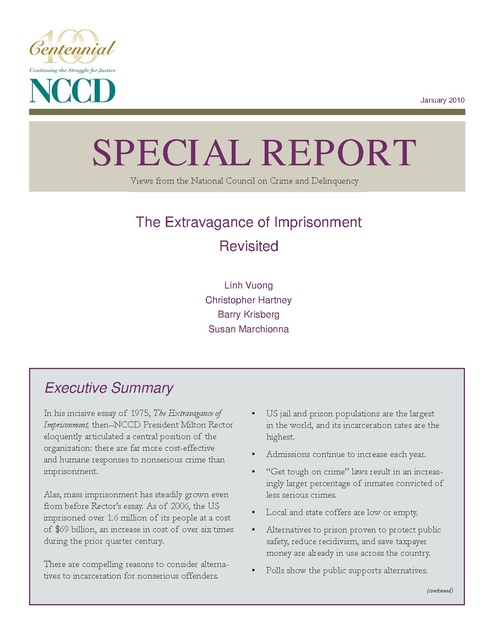
The Extravagance of Imprisonment
Revisited
Linh Vuong
Christopher Hartney
Barry Krisberg
Susan Marchionna

Executive Summary
In his incisive essay of 1975, The Extravagance of
Imprisonment, then–NCCD President Milton Rector
eloquently articulated a central position of the
organization: there are far more cost-effective
and humane responses to nonserious crime than
imprisonment.
Alas, mass imprisonment has steadily grown even
from before Rector’s essay. As of 2006, the US
imprisoned over 1.6 million of its people at a cost
of $69 billion, an increase in cost of over six times
during the prior quarter century.
There are compelling reasons to consider alternatives to incarceration for nonserious offenders.

•

US jail and prison populations are the largest
in the world, and its incarceration rates are the
highest.

•

Admissions continue to increase each year.

•

“Get tough on crime” laws result in an increasingly larger percentage of inmates convicted of
less serious crimes.

•

Local and state coffers are low or empty.

•

Alternatives to prison proven to protect public
safety, reduce recidivism, and save taxpayer
money are already in use across the country.

•

Polls show the public supports alternatives.
(continued)

January 2010

2

Views from the National Council on Crime and Delinquency

This report analyzes prison and jail populations in
the US as a whole and in four key states—California,
Florida, New York, and Texas—to determine 1) how
many prisoners are nonserious offenders and what it
costs to lock them up, 2) what proven effective alternatives are in use and what they cost, and 3) what
savings could be realized if a portion of the nonserious offenders were sentenced to alternatives instead
of prison and jail.

such as most property and public order crimes, that
a less conservative definition might include.
Similarly, cost savings estimates were made in a
conservative manner; it is likely that savings could be
much greater. This report is based on a hypothetical
of adopting alternatives for 80% of the nonserious,
nonsexual prison and jail population.
Each type of nonserious offender was assigned a
level of supervision and treatment or rehabilitation appropriate for the type of offense committed.
The alternatives selected are electronic monitoring, reporting programs (day reporting centers and
work release programs), drug treatment, and drug
courts—all currently in use in the four chosen states.
All are shown to be effective.

In recognition that finding a universally accepted
definition of “nonserious” is a challenge, the term
was defined conservatively for this report; nonserious offenses are those that are not violent, not
sexual, and don’t involve significant property loss.
This definition excludes a large number of offenses

Savings Summary
In 2008, there were 1.6 million sentenced persons
in state prisons and county jails. One-quarter of this
population—413,693 prisoners—were serving time
for nonserious, nonsexual offenses and could be
eligible for alternative sentences.

The following table summarizes the potential cost
savings that could be realized if alternatives were used
for 80% (330,954) of the nonserious, nonsexual offender population.

Potential Cost Savings for 80% of Nonserious Offenders
US

California

Florida

New York

Texas

Current expenditure

$12.9 billion

$1.5 billion

$399 million

$1.8 billion

$2.8 billion

Cost of alternatives

$3.2 billion

$120 million

$128 million

$692 million

$433 million

$9.7 billion

$1.4 billion

$271 million

$1.1 billion

$2.4 billion

Potential savings

January 2010

Views from the National Council on Crime and Delinquency

Introduction

Public Support for Alternatives

The US has the highest rates of incarceration in the
world. Decades of “get tough on crime” laws have
steadily increased prison and jail populations, resulting in ballooning costs and prison overcrowding. Many
elected officials, policymakers, and the general public are
supportive of alternative sentences to incarceration for
nonserious, nonsexual offenders. Reasons for supporting
alternative sentences include lower costs, the potential
for rehabilitation, health and safety issues associated
with overcrowding, and prison and jail being too harsh
a punishment for certain offenses. Having the option to
serve time in one’s own community allows offenders to
stay connected to the support systems that often play
a large role in reducing future criminal behavior. When
alternatives are implemented appropriately, they serve
the dual purposes of rehabilitation and punishment,
while also maintaining public safety.

In April, 2009, NCCD commissioned Zogby
International to conduct a national public opinion poll
about American voter attitudes toward our nation’s
response to nonserious, nonsexual crimes (Hartney &
Marchionna, 2009). The results of this poll showed
that striking majorities favor using methods other than
incarceration to respond to these offenders. These
findings supported earlier NCCD/Zogby polls that
showed public support for rehabilitative programming
both inside and outside of secure facilities (Krisberg &
Marchionna, 2006, 2007).

Incarceration Trends
Of every 100,000 persons in the US, nearly 2,500 are
in some way involved in the criminal justice system. In
2008, there were 1.4 million state prisoners, 785,000 jail
inmates, and another 5.1 million on probation or parole
(Glaze & Bonczar, 2009; Minton & Sabol, 2009; Sabol,
West, & Cooper, 2009). Overall, 19 state prison systems
were over capacity and 19 others were approaching
capacity (West & Sabol, 2008). The number of annual
admissions to state prisons increased by 18% between
2000 and 2008 (Sabol, West, & Cooper, 2009).

3

A Different Approach
This report presents estimates of cost savings that
could be realized if a portion of nonserious offenders
were sentenced to alternatives rather than jail or prison.
It examines four evidence-based alternatives to incarceration and the potential savings they could garner
nationally and in four states—California, Florida, New
York, and Texas. These states are the four most populous in the country and those with the greatest numbers
of prisoners. The goal of this report is to present a
feasible policy alternative, one that might be supported
by most stakeholders—justice and law enforcement
representatives, elected officials, and the voting public.

A significant portion of prisoners committed crimes
that were not violent or sexual, and that did not involve
serious property loss or damage. Many of these individuals can be safely supervised through alternative
As prison populations grow each year, governments
means and still serve a sentence that fits the seriousness
dedicate larger budgets to corrections. In 2006,
of their crime. Evidence-based alternatives are already
justice-related expenditures for federal, state, and local
in use in some places, usually for pre-trial supervision,
governments totaled $214 billion. Corrections accounted probation, parole, or early release. Alternatives tend
for $69 billion, law enforcement $98 billion, and judicial to be less costly than incarceration while also serving
$46 billion—an overall increase of more than six times
to rehabilitate the offender, which reduces recidivism.
in the past three decades (Perry, 2008).
Thus, properly applied, alternatives save taxpayer money
in both the short term—by saving incarceration costs—
and the long term—by reducing recidivism and repeated
system involvement.

January 2010

Views from the National Council on Crime and Delinquency

Method
This report uses the most recent national and state data
available. Numbers used in this report are primarily
derived from the two most comprehensive justicerelated federal datasets, 2003 National Crime Reporting
Program (NCRP) (Bureau of Justice Statistics, 2007a) and
2004 National Judicial Reporting Program (NJRP) (Bureau
of Justice Statistics, 2007b), and reports from the US
Department of Justice (USDOJ), Bureau of Justice
Statistics (BJS). State estimates are derived from each
state’s department of corrections, county jails, or federal
sources.
Defining nonserious, nonsexual offenses: Offense
categories used are the most detailed available from
USDOJ datasets, NCRP and NJRP. Nonserious,
nonsexual crimes included petty theft, non-sales related
drug offenses, minor traffic, drunkenness, morals (e.g.,
adultery), liquor laws, public order, juvenile offenses,
misdemeanors, habitual offenders, and certain non-classified offenses.
Serious offenses include all violent and most property
offenses. Driving under the influence and weapons
offenses are included in this category. Drug manufacturing, sales, and trafficking are also considered serious
offenses, except in New York, where these offenders are
eligible to participate in drug treatment programs.
Estimating current counts: Using the above definition
of nonserious offenses, the number of sentenced prison
inmates and convicted jail inmates in 2008 serving time
for a nonserious offense was estimated using NCRP and
NJRP.
Prison: Counts of the total population of sentenced
prisoners were obtained from Prison Inmates at Midyear
2008 (West & Sabol, 2009). Offense types and time
served were calculated using NCRP and applied to the
total population. This method to obtain a percentage
breakdown of inmates by offense type follows the same
methods used by BJS.

4

Jail: A national estimate of the average daily population
of sentenced jail inmates was obtained from Jail Inmates
at Midyear 2008 (Minton & Sabol, 2009). A proportion
of nonserious offenders was estimated using NJRP and
applied to the population figures.
Detailed state-level offense data are not available for
jails. Therefore, this report focuses on the five largest
jail jurisdictions in each of the four states in order to
demonstrate a portion of the potential jail savings. Data
were requested from each of these jail jurisdictions.
Of 20 counties, nine responded to data requests and
are included in this report (Florida DOC, 2008; Texas
Commission on Jail Standards, 2009; CSA, 2009). Four
counties are represented for California, three for Florida,
and two for Texas. No New York jails responded; New
York jail population data were obtained from NJRP,
which contained data for four of the largest New York
counties. All counties highlighted in this report are
among the nation’s 30 largest jail jurisdictions, including
the top two: Los Angeles and New York City.
Data requested from jails included costs, population, detention status (sentenced/unsentenced), level
of offense (felony/misdemeanor), and offense type
(violent, property, drug, other). Two variables—offense
type and length of stay—were not provided by the
counties. A percentage breakdown by offense type was
estimated using NJRP and applied to the county population figures.
A large number of individuals held in jails are unsentenced but detained for a variety of reasons (e.g.,
awaiting arraignment, trial, or conviction, holding for
other agencies, etc.). These individuals make up approximately 60% of the jail population (Minton & Sabol,
2009), but are excluded from our analyses, because jails
do not report offense type or the reason for detainment
for unsentenced inmates. It is likely that consideration
of this population, possible with improved data collection methods, would increase savings.

January 2010

Views from the National Council on Crime and Delinquency

5

Estimating current costs: To calculate incarceration
costs, time served by offense type was multiplied by
the annual cost of incarceration. Time served includes
total time served for the current sentence. This includes
pre-trial detention, actual sentence, and time served as a
consequence of revoked parole.

nonserious offender was assigned a type of supervision
and treatment or rehabilitation appropriate for the type
of offense they committed. The duration of the alternative sentence was commensurate with the time they
would have served in prison or jail, except in some cases
when programs had a fixed duration.

Average length of stay in jails was obtained from BJS’
State Court Sentencing of Convicted Felons, 2000 (James,
2004).

In this report, nonserious, non-drug offenders are
assigned to some combination of electronic monitoring or reporting program. Offenders remain on these
alternative sentences for the same amount of time they
would have served in prison or jail.

National prison and jail costs were obtained from BJS’
Justice Expenditure and Employment Extracts, 2006 (Perry,
2008). State cost of incarceration for each state was
obtained from each state’s department of corrections
(P. Coltharp, personal communication, August 13, 2009;
CDCR, 2004; Mayor’s Office of Operations, 2009;
Dallas County Sheriff ’s Department, personal communication, August 18, 2009; Tarrant County Sherriff ’s
Department, personal communication, August 17,
2009).

Drug court and drug treatment are assigned to nonserious drug offenders. These programs are of fixed
duration, and program models vary by state (see state
sections for more information). Offenders assigned
to drug treatment in Florida are also assigned to electronic monitoring for the duration of the program, as it
currently does not have a supervision component. New
York drug treatment is the only program that accepts
drug sellers.

Choosing alternatives: An extensive review of alternatives was conducted to select those that had been
evaluated and showed positive outcomes. Four alternatives were selected for this report: electronic monitoring,
reporting programs (day reporting and work release),
drug court, and drug treatment. Day reporting and
work release have similar costs and can be considered
as interchangeabe in the cost analysis. These alternatives
are currently in use in the states selected and could be
expanded for wider use.

Calculating costs of alternatives: Costs of these alternatives were provided by the states. When states could
not provide a cost, the national average cost was used to
estimate state costs. In an attempt to calculate savings as
conservatively as possible, it was assumed that only 80%
of offenders eligible for alternatives would be placed in
those programs. When one group of offenders is eligible
for two alternatives, they are divided evenly between the
available options.

To the extent possible, this study used the same eligibility criteria currently used by the states for determining
if offenders are eligible for alternatives and, if so,
which alternatives are most appropriate. Each type of

Calculating cost savings: The cost of providing alternatives to nonserious offenders was subtracted from the
total cost of incarcerating the same population. This is
the potential cost savings.

January 2010

Views from the National Council on Crime and Delinquency

The Alternatives
Alternatives to incarceration should not be considered
necessarily more lenient than time served in prisons or
jails. They impose restrictions on mobility and individual
freedoms, but differ in that they do not require 24-hour,
secure, isolated facilities. For offenders who have not
committed a serious or sexual crime, alternatives can
serve as both sanction and rehabilitation.
The following alternatives were selected for application in this study: 1) electronic monitoring, 2) reporting
programs (day reporting and work release), 3) drug
court, and 4) drug treatment. While states have the
option of many other evidence-based alternatives, those
chosen represent feasible and expandable strategies.
Each of these alternatives is already in use in the four
states in the report, whether for alternative sentencing,
probation, parole, or prison or jail population reduction. With the exception of electronic monitoring,
the selected alternative sentences entail a rehabilitation component along with some level of supervision.
Depending on the program model, failure to successfully complete an alternative could mean either a return
to regular court proceedings or reactivation of a prison
sentence.

Electronic Monitoring
Electronic monitoring (EM) is a type of intermediate
sanction used widely across the US in several situations, including pretrial, post-conviction probation,
and post-incarceration parole. Post-conviction EM is
used primarily with white collar offenders who are not
considered a public safety risk. Post-incarceration EM
targets offenders with a high risk of reoffending while
on parole, such as sex offenders and chronic offenders.
EM has also become commonly used with DUI/DWI
offenders, with new technology that forces drivers to
take a breathalyzer test before their car can be started.
Generally, EM devices are either active or passive. Active
devices, such as GPS, continuously track the offender
via a bracelet that transmits his or her whereabouts to

6

the supervising officer in real time. Any deviation from
an established schedule is reported immediately. Passive
devices, such as voice verification systems, require
cooperation from the offender to either call a specific
number or to answer the phone at home. Active systems
are generally more commonly used and more costeffective (National Law Enforcement and Corrections
Technology Center, 1999; Harkness & Walker-Fraser,
2009).
Like prison, EM is a significant hindrance to further
criminal activity during the time it is imposed. Unlike
prison, EM allows prisoners a connection with their
families and communities, employment, and a transition into a noncriminal lifestyle. Studies have found
that it is most effective when used in conjunction with
a major treatment component (Courtright, Berg, &
Mutchnick, 2000; Payne & Gainey, 2004; Gable, 2007).
Even when used without specific rehabilitative programming requirements, EM provides the potential for
rehabilitation within the community, whereas incarceration reinforces negative interactions in prison and jail,
weakens ties to society, and often increases the likelihood of reoffending (Courtright, Berg, & Mutchnick,
2000). Critics complain that EM is too controlling and
violates an individual’s privacy, risks public safety, and
is often used in place of rehabilitation (Gable, 2007).
However, in a study of 49 offenders who served onethird of their sentence on EM, these issues never arose.
Instead, an overwhelming majority said it was an effective supervision tool. Most offenders say they would not
have considered escaping (Payne & Gainey, 2004).
Currently, California uses EM primarily for high-risk
parolees and sex offenders, approximately 6% of its
parolee population (CDCR, 2009). In Florida, 1.2%
of all offenders on active supervision are also on EM
(Harkness & Estes, 2007). Florida’s Office of Program
Policy Analysis and Government Accountability
(OPPAGA) found that Florida’s Department of
Corrections has underutilized the funds designated for
electronic monitoring and makes recommendations for
their more effective use (Harkness & Walker-Fraser,
2009).

January 2010

Views from the National Council on Crime and Delinquency

Reporting Programs
Day Reporting Centers and Work Release Programs
are sanctions that serve both punitive and rehabilitative
purposes by allowing offenders to return to or remain
in their communities under strict guidelines. These
types of intermediate sanctions have historically been
used as early release alternatives and have recently been
expanded to sanction pretrial and low-risk nonserious
offenders.
Day Reporting Centers
Day reporting centers are highly structured, nonresidential programs that offer treatment and close supervision
to offenders who have not succeeded with traditional
supervision, such as parole or probation. Participants are
allowed to return home in the evenings, but are required
to maintain a strict schedule that is closely monitored.
Programs vary in duration and specific components.
Some programs focus on drug treatment, others on
vocational services, while others are primarily checkin centers. The flexibility and wide range of programs
makes them adaptable to different groups. The National
Institute of Justice recognizes the use of day reporting centers to reduce prison and jail overcrowding and
details two essential elements: enhanced surveillance for
offenders who have problems under routine supervision
and the provision of or referral to treatment services
(Parent, Byrne, Tsarfaty, Valade, & Esselman, 1995).
A preliminary study of programs in Wisconsin showed
that day reporting participation yielded lower chances
of rearrest and that participants are rearrested for
less serious charges than those in a comparison group
(Craddock, 2000). A Utah study showed that 22%
of participants were rearrested after one year (Vleet,
Hickert, & Becker, 2006).

7

Work Release Programs
Work release programs are residential programs that
allow offenders to work during the day but require
them to return to a locked facility each evening. These
programs ease an offender’s transition to the community, while reducing the opportunity for reoffending. Many
states use this intermediate sanction to reduce prison
and jail sentences.
Work release programs, though not as heavily centered
on treatment as day reporting, allow offenders to earn
a living and acquire positive living habits (Aos, Miller,
& Drake, 2006; Aos, Phipps, Barnoski, & Lieb, 2001).
A meta-analysis of existing research found that such
programs reduce recidivism and improve the job readiness skills of offenders (Seiter & Kadela, 2003). An
evaluation of programs in Ohio that serve moderateand high-risk offenders at the end of their terms reveals
significantly decreased recidivism rates up to 34% lower
than those in the comparison group (Lowenkamp &
Latessa, 2002). A Washington state report finds that
early release offenders who participate in work release
programs have lower rates of recidivism (6-15%)
than non-work release participants (22%) (Sommers,
Mauldin, & Levin, 2000).
Work release programs in Texas are currently geared
towards parole and probation violators and are used in
place of return to prison (Levin, 2008). A 2007 study
found that Florida’s work release program significantly
improves an early release offender’s post-prison employment outcomes but that there are not enough beds for
the individuals who qualify. There were 3,000 beds available, but another 1,000 prisoners were on the waiting list
(Berk, 2007).

January 2010

Views from the National Council on Crime and Delinquency

Drug Treatment
There is a variety of drug treatment programs for
substance abusers, including outpatient, short-term
residential, and long-term residential placements.
Evaluations of individual programs tend to show similar
results. Recidivism rates are significantly lower for
successful graduates, but most drug treatment programs
have only a 40-60% completion rate (Jolin & Stipak,
1992; Inciardi, Martin, & Butzin, 2004; McMurran,
2007). Those who drop out or are terminated early
tend to have similar recidivism rates as nonparticipants,
highlighting the importance of correctly matching an offender’s needs to the proper programming
option and actively encouraging retention (Inciardi,
Martin, & Butzin, 2004; Warner & Kramer, 2009).
Completion rates depend in part on how relapse is
handled. Although practitioners believe that relapse is
an inevitable part of therapy, many programs terminate
participants after a single relapse incident.
Despite a growing number of programs, state correctional facilities generally report a lack of program
availability for prisoners. Many programs serve firsttime offenders exclusively. None of these programs
accept violent offenders and all are selective regarding the mentally ill population (depending on resource
availability). Only the New York program accepts drug
sellers. The number of prisoners served over the past
decade represents a small portion of those eligible for
treatment; there is a high prevalence of substance abuse
among the general prison population.

Drug Courts
Drug courts are a relatively recent innovation in the
judicial system. The model originated in Dade County,
Florida, in 1989, when prison overcrowding jeopardized
funding. The panel appointed to address the issue found
that a large proportion of inmates had drug-related
offenses, which often led to reincarceration. Today, drug
courts are part of a system called collaborative courts,
which include courts designed for the mentally ill population, the homeless, and domestic violence offenders.

8

Currently, there are over 2,300 drug courts in the US,
with many more in the planning stages. Their success
depends on available resources and the coordinated
strategy and collaboration of stakeholders such as
courts, attorneys, and community agencies. Drug courts
serve different populations and vary in cost. Cost
differences are tied to the scale of the program, the
level of treatment, the degree of participation on the
part of agencies, and the services available to participants. However, all drug courts combine long-term
treatment with the structure and accountability of the
justice system. Most combine at least one year of drug
treatment with intensive supervision and may include
rehabilitative programming apart from substance abuse
treatment. They include routine drug testing, regular
court appearances, and a system of rewards and sanctions. Participants are generally selected by the District
Attorney’s office and can agree to participate or not.
Successful completion of the program most often
results in dropped charges, while failure to complete can
result in regular court proceedings or immediate activation of the sentence.
Evaluations of drug courts reveal promising results.
A national review by the Government Accountability
Office of 27 evaluations representing 39 programs
showed that drug court participation reduced recidivism
levels both during the program and after completion;
program completion further reduced recidivism. This
conclusion is supported by a growing body of research
(Barnoski & Aos, 2003; Wilson, Mitchell, & MacKenzie,
2006; Bhati, Roman, & Chalfin, 2008). A study conducted by the Urban Institute found that drug courts, while
effective, target only a very small population (Bhati,
Roman, & Chalfin, 2008). For example, approximately
80% of drug courts exclude offenders with any prior
conviction or offenders charged with sales (regardless of an offender’s dependency issues). A number of
drug courts reject offenders whose problems are too
severe, while others reject those whose problems are not
severe enough. Many programs reject offenders based
on capacity. The Urban Institute estimates that, of the
millions arrested yearly on drug charges, only 30,000 are
accepted into a drug court (Bhati, Roman, & Chalfin,
2008).

January 2010

9

Views from the National Council on Crime and Delinquency

Estimated Savings, Prisons and Jails, 2008
National
Prisons. In 2008, there were 1.3 million sentenced prisoners under the jurisdiction of states. An estimated 22%
(301,331) of all prisoners were convicted of nonserious,
nonsexual offenses.

offenders. In 2006, the national average cost to house an
offender in jail was $27,237 per year. Collectively, states
spent $21 billion on local corrections, which includes jail
and probation.

The national average cost to incarcerate an offender
for one year was $28,648. Collectively, states spent $39
billion in 2006 on state corrections, which includes
prisons, parole, and juvenile justice.

Cost savings of alternatives. In 2008, states spent
$12.9 billion to incarcerate 80% (330,954) of nonserious,
nonsexual offenders in prisons and jails. Alternatives are
estimated to cost $3.2 billion. A total cost savings of at
least $9.7 billion can be expected with implementation
of alternatives.

Jails. In 2008, the average daily population of jails was
776,573. According to the Bureau of Justice Statistics,
37% (288,109) of these were convicted. Of convicted
jail inmates, 39% (112,362) were nonserious, nonsexual

National Cost Savings
Prison

Jail

Total

1,059,001

175,746

1,234,747

Total Nonserious

301,331

112,362

413,693

80% of Nonserious

241,065

89,890

330,954

$12 billion

$816 million

$12.9 billion

$49,963

$9,079

$2.7 billion

$500 million

$11,898

$7,145

$9.4 billion

$316 million

Total Serious

Cost of Incarcerating 80% of Nonserious
Offenders
Average Per Capita Cost of Incarceration
(based on time served)

Cost of Alternatives for 80%
Average Per Capita Cost of Alternatives*
(based on program duration)

Total Savings

$3.2 billion

$9.7 billion

* Electronic Monitoring: $450/month; Reporting Programs: $1,500/month; Drug Treatment: $16,448/participant; Drug
Court: $4,333/participant.

January 2010

10

Views from the National Council on Crime and Delinquency

California
Prisons. In 2008, California had jurisdiction over
173,186 prisoners. Of all prisoners, 23% (40,628) were
nonserious, nonsexual offenders.

population was sentenced. Of sentenced inmates, 80%
(9,335) were serious offenders and 20% (2,273) were
nonserious offenders.

It costs California $49,000 per year to house one offender in a state facility. The 2008 budget for California
Department of Corrections (CDCR) was $10.6 billion
(7% of the state budget), which includes costs for
administration, institution operation (adult and juvenile),
and parole.

The average annual cost for these four county jails is
$27,012 per offender. The Legislative Analyst’s Office
(LAO) estimates that all California counties spent an
average of $33,600 per year per offender on jails in
2005-2006. In that year, California counties spent a total
of $2.3 billion on local adult detention.

Jails. In 2008, the average daily population of jails in
California was 82,398. The four counties used for this
analysis—Los Angeles, Orange, San Diego, and San
Bernardino—had a combined average daily population of 36,676. On average, about 31% (11,607) of this

Cost savings of alternatives. In 2008, California spent
$1.5 billion to incarcerate 80% (34,321) of nonserious,
nonsexual offenders in prisons and these four county
jails. Alternatives are estimated to cost the state $120
million. A total cost savings of at least $1.4 billion can
be expected with implementation of alternatives.

California Cost Savings
Prison

Jail*

Total

Total Serious

132,558

9,335

141,893

Total Nonserious

40,628

2,273

42,901

80% of Nonserious

32,503

1,818

34,321

$1.5 billion

$14 million

$1.5 billion

$46,110

$9,004

$116 million

$4 million

$4,591

$2,164

$1.4 billion

$10 million

Cost of Incarcerating 80% of Nonserious
Offenders
Average Per Capita Cost of Incarceration
(based on time served)

Cost of Alternatives for 80%
Average Per Capita Cost of Alternatives**
(based on program duration)

Total Savings

$120 million

$1.4 billion

* Jail estimates are based on counties that represent 48.7% of the state’s population.
** Electronic Monitoring: $540/month; Reporting Programs: $660/month; Drug Treatment: $2,262/participant;
Drug Court: $1,593/participant.

January 2010

Views from the National Council on Crime and Delinquency

11

Proposition 36, Substance Abuse and Crime Prevention Act

In 2000, California voters passed Prop 36, formally
known as the Substance Abuse and Crime Prevention
Act. The legislation was designed to divert first- and
second-time nonviolent drug offenders charged with
use, possession, or transportation of illegal drugs for
personal use. The Act mandates one year of treatment
followed by six months of aftercare. Participants
generally have less serious charges than those entering
drug court. An analysis by UCLA found that 43% of
those who completed the program were rearrested for
a drug offense, compared to 65% of those who did not
complete treatment. Among participants, the state saved
$2.50 for every $1 invested and $4 (per $1 investment)
for every person who completed the program.

by expanding drug treatment options for nonserious, nonsexual offenders. A study by the Justice Policy
Institute found that, from 2000 to 2005—the years
following the passage of Prop 36—drug possession
prison admissions decreased over 30%. Also, while drug
treatment facilities and spending has decreased in the
rest of the country, California has increased its drug
treatment facilities by nearly 25%, and spending on drug
treatment has doubled. The study finds a cost savings
from reduced prison use of $2,861 per offender enrolled
as a result of Prop 36.
Sources: Longshore, D., Hawken, A., Urada, D., & Anglin., M. D. (2006).
Evaluation of the Substance Abuse and Crime Prevention Act. Los Angeles:
University of California at Los Angeles.; Ehlers, S., & Ziedenberg, J. (2006).
Proposition 36: 5 years later. Washington DC: Justice Policy Institute.

Prop 36 is a fitting example of how other states can
save money and reduce prison and jail populations

Drug Court

There are over 200 drug court programs in California’s
58 counties. In 2005, the courts accepted over 7,000
adult felons into the program. In that same year, nearly
300,000 juveniles and adults were arrested in California
for a drug offense.

program still received some benefit; they were rearrested
at a lower rate of 29%. Within the nine sites studied,
the state saved $90 million per year, with most of the
savings found in corrections ($3,292 per participant) and
law enforcement ($1,525 per participant).

California recently received a grant from the federal
government to conduct a cost-benefit analysis of adult
drug courts in the state. The study found that, after
2–4 years (depending on the court), only 17% of drug
court graduates were rearrested, compared to 41% of
nonparticipants. Participants who did not complete the

Sources: Byrne, F., Taylor, N., Nunez, A., Parrish, K., & Tate, D. (2006).
California drug court cost analysis study. San Francisco, CA: Center for Families,
Children & the Courts.; California Department of Alcohol and Drug
Programs. (2005). Comprehensive Drug Court Implementation Act of 1999. Final
report to the Legislature. Sacramento, CA: Author.; NPC Research. (2005).
California drug courts: A methodology for determining costs and benefits. Phase II:
Testing the methodology. San Francisco, CA: Administrative Office of the
Courts.

January 2010

12

Views from the National Council on Crime and Delinquency

Florida
Prisons. In 2008, there were 100,494 sentenced prisoners in Florida state prisons. Of this number, 15%
(14,827) were convicted of nonserious, nonsexual
crimes.
Florida spends $20,108 per year for each offender in
state prison. The Florida Department of Corrections
budget for 2008-09 is $2.7 billion (3% of the state
budget), which includes expenses for state institutions,
parole, and administration.
Jails. Florida’s average daily population for jails in 2008
was 61,500. The three Florida counties used for this

analysis—Orange, Palm Beach, and Miami-Dade—had
a combined average daily population of 14,496 persons
in 2008. Of these, 25% (3,743) were sentenced; and
of these inmates, 87% (3,271) were serious offenders,
and 13% (472) were nonserious offenders. The average
annual cost for these three jails was $37,524 per inmate.
Cost savings of alternatives. In 2008, Florida spent
$399 million to incarcerate 80% (12,240) of nonserious,
nonsexual offenders in prisons and these three county
jails. Alternatives are estimated to cost the state $128
million. A total cost savings of $271 million can be
expected with implementation of alternatives.

Florida Cost Savings
Prison

Jail*

Total

Total Serious

85,667

3,271

88,938

Total Nonserious

14,827

472

15,299

80% of Nonserious

11,862

378

12,240

$393 million

$4.7 million

$399 million

$33,202

$12,508

$126 million

$1.4 million

$9,787

$4,232

$267 million

$3.3 million

Cost of Incarcerating 80% of Nonserious
Offenders
Average Per Capita Cost of Incarceration
(based on time served)

Cost of Alternatives for 80%
Average Per Capita Cost of Alternatives**
(based on program duration)

Total Savings

$128 million

$271 million

* Jail estimates are based on counties that represent 25.8% of the state’s population.
** Electronic Monitoring: $300/month; Reporting Programs: $1,500/month; Drug Treatment: $10,362/participant;
Drug Court: $1,800/participant.

January 2010

Views from the National Council on Crime and Delinquency

13

Nonsecure Substance Abuse Treatment Programs

Florida’s Nonsecure Substance Abuse Treatment
Programs offer six months of community-based treatment that combines intensive treatment (two months)
and employment/reentry (four months). Offenders,
including probation violators, can only be enrolled if
referred by a judge as a special condition to probation
or community supervision. Sex offenders and those
with severe mental illnesses are prohibited from participating. Participants undergo treatment for a minimum
of 6-10 hours weekly. The first component focuses on
addiction education, life management skill-building, and

relapse prevention. The second requires various activities and full-time employment in addition to treatment.
The Florida Department of Corrections reports a 60%
completion rate since 1991. A three-year follow-up
shows that those who complete the program are recommitted at a rate of 43%, whereas those who do not are
recommitted at a rate of 61%.
Source: Bryant, P. T. (2000). Florida’s award-winning Nonsecure Drug
Treatment Program. Corrections Today, 62(3), 98-105; R. N. Fitch, personal
communication, August 28, 2009.

Drug Court

There are 107 drug courts operating in Florida, 47 of
which are for adults. Florida’s drug courts serve approximately 10,000 individuals annually, only 25% of the
eligible population.
Florida’s drug courts serve nonviolent drug offenders,
both first-time and those with prior convictions. Eligible
participants are screened in jails, offered the opportunity to participate, undergo graduated treatment, are
monitored by a probation officer and a case manager,
and are offered aftercare services. Offenders charged
with drug sales or trafficking are generally not eligible.
Completion rates were approximately 50%, but among
graduates, reincarceration rates were significantly lower
than for nonparticipants. Only 6% of graduates were
reincarcerated within a three-year period compared to
nongraduates.

Currently, the Office of Program Policy Analysis and
Government Accountability (OPPAGA) reports that
Florida drug courts serve a population that would otherwise face a probation sentence and not a prison term.
OPPAGA identifies three offender groups currently
facing incarceration that could be targeted for expanding
program eligibility: nonserious, nonviolent offenders; technical parole violators with a substance abuse
problem; and inmates with a nonviolent criminal record
who are facing a mandatory sentence. In 2007, this
group of prisoners numbered 5,700.
Sources: Harkness, M., & Walker-Fraser, L. (2009). State’s drug courts could
expand to target prison-bound adult offenders (No. 09-13). Tallahassee, FL: Office
of Program Policy Analysis & Government Accountability.; Harkness, M.
(2009). Florida adult drug courts. Tallahasse, FL: Office of Program Policy
Analysis & Government Accountability.

January 2010

14

Views from the National Council on Crime and Delinquency

New York
Prisons. In 2008, there were 61,799 sentenced prisoners
in New York state prisons. Excluding drug traffickers, 13% (8,050) of prisoners had been convicted of a
nonserious, nonsexual charge. Drug traffickers constitute another 32% (19,887) of offenders. In this analysis,
45% (27,937) of New York’s sentenced prisoners are
considered for alternative sentencing.
New York reported an average annual cost per offender
of $37,956. The Department of Correctional Services
budget for 2008-09 was $2.8 billion (3% of the state
budget), which excludes the Division of Parole, which
was budgeted $196 million.
Jails. New York City accounts for nearly half of the
state’s population and is the second largest jail jurisdiction in the country. Four of New York City’s five

boroughs are also the most populous counties in the
state: Bronx, Kings (Brooklyn), New York (Manhattan),
and Queens. In 2008, the average daily population
in these jails was 13,849 persons. It could not be
determined what percentage of these persons were
sentenced. However, according to 2004 NJRP, 43%
(1,667) of convicted jail inmates in these 4 counties
were serious offenders and 57% (2,234) were nonserious
offenders. New York City jails cost $69,600 per year per
offender.
Cost savings of alternatives. New York spent $1.8
billion to incarcerate 80% (24,137) of nonserious,
nonsexual offenders in prisons and these four jails.
Alternatives are estimated to cost the state $692 million.
A total cost savings of $1.1 billion can be expected with
implementation of alternatives.

New York Cost Savings
Prison

Jail*

Total

Total Serious

33,862

1,667

35,529

Total Nonserious

27,937

2,234

30,171

80% of Nonserious

22,350

1,787

24,137

$1.7 billion

$82 million

$1.8 billion

$75,238

$110,536

$650 million

$42 million

$26,682

$11,277

$1.0 billion

$40 million

Cost of Incarcerating 80% of Nonserious
Offenders
Average Per Capita Cost of Incarceration
(based on time served)

Cost of Alternatives for 80%
Average Per Capita Cost of Alternatives**
(based on program duration)

Total Savings

$692 million

$1.1 billion

* Jail estimates are based on counties that represent 40.4% of the state’s population.
** Electronic Monitoring: $450/month; Reporting Programs: $1,500/month ; Drug Treatment: $32,975/participant;
Drug Court: $4,333/participant.

January 2010

Views from the National Council on Crime and Delinquency

15

Drug Treatment Alternative Program (DTAP)

Created in 1990, DTAP is a 15- to 24-month program
that offers treatment in lieu of prison time. Like drug
courts, successful completion leads to a withdrawal of
charges, but termination leads directly to activation of
the sentence. However, unlike drug courts and many
treatment programs, DTAP services are also targeted
to repeat offenders as well as first-time offenders. This
includes drug sellers, whose sentence would be 4.5–9
years in prison. Most participants have had an average
of five prior arrests and a number of years in prison.
DTAP is a long-term residential program with a highly
structured, hierarchical environment, where participants
share the responsibility for rule enforcement with the
staff. A five-year evaluation by the National Center on
Addiction and Substance Abuse at Columbia University

(CASA) found that just over half (52%) completed the
program successfully. In a two-year follow-up, those
who participated in the program were 26% less likely to
be rearrested, 36% less likely to be reconvicted, and 67%
less likely to be reincarcerated than those in the matched
comparison group. Program graduates did even better:
33% were less likely to be rearrested, 45% were less
likely to be reconvicted, and 87% were less likely to be
reincarcerated. Graduates were 3.5 times more likely to
be employed upon graduation than at entrance. DTAP
also showed impressive retention rates, with a median
stay of 17.8 months.
Source: The National Center on Addiction and Substance Abuse at
Columbia University (CASA). (2003). Crossing the bridge: An evaluation of the
Drug Treatment Alternative (DTAP) to prison program. New York: Author.

Drug Court

By the end of 2007, 171 drug courts were operating in
New York state, 91 of which were for adults. Almost all
counties have a drug court or are planning one. About
7,000 persons participate in the program annually. In
2007, there were nearly 150,000 drug-related arrests in
New York.
Almost all of New York drug court programs require
at least one year of participation, with some proportion
of that time spent clean. New York programs showed
diversity in approach and population served.
In a recent evaluation of 11 New York drug courts, the
Center for Court Innovation found that participants
were about 27% less likely to be rearrested one year

after completing the program and 35% less likely to be
rearrested three years after the initial arrest. As in other
states, graduates were significantly less likely to recidivate than those who participated but were terminated
before completing the program. Several New York
drug courts exceeded the national average retention rate
(60%), retaining 70% of all participants to graduation.
Graduates were significantly more likely to be employed
or enrolled in school at graduation than at intake.
Sources: Cissner, A., & Rempel, M. (2005). The state of drug court research:
Moving beyond “Do they work?” New York: Center for Court Innovation.;
Office of Court Drug Treatment Programs. (2008). Drug treatment courts,
2007 Annual report. New York, NY: Author.; Rempel, M., Fox-Kralstein, D.,
Cissner, A., Cohen, R., Labriola, M., Farole, D., et al. (2003). The New York
State adult drug court evaluation. New York: Center for Court Innovation; S.
Davis, personal communication, August 19, 2009.

January 2010

16

Views from the National Council on Crime and Delinquency

Texas
Prisons. In 2008, Texas had jurisdiction over 162,578
sentenced prisoners. Of this number, 31% (50,460)
were convicted of nonserious, nonsexual offenses.
Texas spends about $17,400 per year for each prisoner.
The Department of Criminal Justice was budgeted
about $3 billion in 2008 (2% of the state’s total budget).
Jails. The average daily population of all county jails in
Texas was 61,103 persons. Dallas and Tarrant Counties
were included in this analysis. Their combined average
daily population was 9,142 persons. Of this total, 16%
(1,508) were sentenced. Of these inmates, 62% (942)
were serious offenders, and 38% (566) were nonserious

offenders. The average annual cost of these jails is
$17,100 per person.
Cost savings of alternatives. Texas spent $2.8 billion
to incarcerate 80% (51,026) of nonserious, nonsexual offenders in prisons and these two county jails.
Alternatives are estimated to cost the state $433 million.
A total cost savings of $2.4 billion can be expected with
implementation of alternatives. In this analysis alternatives for jail inmates result in a negative cost savings.
This is due largely to the extended duration (two years),
and cost of the drug treatment program. Tailoring
that alternative to be shorter in duration and achieving
economies of scale would likely lead to a greater cost
savings.

Texas Cost Savings
Prison

Jail*

Total

Total Serious

112,118

942

113,060

Total Nonserious

50,460

566

51,026

80% of Nonserious

40,368

453

40,821

$2.8 billion

$2.7 million

$2.8 billion

$69,405

$5,700

$429 million

$3.2 million

$23,750

$6,747

$2.4 billion

- $458,582

Cost of Incarcerating 80% of Nonserious
Offenders
Average Per Capita Cost of Incarceration
(based on time served)

Cost of Alternatives for 80%
Average Per Capita Cost of Alternatives**
(based on program duration)

Total Savings

$433 million

$2.4 billion

* Jail estimates are based on counties that represent 17.1% of the state’s population.
** Electronic Monitoring: $480/month; Reporting Programs: $1,530/month; Drug Treatment: $16,175/participant;
Drug Court: $1,681/participant.

January 2010

Views from the National Council on Crime and Delinquency

17

Drug Treatment: Substance Abuse Felony Punishment (SAFP)

This statewide program, with a capacity of 4,500 beds,
is offered to probation violators who would otherwise
be returned to prison for approximately three years.
The program is operated by the corrections department
and requires a year in institutional (secured facility)
treatment, three months in residential facilities, and
three to nine months in outpatient services. Perhaps due
to the length of the program, retention rates are lower
(44%) than those of other treatment programs. Most
participants relapse in the outpatient phase, but over
half of these relapsed offenders are directed to more
intense treatment options; 44% of those terminated are
returned to prison. Recidivism rates for those redirected
to other treatment options are significantly lower
(29%) than those returned to prison (68%). Those who

completed the entire SAFP program are significantly
less likely to be reincarcerated (7%) than those on
probation (31%) or leaving other residential treatment
programs (32%). Overall, program participants had a
recidivism rate of 25%. Greater cost savings would be
realized if retention, particularly during the outpatient
phase, could be improved; if more technical violators
were sent to treatment programs instead of prison; or
if eligibility criteria were expanded. For one cohort of
1,506 offenders, the evaluation estimated that the state
saved $6.4 million.
Source: Eisenberg, M. (2001). The Substance Abuse Felony Punishment Program:
Evaluation and recommendations. Austin, TX: Criminal Justice Policy Council.

Drug Court

As of 2009, there were 90 current and planned drug
courts in Texas, 65 of which were for adults. A 2003
study found that, in five representative counties with
drug courts, there were over 22,000 arrests for drug
possession. The five courts had a combined capacity of
855.
Essential components of the Texas program include
screening and assessment, weekly court hearings
and drug testing, monitoring and evaluation by case
managers, and a continuum of treatment services. The
programs range from 12 to 18 months and are generally open to nonviolent, first-time drug or DUI/DWI
offenders. A 2003 study ordered by the Legislature
chose three counties with drug court programs

representative of those in the rest of the state. Over
half of participants (52%) completed the program
and had a rearrest rate of 29% within three years. Of
all program participants, including those who did not
complete, the rearrest rate was 41%, compared to 65%
for nonparticipants. Reincarceration rates were similar to
rearrest rates.
The report found that Texas had fewer programs
compared to other states, and the existing programs had
limited capacity, despite successful results.
Sources: Martinez, A., & Eisenberg, M. (2002). Overview of drug courts in
Texas. Austin, TX: Texas Criminal Justice Policy Council.; Martinez, A.,
& Eisenberg, M. (2003). Initial process and outcome evaluation of drug courts in
Texas. Austin, TX: Texas Criminal Justice Policy Council.

January 2010

Views from the National Council on Crime and Delinquency

18

Summary
The US spends billions of dollars on corrections,
locking away more than half a million people each year
in secure facilities. This has largely been a result of the
“get tough on crime” approach to sentencing favored
in the past few decades. Each state has its own blend of
sentencing practices that affect increasing incarceration
rates. Laws such as three strikes, mandatory minimum
sentencing, mandatory parole, and compulsory return
to prison for minor infractions have had a significant
impact on the size of prison populations and corrections budgets.
It is time to explore alternative sentences to incarceration. Although incarceration is an effective way of
protecting public safety and is necessary for serious
offenses, it also often has adverse impacts on the

References
Aos, S., Miller, M., & Drake, E. (2006). Evidence-based public policy options to
reduce future prison construction, criminal justice costs, and crime rates. Olympia, WA:
Washington State Institute for Public Policy.
Aos, S., Phipps, P., Barnoski, R., & Lieb, R. (2001). The comparative costs and
benefits of programs to reduce crime, v 4.0. Olympia, WA: Washington State
Institute for Public Policy.
Barnoski, R., & Aos, S. (2003). Washington state’s drug courts for adult defendants:
Outcome evaluation and cost-benefit analysis. Olympia, WA: Washington State
Institute for Public Policy.

offenders, their families, and their communities due to
lost jobs, neglected children, broken relationships, and
cycles of poverty, crime, and incarceration.
A significant number of offenders do not require secure
confinement and isolation. Well run alternatives to incarceration have proven to reduce recidivism. Alternatives
for nonserious offenders still assure public safety and
are an appropriate sanction for these crimes. They also
allow the offender to undergo rehabilitation while maintaining their ties to family, work, professional services,
and community. Moreover, in light of the budget deficits
states are current facing, alternative sentences would
lead to a significant savings in the short term and the
long term. Alternative sentences thus represent the more
humane, cost-effective, and crime reducing alternative to
imprisonment that Milton Rector sought.

California Department of Corrections and Rehabilitation (CDCR). (2004).
Average Daily Cost to House Inmates in Type II & III Facilities. Retrieved July
15, 2009, from http://www.cdcr.ca.gov/Divisions_Boards/CSA/FSO/
Average_Daily_Cost_Survey.html.
California Department of Corrections and Rehabilitation (CDCR). (2008).
California prisoners and parolees, 2007. Sacramento, CA: Author.
California Department of Corrections and Rehabilitation (CDCR). (2009).
Parole statistical data. Retrieved August 3, 2009, from http://www.cdcr.
ca.gov/Parole/Sex_offender_facts/Jessicas_Law.html#stats?1&_c=d|wt1t
ngrcq9who3|xov67dzk01k146&_ce=1255388962.6a869b7095029d9d2edc
e1da96ca4f6e

Berk, J. (2007). Does work release work? Providence, RI: Brown University.

Cohen, T., & Reaves, B. (2007). Pretrial release of felony defendants in state courts.
Washington, DC: US Dept of Justice, Bureau of Justice Statistics.

Bhati, A. S., Roman, J. K., & Chalfin, A. (2008). To treat or not to treat:
Evidence on the prospect of expanding treatment to drug-involved offenders.
Washington, DC: Urban Institute, Justice Policy Center.

Corrections Standard Authority (CSA). Jail Profile Survey, 2008 (Draft).
Obtained via special request, October 1, 2009.

Bureau of Justice Statistics. (2007a). National Corrections Reporting Program,
2003. Ann Arbor, MI: Inter-university Consortium for Political and Social
Research, US Department of Justice.

Courtright, K., Berg, B., & Mutchnick, R. (2000). Rehabilitation in the new
machine? Exploring drug and alcohol use and variables related to success
among DUI offenders under electronic monitoring. International Journal of
Offender Therapy and Comparative Criminology, 44(3), 20.

Bureau of Justice Statistics. (2007b). National Judicial Reporting Program,
2004. Ann Arbor, MI: Inter-university Consortium for Political and Social
Research, US Department of Justice.

Craddock, A. (2000). An exploratory analysis of client outcomes, costs, and benefits
of day reporting centers. Terre Haute, IN: Indiana State University.

January 2010

Views from the National Council on Crime and Delinquency

Expert panel on adult offender reentry and recidivism reduction programs.
(2007). A roadmap for effective offender programming in California. Sacramento,
CA: California Department of Corrections and Rehabilitation.
Florida Department of Corrections. (2008). County Detention Facilities.
Retrieved August 18, 2009, from http://www.dc.state.fl.us/pub/jails/2008/
index.html
Florida Department of Corrections. (2008). 2007-2008 Departmental annual
report. Tallahassee, FL: Author.
Gable, R. (2007). Electronic monitoring of offenders: Can a wayward technology be
redeemed? Berkeley, CA: Claremont Graduate University.
Glaze, L., & Bonczar, T. (2009). Probation and parole in the United States, 2007.
Washington DC: US Dept of Justice, Bureau of Justice Statistics.
Harkness, M., & Estes, A. (2007). Electronic monitoring expanded to target
communities’ more dangerous offenders (No. 07-42). Tallahassee, FL: Office of
Program Policy Analysis & Government Accountability.
Harkness, M., & Walker-Fraser, L. (2009). State’s drug courts could expand
to target prison-bound adult offenders (No. 09-13). Tallahassee, FL: Office of
Program Policy Analysis & Government Accountability.
Hartney, C., & Marchionna, S. (2009). Attitudes of US voters toward nonserious
offenders and alternatives to incarceration. Oakland, CA: National Council on
Crime and Delinquency.
Inciardi, J., Martin, S., & Butzin, C. (2004). Five-year outcomes of therapeutic community treatment of drug-involved offenders after release from
prison. Crime & Delinquency, 50(1), 88-107.
James, D. (2004). Profile of jail inmates, 2002. Washington, DC: US Dept of
Justice, Bureau of Justice Statistics.
Jolin, A., & Stipak, B. (1992). Drug treatment and electronically monitored
home confinement: An evaluation of a community-based sentencing
option. Crime & Delinquency, 38(2), 158-170.
Krisberg, B., & Marchionna, S. (2006). Attitudes of US voters toward prisoner
rehabilitation and reentry policies. Oakland, CA: National Council on Crime and
Delinquency.
Krisberg, B., & Marchionna, S. (2007). Attitudes of US voters toward youth
crime and the justice system. Oakland, CA: National Council on Crime and
Delinquency.
Legislative Analyst’s Office. (2009). AHow much do California counties spend
on local corrections? Retrieved July 15, 2009, from http://www.lao.ca.gov/
laoapp/LAOMenus/Sections/crim_justice/2_cj_county_spending.
aspx?catid=3
Levin, M. (2008). Work release: Con job or big payoff for Texas? Austin, TX:
Texas Public Policy Foundation, Center for Effective Justice.
Lowenkamp, C., & Latessa, E. (2002). Evaluation of Ohio’s community based
correctional facilities and halfway house programs. Cincinnati, OH: University of
Cincinnati, Center for Criminal Justice Research.
Mayor’s Office of Operations. (2009). Fiscal 2008 New York City Mayor’s
Management Report. Retrieved October 8, 2009, from http://www.nyc.gov/
html/ops/downloads/pdf/2008_mmr/0908_mmr.pdf

19

Minton, T. & Sabol, W., (2009). Jail inmates at midyear 2008-Statistical Tables.
Washington, DC: US Dept of Justice, Bureau of Justice Statistics.
McMurran, M. (2007). What works in substance misuse treatments for
offenders? Criminal Behavior and Mental Health, 17, 225-233.
National Law Enforcement and Corrections Technology Center. (1999).
Keeping track of electronic monitoring. Rockville, MD: Author.
New York Department of Correctional Services. (2008a). Statistical overview,
year 2007 court commitments. Albany, NY: Author.
New York Department of Correctional Services. (2008b). Statistical overview,
year 2007 discharges. Albany, NY: Author.
Parent, D., Byrne, J., Tsarfaty, V., Valade, L., & Esselman, J. (1995). Day
reporting centers, volume 1 and 2. Washington, DC: National Institute of Justice.
Payne, B., & Gainey, R. (2004). The electronic monitoring of offenders
released from jail or prison: Safety, control, and comparisons to the incarceration experience. The Prison Journal, 84(4), 24.
Perry, S. (2008). Justice system expenditure by character, state, and type of government,
fiscal 2006. From Justice Expenditure and Employment Extracts, retrieved
October 7, 2009, from http://www.ojp.usdoj.gov/bjs/eande.htm#selected.
Washington, DC: US Dept of Justice, Bureau of Justice Statistics.
Sabol, W., West, H., & Cooper, M. (2009). Prisoners in 2008. Washington,
DC: US Department of Justice, Bureau of Justice Statistics.
Seiter, R., & Kadela, K. (2003). Prisoner reentry: What works, what does
not, and what is promising. Crime & Delinquency, 49(3), 360-388.
Sommers, P., Mauldin, B., & Levin, S. (2000). Pioneer Human Services: A
case study. Seattle, WA: University of Washington, Evans School of Public
Affairs.
Texas Commission on Jail Standards. (2009). Texas County Jail Population.
Retrieved October 7, 2009 from http://www.tcjs.state.tx.us/docs/incar.pdf.
Texas Department of Criminal Justice. (2009). Fiscal year 2008 statistical
report. Austin, TX: Author.
Texas Legislative Budget Board. (2009). Criminal justice uniform cost report,
fiscal years 2006-2008. Austin, TX: Author.
US Sentencing Commission. (1991). Special report to the Congress: Mandatory
minimum penalties in the federal criminal justice system. Washington, DC: Author.
Vleet, R., Hickert, A., & Becker, E. (2006). Evaluation of the Salt Lake County
Day Reporting Center. Salt Lake City, UT: Utah Criminal Justice Center.
Warner, T., & Kramer, J. (2009). Closing the revolving door? Criminal Justice
and Behavior, 36(1), 89-109.
West, H., & Sabol, W. (2009). Prison inmates at midyear 2008: Statistic tables.
Washington, DC: US Dept of Justice, Bureau of Justice Statistics.
Wilson, D. B., Mitchell, O., & MacKenzie, D. L. (2006). A systematic review
of drug court effects on recidivism. Journal of Experimental Criminology, 2(4),
459-487.

January 2010

Views from the National Council on Crime and Delinquency

This research was made possible by a generous donation from Guardsmark, LLC.

20