





Taser Police and Security News Excited Delirium 2007
Download original document:
Document text
Document text
This text is machine-read, and may contain errors. Check the original document to verify accuracy.
The Information Source For
Law Enforcement And Homeland Security
SEPTEMBER/OCTOBER 2007

PUBLISHED BY DAYS COMMUNICATIONS, INC.

By John G. Peters, Jr., Ph.D., CLS

Every media savvy police chief or
PIO knows that the key to not getting
“sandbagged” by the media is to organize
and control a press conference, such as
one concerning a sudden in-custody death.

W

hen law enforcement administrators are confronted by the
media event surrounding a Sudden In-Custody Death (SICD), they
often do not know what to say. Many times, what the chief says
during an unplanned media event will haunt that chief for a long
time and provide a basis for unpleasant cross-examination during
a civil trial.
As a former law enforcement administrator who handled
media interviews, I know firsthand how difficult it is to provide
accurate and timely information about an event on a moment’s
notice. It is also often difficult to provide complex scientific information in a brief media sound bite. That is why “the tail should not
wag the dog” in a potentially high profile, controversial event.
Rather than provide an impromptu and disorganized media conference which may be misperceived by the media and the public

VOL. 23 ISSUE 5

as “hiding the facts,” the chief and/or Public Information Officer
(PIO) should organize and control the media event by allowing
time to gather information; by getting briefed on the incident; by
preparing a written media release; and, then, by appropriately and
accurately informing the media and the public. Answering “No
comment” to media questions is giving the media a license to invent, suggest, or help perpetuate baseless allegations which may
be very negative to the agency’s public relations and to third party
advocates.
The following information about excited delirium, ECDs (Electronic Control Devices), and SICDs is designed to provide a basic
understanding for the PIO or law enforcement administrator who
is being interviewed by the media. A media kit should be developed and then given to interested parties regarding possible incidents involving excited delirium; the use of an ECD; or other SICDrelated issues and media concerns. It should be made available
before, during, and after the news conference. Although space prevents a full explanation about each selected topic, the chief or PIO
can direct the media to other organizations for additional timely,
peer reviewed, and accurate information.
The following questions have been asked of the PIO and others, and are presented in a question and answer format.
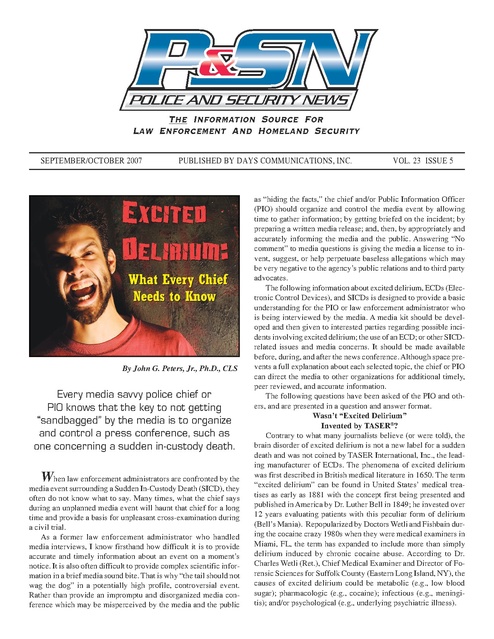
Wasn’t “Excited Delirium”
Invented by TASER®?
Contrary to what many journalists believe (or were told), the
brain disorder of excited delirium is not a new label for a sudden
death and was not coined by TASER International, Inc., the leading manufacturer of ECDs. The phenomena of excited delirium
was first described in British medical literature in 1650. The term
“excited delirium” can be found in United States’ medical treatises as early as 1881 with the concept first being presented and
published in America by Dr. Luther Bell in 1849; he invested over
12 years evaluating patients with this peculiar form of delirium
(Bell’s Mania). Repopularized by Doctors Wetli and Fishbain during the cocaine crazy 1980s when they were medical examiners in
Miami, FL, the term has expanded to include more than simply
delirium induced by chronic cocaine abuse. According to Dr.
Charles Wetli (Ret.), Chief Medical Examiner and Director of Forensic Sciences for Suffolk County (Eastern Long Island, NY), the
causes of excited delirium could be metabolic (e.g., low blood
sugar); pharmacologic (e.g., cocaine); infectious (e.g., meningitis); and/or psychological (e.g., underlying psychiatric illness).

Isn’t It True That Excited Delirium
Is Not a Recognized Medical Diagnosis?
Many journalists may try to put the PIO or administrator on
the spot by naïvely pointing out that “excited delirium” is not recognized by the American Medical Association (AMA) and/or is
not a diagnosis found in the International Classification of Disease (ICD) manual or the Diagnostic and Statistical Manual of
Mental Disorders, Fourth Edition, Text Revision (DSM-IV-TR).
While this is technically true, delirium and closely associated diagnoses to “excited delirium” are found in both manuals under
terms such as “manic excitement,” “psychomotor excitement,” “abnormal excitement,” etc. In addition, it is interesting to note that
the terms “in-custody death” and “sudden custodial death” are not
listed, but people acknowledge that these exist. One must keep in
mind that it takes approximately ten years for a new diagnosis to
be added to such manuals. Also, excited delirium is not really a
diagnosis, but rather a state.
To help correct the misperceived “diagnosis” argument, your
media kit should provide the following sections from the ICD which
could be used by medical doctors to provide a diagnosis for a person who is in an excited delirium state: 799.2X Abnormal Excitement; 296.00S Manic Excitement; 799.2AM Psychomotor Excitement; 307.9AD Agitation; 799.2V Psychomotor Agitation; 780.09E
Delirium; 293.1J Delirium of Mixed Origin; 292.81Q Delirium,
Drug Induced; and 292.81R Delirium, Induced by Drug. Remember: A diagnosis is important so the medical doctor can get paid for
his (or her) evaluation and/or treatment of the individual. The preceding “codes” are also necessary for billing purposes.
What Are the Signs of
Excited Delirium?
It is important to explain and reinforce to the media that an
excited delirium state creates a medical emergency; hence, the
need to have emergency medical providers present to provide reasonable and immediate medical intervention. Realistically and
practically, such medical intervention cannot be initiated until the
person has been captured, controlled, and restrained. Knowing the
following psychological, communication, and physical behaviors
and characteristics may help the chief and/or PIO to explain that
the individual who fought with law enforcement officers demonstrated one or more of these behavioral cues which match the profile of a person who is in an excited delirium state.
Psychological Behaviors:
• Demonstrates intense paranoia;
• Demonstrates extreme agitation;
• Rapid emotional changes;
• Disoriented about place, time, purpose;
• Disoriented about self;
• Hallucinating;
• Delusional;
• Scattered ideas about things;
• Easily distracted;
• Psychotic in appearance; and
• Described as “just snapped.”
Communication Behaviors:
• Screaming for no apparent reason;
• Pressured, loud, incoherent speech;
• Grunting;
• Talks to imaginary people; and
• Irrational speech.
Physical Behaviors:

• Demonstrates violent behavior;
• Demonstrates bizarre behavior;
• Demonstrates aggression toward inanimate objects, such as
glass;
• Runs into traffic;
• Runs for no apparent reason;
• Runs wildly;
• Naked or partially disrobed;
• Apparent superhuman strength;
• Seemingly unlimited endurance;
• Resists violently during capture, control, and restraint;
• Resists violently after being restrained;
• Diminished sense of pain (e.g., OC or baton strike ineffective); and
• Self-induced injuries.
Physical Characteristics:
• Dilated pupils;
• Profuse sweating;
• High core body temperature;
• Skin discoloration;
• Large belly;
• Foaming at the mouth;
• Uncontrollable shaking; and
• Respiratory distress.
Are There Observable Phases to Excited Delirium?
Excited delirium generally has four observable phases: sweating profusely which may indicate a high core body temperature,
but may not always be present; delirium with agitation; respiratory compromise or arrest; and, finally, cardiac arrest. Basically,
this equates to a brain disorder – not an acute drug overdose when
the person has maladapted dopamine transporters, presence of heat
shock proteins, and preincident amygdale activation (fight or flight).
If it is known that the individual was sweating and highly agitated,
tell the media. If the person suddenly stopped breathing, the chief
or PIO can explain that this phase often follows the first two phases.
Finally, if (s)he died after engaging in a violent struggle with law
enforcement officers, do not speculate about why the person may
have died. Simply explain that there will be an autopsy and that
the medical examiner will, if possible, determine the cause, manner, and mechanism of death. Coordinate the release of the medical examiner’s findings to the media so that no one is surprised by
the findings. Remind the media that they, too, should not speculate
about the cause of death.
In some cases, batons, pepper spray (OC), compression,
multiple officer force, restraint tools, and/or ECDs may have been
used by law enforcement officers to help capture, control, and restraint the violent individual. If an ECD was used, the following
information should help the chief and/or the PIO answer ECD
specific questions.
Can’t 50,000 Volts Kill a Person?
It’s possible, but, from an ECD, “No.” The reason: When discussing electrocution (death by electricity) incidents, the focus
needs to be on the amount and duration of electrical charge flowing into the person, not the misperceived media myth of voltage.
While TASER brand ECDs are designed to produce 50,000 (peak
arching) Volts (V) (to allow the electricity to jump a spark gap of
up to two inches to avoid the necessity for direct skin contact); in
contrast, a Van de Graaff generator can produce between one and
20 million volts and is not considered dangerous. Many people
(possibly, even you) have placed one or two hands on a Van de

Page 2

Graaff generator in a high school science lab, a museum, or at a
carnival, and then gleefully watched as the hair stood straight out
from the head.
Another example is a static electric shock one receives when
touching a metal file cabinet or metal door handle after walking
across a carpet. Static electrical discharges often range between
35,000 V and 100,000 V. In short, it is not the volts which are
dangerous, but, rather, the amount and duration of current which
enters the body. According to scientific studies about TASER brand
ECDs, the pulse of a TASER ECD has less peak current than a
strong static shock, and is 50 to 200 times too short in duration to
efficiently stimulate the heart.
At open peak arching (two inch arc), the TASER brand ECD
has 50,000 V peak. When the ECD is applied to the body, an ADVANCED TASER M26™ ECD produces 5,000 V peak, while the
TASER X26™ ECD produces 1200 V peak. The average actual
voltage over one second is 0.76 V for a TASER X26 ECD, and 1.3
V for a TASER M26 ECD. The 50,000 V is produced to push the
electricity through clothing and spark gap and is not what is being
delivered into the person. In contrast, the Amperes (A) are 2.1
milliamperes (or 0.0021 A) for a TASER X26, and 3.6 milliamperes (or 0.0036 A) for a TASER M26, respectively.
Paint a mental picture for the media and the general public
they should understand. Verbally illustrate, or physically demonstrate, the stacking of 10,000 sheets of copy paper (about four feet
tall). These sheets represent the “on time” of wall outlet electricity
and also equal one second of time. To show the duration of the
electrical output over one second (19 pulses) of a TASER X26
ECD, remove 19 sheets of paper from the stack of 10,000 sheets,
as this represents the “on time” of the X26 during one second of
time, meaning the X26 is only discharging current into the person
0.0019 of the time.
When preparing a media kit or during a press conference, explaining key terms to the media often proves valuable, too. For
example, explain electrical voltage and current which goes into
the person through analogies. Most people can understand the concept of height and weight. Using the following analogy, explain
that height is equal to voltage, while weight is equal to current.
Dropping a bowling ball from 100 feet (high voltage electrical
power transmission line) will have far more impact on an object
than the dropping of a Ping-Pong™ ball from 100 feet (an ECD).
The height of the drop can be compared to voltage or electrical
pressure, with the weight of the ball being compared to current or
flow of the electricity. Another example is the comparison between
Niagara Falls (high line voltage) and a summer rain (ECD).
Do Two Simultaneous TASER ECD
Deployments Equal 100,000 Volts?
No. Electricity is not cumulative. Remember: The individual
does not receive the 50,000 V per deployment. Even if simultaneous device discharges were a concern – which they are not –
with the X26 pulse width of only 100 microseconds (millionths
of a second), the chances of exactly overlapping discharges is
infinitesimal.
Isn’t It True That TASER ECDs
Have Caused Over 200 Deaths?
No. This sensationalistic inaccurate information is published
by select anti-ECD groups and is based upon self-serving agendas.
To date, there has not been one scientific research report or court
verdict which has found TASER brand ECDs to have caused

anyone’s death.
What Kills These People if It Is Not the TASER ECD?
The cause of death in most of these SICDs is from chronic
illicit drug use (such as methamphetamine, PCP, cocaine, ephedra), mental disorders (and neuroleptic medications or their withdrawal), and/or alcohol. Also, the acute use of drugs can cause the
heart to stress and, during a struggle with law enforcement or correctional officers, the heart may suddenly stop because of the
amount of illicit substances in the bloodstream and/or metabolic
acidosis (e.g., low pH levels) resulting from the struggle with officers, struggle against restraints, struggle against medical restraints,
etc. Chronic abuse in those individuals with brain disorders can
cause maladapted dopamine transporter overload. The exact cause
of death may not be identified by the medical examiner, but the
medical literature on excited delirium, sudden death, neuroleptic
malignant syndrome, etc. supports these probable causes of sudden death.
Sudden Deaths Are Not New
in Law Enforcement
The media have been accusing law enforcement and attempting to hold it responsible for the sudden deaths of individuals for
several decades. In the 1970s, it was the carotid neck restraint. In
the 1980s, the focus and accusation was on hog-tying. The 1990s
saw the hue and cry from such activist groups as the American
Civil Liberties Union regarding the use of pepper spray. Then, it
was compression – holding the person down or a knee in the back.
This decade the focus is on the use of ECDs. Scientific and medical research has unquestionably shown that the accusations about
the sudden deaths of individuals in the 1970s, 1980s, and 1990s
from the carotid neck restraint, hog-tying, and pepper spray were
just that – unscientific, baseless accusations. Scientific and medical studies have shown that the proper application of a carotid restraint hold, hog-tying, and pepper spray were not the cause of
sudden deaths as initially baselessly complained about by activist
groups. TASER brand ECDs have been the most scientifically and
medically researched tool ever manufactured for law enforcement
– not just in the United States, but in the world – and, to date, there
has been no scientific or medical evidence showing that ECDs cause
a sudden death. So, what kills these individuals?
Current medical theories about why certain people may die
suddenly when fighting with law enforcement officers, paramedics, hospital staff, or psychiatric staff include, but are not limited
to, preexisting cardiac disease; restraint stress; mental illness and/
or medications; excited delirium; use of intermediate impact tools
(e.g., baton); stimulant abuse; and asphyxia. Many times, the
individual’s long-term lifestyle choices, such as using illicit drugs,
diet, etc., play a role in his (or her) sudden death.
Prepare That Media Kit
Outline what should be contained in your media kit; write it;
publish it; and, then, give it to the media. The accompanying sidebar
provides an example of a media release regarding a SICD following a TASER ECD deployment.
If you need additional information, please visit the IPICD Web
site at www.ipicd.com or attend the IPICD’s 2nd Annual Excited
Delirium Conference this November in Las Vegas, NV, where the
world’s leading medical researchers, scientists, and other professionals who have researched, studied, practiced, and/or defended
sudden death events will be presenting the most cutting edge research on this and related topics. Also, go to www.ecdlaw.info for
ECD legal resource information.

Page 3

When discussing excited delirium, ECDs, or sudden death
issues with the media, always use terminology which will not hurt
the information transfer. For example, do not say, “The officer shot
the man with an ECD.” ECDs are not firearms, but the word “shot”
will imply that notion. Instead, say the ECD was “deployed.” Also,
do not use the word “tased,” as this not only negatively impacts
the trademark, TASER, but it also helps to perpetuate the use of
this improper word, and it sounds unprofessional in reports and in
print. Again, simply say, “deployed.”
If you have time, practice what you plan to say and do not use
terms and concepts which you do not understand. Rather than make
a mistake or misspeak which can be very costly (not only monetarily, but also professionally), please have the agency use-offorce instructor, ECD instructor, or other trained professional
present to answer specific questions. Further, do NOT guess or
make information up – if you do not know, find out from someone

who does BEFORE you speak or give an opinion.
Remember: All of us have a responsibility to provide accurate
information and that includes a responsibility to educate the media
and correct misstatements about sudden death events. Only when
the media are educated will they hopefully begin to practice ethical journalism by writing accurate headlines, such as “Man Dies
After Struggling with the Police” rather than stating a cause of
death days before there are autopsy findings.
About the Author: John G. Peters, Jr., Ph.D., M.B.A., CLS,
serves as President and Chief Learning Officer of the Henderson,
Nevada-based Institute for the Prevention of In-Custody Deaths,
Inc. A judicially qualified expert witness, he is also one of a few
professionals who hold the Americans for Effective Law Enforcement (AELE) designation of Certification Litigation Specialist in
the areas of police liability, corrections liability, and public employment liability.

A Sample Media Response
and News Release
Summary: This afternoon, police officers were dispatched to a suburban home
where a naked man, age 42, was sweating profusely, screaming, running wildly,
and speaking to imaginary people. After the police arrived, he hid behind some
bushes. While officers were attempting to talk with the naked man, he grabbed a
shovel which was in the yard of the home and tried to strike officers with it. The
officers told the man to “drop the shovel” and, when he failed to comply with their
repeated commands, one officer deployed her TASER® X26™ ECD a single time,
decentralizing him to the ground where other officers quickly controlled him and
then restrained him with metallic handcuffs. Paramedics who were already at the
scene immediately provided aggressive medical intervention, placed him into an
awaiting ambulance, and transported him to XYZ University Medical Center. The
man died two hours later.
According to family members, the man had a history of chronic drug abuse.
His behavior appears to match that of an individual who was in a state of excited
delirium, and match our training on this subject. Excited delirium behavioral cues
include partial or full disrobing, sweating profusely, screaming for no apparent
reason, paranoia, incoherent speech, talking to imaginary people, and resisting
violently after being decentralized.
According to preliminary police reports, a TASER X26 ECD was deployed
one time resulting in the man falling to the ground. He was immediately controlled
and restrained by other officers on the scene, and was immediately given to awaiting paramedics who performed medical intervention prior to transporting him to
the hospital. Paramedics told us that the man was struggling violently with them
during transport to the hospital. Unfortunately, the man was pronounced dead two
hours after entering the hospital. The exact cause of death is not known at this
time, but will be made available through our office and/or the Medical Examiner’s
Office when the cause of death is known.
A media kit explaining excited delirium, ECDs, and sudden death is available
in the back of the room. Please take one with you; it may assist you in understanding the bizarre events which faced our officers this afternoon. Thank you.

Page 4