





Taser Univ Wisconsin Dept of Elec Engineering Lethal Report 1976
Download original document:
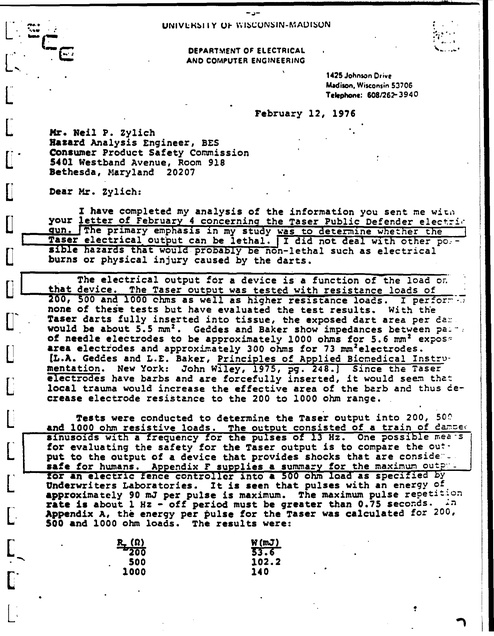
Document text
Document text
This text is machine-read, and may contain errors. Check the original document to verify accuracy.
r
~'; ::
L . -C
L~. .
. l::;.;
~.
UI~IVl:H::i11
•;
e
DEPARTMENT OF ELECTRICAL
AND COMPUTER ENGINEERING
U
U
your
un.
Taser
a
e
burns
U
o
D'
.
•.. I
i.,
'425 Johnson Or
Madison, Wisconsin 53706
Telephcllle: 60B126:r3940
February 12, 1976
•
Hazard Analysis Engineer, BES
COnaumer Product Safety Cornmission
5401 Westband Avenue, Room 918
Bethesda, Maryland 20207
Dear Mr. Zylich:
•
•
' .... -,-'
Mr. Neil P. Zylich
[1'
..•
•• '
•
•
,
•
L
•
.~
•
L
,•
y ut- WI::il:UN::iIN-MAUI::iUN
•
•
t
-.;,-
~·
•
Tn oTT US
•
•
•
•
•
•
r------::T~h:-e:-e""':'l-e":c":'t-r-.i-c":a~l:-o-u-t:-p-u""':"t"""":f~o-r-a-d':"e-v--:'i-c-e"""":i
....s....·-a-f::'u-n-c--:'t":'i-o-n-o~f~t~h~e-"'l-o-a"'d~o-r:
~~device.
The Taser out ut was tested with resistance loads of
__
DO an~
000 ohms as WE 1 as hlgher resutance loads. I per:or:- -.1
none of these tests but have evaluated the test results. With tne
Taser darts fully inserted into tissue, t:he exposed dart area per da::
would be about 5.5 rnm 2 • Geddes and Baker show impedances between pa"--,
of needle electrodes to be approximately 1000 ohms for 5.6 mm 2 expos,area electrodes and approximately 300 ohms for 73 mm 2electrodes.
[L.A. Geddes and L.E. Baker, Princi les of A lied Biomedical Instrumentation. New York: John Wl1ey, 1975, pg. 248.
Since the Taser
electrodes have barbs and are forcefully inserted, it would sea~ that
local trauma would increase the effective area of the barb and thus decrease electrode resistance to the 200 to 1000 ohm range •.
D
L
•
L
l
L
[
•
Tests were conducted to determine the Taser output into 200, SOC
~__a~nd 1000 ohm resistive loads.
The outDut consisted of a train of d~~=e(
a nusol 5 wlt a requency or t e pu ses 0
Hz. One pOSSl e mea-s
for evaluating the safety for the Taser output is to compare the output to the output of a device that provides shocks that are conside",.
aafe for humans. A endix F su lies a sum.~a= for the maximum outP,·---- or an e ectrlc ence con ro er lnto a
0
oa as specl.1e
Y
Underwriters Laboratories. It is aeen that pulses with an energy ~f.
approximately 90 mJ per pulse is maximum. The maximum pulse repetlt~on
rate ia about 1 Hz - off period must be greater than 0.75 seconds. .n
Appendix A, the energy per pulse for the Taser was calculated for 200,
SOO and 1000 ohm loads. The results were:
C__
~
00
•
o
•
C"
L·
•
•
500
1000
W(mJ)
n.6
102.2
140
•
•
•
0
•
•
••
r
-,
[.:
•
T'ifIPP'·;"Z:!
.,
'
the ~aser output energy per pulse is somewhat higher than the
allowable output for 4ft eloctric fence. A mere important point, howev.~
is that the Taser pulses occur 13 times per second compared to the once
per second for the fence. The power into the load is then 13 times
greater for the'Taser output than .for the electric fence. These result
indicate that the Taser output is more hazardous than an electric fence
output.
'
~hus,
•
•
L,
L
••cause the Taser output consists of a pulse train, it appears
beat to compare this output to the known effects of steady state sinuaoidal currents. Much work has been done on the effects of different
values of effective, rms, currents and on the effect of different frequencies. In Appendix S, the effective value for the Taser output
current is calculated. The results are:
L
•
U
,
,
Rz,un
[l
I
rms
(mA)
,
200
500
1000
u
,
60
51.6
,
,-
42.7
,
•
•
For 60 Hz, alternating current, the current that will cause ventrJ,cu ': :'
•
fibrillation in one out of two hundred individuals is greater than
approximately
150
I
mA
•
,
u
•
u
o
u
,
[
[
[,
[
-IT
where T is in seconds _ This expression is valid for'S. 3 ms < T < 5s
with the value of current frem 5 to 20 seconds about the same as for
5 seconds. 'l'he cons-tant, l-i~is.....ometi.mes reduced to 100 when consie ..
ing safe current levels for children. The effective current output :',.
the Taser appears to be close to the 'level that can 'cause ventricula~
fibrillation and death except for the fact that the heart does not r'
pond readily to hiqher frequency currents. The lethal level for 60 ~
current cannot be compared dir~ctly to the total effective current
output of the Taser because the Taser output has high frequency compL'ents that have negligible effect on the heart •
u
[
rms
. ~o include the response of the heart to the frequency of the
electric current, the frequency spectr~~ for the Taser output was ca
culated in Appendix C. Appendix D provides a calculation for the
effective value for each of the frequency components for the Taser 0:' ,;put; in addition, compensation is included in the calculations to
include the fact that higher frequency components have less effect C'
the heart. It is shown in Appendix D that a conservative approach, . ,~
that maximizes any danger, is to assume that the heart responds equa.·,y
to all frequencies of current to 13 kHz and does not respond to frequencies above this value. Taking equal magnitudes for all frequenc':
components below 13 kHz in the Taser output and with a 13 kHz cut-ofi,
the following effective· currents- wer, calculated:
,
•
Irma
(mA) .
Rz,
,
8.9
]00
8.7
10.9
500
1000·
[
•
•
,
,
•
•
L:
,
,
•,
Ii
-
.
C: ." ~h~~ '11: appears
iJ:T1UtWl:t.....
:_-,
".7' iii"; -.-.
-~-
i~ approx~ma
that the maximum Taser output current
tcly
J 10' of the lethal value. The current is about twice the 5 mA let-go
f" . curfent level which seem~ to explain why the shocks are effective in
L\ incapacitating an individual.
Appendix E includes a discussion of the Taser provided test resul.:s
and references.
[
Conclusions
• •
'l'bJ 'laser electrical output is not lethal.
. 1.
2.
As with any electric shocking device, there may be cases of
lethality because of individual susceptibility.
•
'lhe hazard in the output would be increased if the pulse repetltion rate
should increase or the amplitude of the output increased.
,
3.
Sincerely,
•
u
•
•
•
•
•
•
,
Dr. Theodore Bernstein
Professor
•
'1'B:aeh
•
(.
c
•
•
u
u
•
•
•
•
-
•
D
-_.
-
••
•
•
U
D
•
•
[j
•
l
•
•
l
•
•
•
•
•
[
•
.:
•
[
[
•
"
•
•
•
•
•
•
L~
•
•
•
•
•
•
•
•
•
't ."; .
[, .
FE B II
•
UNITEO STATES GOVEFIlNMENT
[
Memorandum
TO
U
U
U
U
U··,
•
u.
l
l
l
l
ll·
-
'U~
, •.• , .. ~.,. l\1'l\~
-,
'. • i.M.• '"
:
. C:ONSUMEI'l PI'lODUC'T
.."
SAFE TV C:OMMISSIDI\J
WASHINGTON. D.C:. :20:20-
,Joesph Z. Fandey, TAD/OSCA
/J
--..' February 10, 1976
.Albert F. Esch, M.D., Director, OMDUi/~&..Jl..
"
I
'Leo T. Duffy, M.D .. Dep~ty Director
Office of the Medical Dlrector
. . . ·CT:
4-.:'
~
TASER TF-1, CP-71-5
4~-;-~
~
•
•
,
The. Office of the Medical Director has reviewed the
ma.teria1 submitted by your Office concerning the subject petition. Although this reply will concern itself
•
only with the medical aspects of this subject, we
recognize at the'staitthat this product is manufactured as a Wdangerousweapon-, and should be so treated.
As such, its effectiveness depends on the creation
o£ some measure ~f injury in order to fulfill ,its
intended purpos~. Therefore, it appears that the role
of this Office is more concerned with assessing the
-risk of unreasonable injury~ rather th4n th~ "unre3sonable
risk of i!!iurY.:,. This memorandum will' not address
- the sociar; moral -ana'pl'lilosophical issues which are
necessarily bound to be raised in the discussion and
•
. consideration of the use of this product.
From the electrical data supplied as the design output,
and our survey of the 1iteratur~ (references attached),
it is apparent that the stated available electrical
current (50,000 V/0.3 joules/10 pps) is non-lethal
when the wea on is used as directed on the wavera e,
~-- ea t y aut.
e current-re ate lnJury sustalne
with the intended use of the TASER is related to the
neuromuscular system, and is exhibited as an abnormal,
tetanic or sustained contraction of muscle groups which
has the effect of immobilizing the recipient. This
reaction is induced by the action of the electric ,
current passing through the skin, and then following
nerve pathways by means of the nerve fibrils (cells)
'and their myelin sheaths, both of which ,are excellent
~~nductors. The current is then continued through
.
~.rve endings (synapses) which are attached to muscle.
• The transference of the charge ~o the muscle cell.
~~~a~ s them to contract. This in ur
process, ordinarily,
• temporary and reverslb e w en use as n ca e
on the health human. The level of current i. com arable'
to t at 0 U.L. approve e ectr c w re e~ces a. ar
•
L
•
•
L;rSRU
[
/:.
'·C;!,o",..,
'1~/ti
...... -.wi_1ft ,...., ...
.,'teI: .". ,u.lun... a.a
•
•
•
l~
••
•
,•
[- ~:
•
•
[
•
[
U
U
U
U
L
[j
•
•
[
U
-7~
•
•
•
~
!ill: .. t -;; , Wi DU' t"'tttr:t:m..._ _
•
[
U
757 ;.;
•
L-
- 2 -
•
8
as the 8freezing action is concerned. However, a
major difference exists in that the electric fence
pulsed charge of approximately 4.0 mAmp has OFF and
ON periods which would allow the ability to ·letg08,
and get free from the fence. With the TASER the 8l et908 is dependent on the user interrupting the flow
of current by releasing the release bar.
1t exposure to the stated amount of TASER current,
there is a wide margin of safety as related to causing
severe cardio-vascular reactions. An alternatin
current 0
mperes,
0 t,
z can resu t
in ventricular fibrillation. This is an asynchronous,
uncoordinated rhythm of the heart beat which is incompatible with survival unless the normal rhythm is
restored b menns of a defibrillator device. The TASER
current 0
• JOu es watts secon l 1S we
e ow
the 10 to 50 joule threshold above which ventricular
fibrillation can occur; This saf t m in would e
1m1n1S e 1n a person w 0 as ex st1ng car ~i~o~-~v~a~s~c~u~l~a~r-------J
disease. For example, an elderly person with arteriosclerotic
heart disease would be subject to the precipitation
of heart failure under the stress of convulsive seizures
associated with Electric Shock Therap~. The margin
of safety would also be reduced with a prolonglt9..continuation
of TASER current.
.
.
---. - - ..
Injuries related to the impact of the barbed darts
causing puncture wounds of the external surface of the
body would be relatively minor, except for impact on
the eye. The chance for initiation of events leading
to a total loss of vision in the affected eye would
be extremely high should such contact occur. Electric
energy applied in the vicinity of the eye has also
resulted in delayed cataract formation.
L
There is no evidence that adverse psychological, or
neurological, effects, stemming purely from the electric
current charge of a TASER, would be induced.
l
Injuries, resulting from falls involving an incapacitated,
inert hum~~ body, are speculative depending upon the
activity o~ the recipient at the time of impact, and
on contact with external hazards, such as the head
striking the sharp corner of a table. The likelihood
of injuries, such as fractures, is increased in the
case of the aged or physically handicapped.
L·
L
•
l
In general, the severity of systemic effects from the
passage of electric current thr~ugh the body depends
on several factors. These are: 1) type of circuit,
•
l~
••
•
\•
I
7 !iF;; . it J5 mrpp
y
o.
L
.'
•
L~
L
L
•
L
L
U
'.
•
•
•
•
••
•
•
.
- 3 -
•
2) voltage, 3) value of the current, 4) duration of
flow,S) resistance of specific tissue, 6) area of
contcct, and 7) pathw3ys followed through the body.
In addition, people with chronic cardio-vascular disease,
~__~the elderly and children would be increasin 1 ausce tible
o a verse e ec s ,
ere ore,
lS
lce agree~s~
.
with the conclusions stated by the manufacturer in
. his summary of May 10, 1972, page 3, which reads
---"the conclusions reached as a result of these studies
and special tests is that the TASER is non-lethal at
the design output to normally healthy people. However,
it must b-. emphasized that neither this feature nor
the non-injury or no harmful after-effect aspects can
ever be guaranteed. There is no weapon, technique
or procedure for subduing, constraining or dispersing
that does not involve some risk of injury to healthy
persons or of death especially if the individual has
a heart ailment."
r;
....
•
u
-_.---_
---_. .. ----•
u
U
•
•
•
L
•
L
L
L
•
•
L•
•
L--,
•
L
L~
•
•
-
•
• •
•
••
•
'"
[i
•
•
•
"
,
•
..
-9-
,
['
•
•
•
u.s.
CONSUMEI=I PI=IOOUC r
SAFETY COMMISS'O:"
WASHINGTON, O.C. 20207
U'oIITEC STATES GCVEI=INMENT
[:•
Memorandum
•
•
bI
Ui
TO ,
OATE:
Joseph Z. Fandey
Technical Analysis Division
I
•
I
,
•
Neil P. Zylich, Hazard Analysis Enginee;\1
Special En&ineering Studies Division
I
I
,
I
TASER Evaluation and Analysis
• • IE'=":
[
I
U·
•
[J'•
The Bureau of Engineering Sciences was requested by the
Office of ' Standards Coordination and Appraisal to evaluate
the TASER Public Defender for potential for injury.
•
, ,
•
•
DESCRIPTION
, '
;
,
fJ
The TASER is a battery operated device the size of a large
flashlight (dimensions' are g"x3"x2" and weighs 1-1/4
pounds). It contains a cartridge-like insert that when
actuated by a s~all charge of ~ow~er, pr~pels two small
darts. Each dart is connected by a'wire 18 feet in length
to a- t'ransforrner power' source ~li thin the TASER. When
the darts are propelled, if they strike either skin or
clothing they will imbed the~selves in it. If both darts
imbed themselves in either skin or clothing on a person,
the person can be subjected to an electrical shock.
Note, the darts do not have to make physical contact
with a person but just attach themselves to a person's
clothing in order for the person to receive an electrical
shock. The holder of the TASER depresses a switch on
the TASER after the darts have been fired and imbedded
in order to transmit an electrical shock to the intended
victim. The electrical shock lasts as long as the switch
is depressed. Approxi~ately two to three minutes is the
maximum time duration the electrical shock can be applied
continuously before the battery is discharged and the
TASER becomes ineffect~ve.
,
I
•
U·,
,
U';
I •
•
•
U
u·
Lj
L!,
L
L::
i
•
,/'
.
,
,
,
.' Rl:.Ct.IVto
•
•
•
'
•
~'\
I
Li
Lt
. I•
•
..
,•
\
.
•
.
( .....
.. ~ l
,
•
~.. .
~
... ¢.~
.'
~
.
.
..\ .... .,..
•
.I>
•
...
'.-
FEB 191976
••_
'~:i
t:
.
,.....
",t,
~
•• ,
•
!,.
'.
.--t" . ' '"
,
'
_
"......
. '"
,..
...
I ..
"rr:, .....-:,-, \",; . .
..
I
,
•
•
••
~~~
is'NIC1L ANALYSIS ~~
.
...... ..,......, ....'Il1O 0"'": It'. UJ.u".... I••
•
:~
L·
••
\'
I
•
•
[~
•
"
-10-
00.
,
L..:.
2
•
•
S~bject:
L'
~ASER
Evaluation and Analysis
BACKGROUND
L
•
SEZ throur:~ esc,' obtained t\IC ':'A~F.?S, a circuit descriJ:'- TASER, and test and operational literature
tion of the
on the TASER. After an initial review and analysis of
the TASER by BES (which included taking photographs
of the TASER output waveform at various impedances
which simulated body impedance; see Attachment 3) it was
decided to concentrate on the electrical aspects of the
TASER only. The injury effect of the pointed darts was
considered. It is concluded that the barbs will penetrate
human skin to a maximum depth of approximately 5/16".
The most obvious serious injury which could result from
the dart itself would be an injury to the eye.
•
U
U'
U
,
UJ
BES contracted with Dr. Theodore Bernstein of the '
University of Wisconsin, l-recogn1zed autnority in the
tJe~d of electric shock effects, to evaluate and ana!Y:e
the TASER electrical output. The TASER output waveforms
tlere measured at the llationa1 Bureau of Standards by
CPSC personnel and photographed. This information, a
TASER, and literature made available by the TASER manufacturer concerninG ~he testing and safety of the device
were supplied to Dr. Bernstein for evaluation.
U
BES has reviewed Dr. Eernstein's analysis, a copy of
which is attached. Attachment 2 contains specific
comments and/or clarification concerning this analysis.
U
U
-
•
L
L
L·
L -.
[
L:
,
-
RESULTS
L
L
.
,
•
The calculated effective current to which an individual
would be subjected is apprOXimately ten milliamperes.
This current is above the threshold of the "let go"
current value in the literature for Which test data is
available. Professor Da1Eie~reported on tests conducted
.on volunteer subjects: ~O~ of the women tested and 15~
of the men tested could not let go of a current in excess
of l~ mao While this value caused pain, no permanent
injury resulted. These tests were conducted at 60 hz.
It should be noted however that.~he effect of let go
is a f~nction of frequency as wt-:.. i as current. At
frequencies above 100 hz the effects of current decrease
such that the let go current increases. For example
the fifty percentile let go threshold for men at 60 hz
is 17 ma While the fifty percentile let go threshold
for men at 10 khz is 74 mao Thus the 10 khz threshold
is over four times as high as for 60 hz.
•
Irrofessor Charles Dalziel of the Vniversity of Californja, the'
recor:nized lend'n~ authority in this field pr10r to hi:
1·" C en t
1'(: t
•
11°c..'t:,\': tl \.
•
.,
•
-
'."
••
Ii
...
L..
•
,,
•
•
••
Ffi:r pm' )
..
-11-
•
rr::
•
•
•
L~.
3
Subject:
L
L
•
•
L
L
[l
[l
U
U-- ..
U
L
L
Dr. Bernstein states that the "maximum TASER output is
L......;. roximatel 10:: of the lethal value". '1'his =rj,ie~l:li.:::t:;:e~s::e va ue 0 rrns curren
or a
requency e mponen s
up to 13 khz of approximately 10 ma to the commonly
. accepted value of 100 ma for ventricular fibrillation
of a normal adult human. Professor Kouwenhoven in his
paper on "Effect of Electric Shock" in the Transaction
of A.I.E.E. V.~9, January 1930, p. 381 stated that
100 milliamperes may cause death and that for normal
pers~ns the current should not exceed 30 milliamperes.
Ferris, Spence, Williams and King stated in the~r report,
"Effect of Electric Shock on the Heart" in Electrical
Engineering, V. 55, May 1936, p. ~98 that the maxi~urr.
current to which man may safely be subjected for shocks
of one second or more in duration is about 100
1Il1111amperes. Dalziel and Lee have shown with tests
•
on dogs in their report "L~thal Electric Currents"
in the February 1969 IEEE Spectrum on Page ~8 that the
average 100 pound or more animal requires approximately
100 milliamperes for ventricular fibrillation.
H. Spencer Turner in his report on "Human Re~ponses to
Electricity A Literature Review", Ohio State University
Research Foundation, 1972 on Page ~3 states that sinu'---soHla1' 'currents in excess of 100 ma at 60 hz from har.d
to foot will be ~angerous for shock durations of three
seconds or more for man.
•
The energy output of such devices would have to be defined
in terms of frequency, pulse hei6ht, pulse width, on
and off time of pulses. The maximum energy would then
have to be determined for various frequency bands such
that at least the 30 dispersion of the population would be
covered. The definition of the energy levels would
depend on medical judgements, and whatever data may be
available in the literature.
•
L-
•
L
•
•
r>
L
L~
-l
With regard to establishing a standard for such a device;
simply stated, a standard would address such devices
for both AC and DC operation.
U
L
TASER Evaluation and Analysis
•
•
•
-
•••
-.
.- .
•
.. '
••
,I
7;
-'.' .
L
• o.
•
•
.
-.a..-
.
-
•
• ..
•
•
•
[
•
•
•
U
Subject:
TASER Evaluation and Analysis
•
COI~CLUSIO:I
U
. In conclusion, BES a.grees with the finding that the TASER
•
______should
not be lethar-to a norm 1 hea th
erson.
his is
ase on a comparison of Dr. Bernstein's engineering
results with the known engineering data in the literature.
Additionally a standard could be developed but not
without a costly and time consuming program to do so.
U
u
530959:76:NPZylich:pc
u
u
•
u
['
L
•
•
•
-
-
--
.-
• •
- --
•
•
L
•
L
L
L
•
L:
•
L
('
[
L~
•
•
•
••
"1
•
•
[.
"
-:
•"
7 nCt ;·W'lyt' itS '
"
•
L
L
L
•
"
•
•
L
•
L
EVALUATION OF THE ELECTRIC SHOCK
HAZARD FOR THE NOVA XR 5000
STUN CUN
U
L
U
U
U,
,
Theodore Bernstein. Ph. D.
Profe..or of Electrical and Computer
Engineering
University of Wisconsin-Madison
u
January 22. 1985
L
L
L
L:
L
L
•
L~
[
..
•
•
•
•
•
•
•
•
•
•
•
L·
ABSTRACT
The electric shock hazlrd for the XR 5000 is determined by compering
the shock delivered to the known effects of I 60 Hz shock. WIth 60 Hz .
shocks I current of 1 IlIA is It the threshold of perception,S IlIA Is It the
Iet-go current 'evel where shocks Ire peinful but not dlngerous, Ind 50 mA
II the level where ventrlcullr flbrlllition Ind duth Cln occur. The XR 5000
. output Is a train of damped, sinusoidal pulsel with an approximate 10 III
time constant. The true r.m.s. value of the output Is not a valid indlcltion
of the hlzlrd bec:luse the output contains frequency components well Ibove
the 1 kHz frequency lbov" which the effect for I gIven frequency component
Is reduced. When these factors Ire considered, the output for the XR 5000
. II In the 3 to • mA range of In equlvllent 10 Hz lhock Ind II not dlngerous~ The fact thlt the shock II delivered between two probes 2 inches
lpert adds to the Ilfety beclule the current Is concentrlted In the region of
the body between the two probes and only I negligible current Cln ruch the
hurt•
l
L
U
U
U
•
U
U
U.
L
L
L
L
L
L·
L
L
L·
•
•
51
•
.
"
"
•
INTROOUCTI ON
The design of most electricil equipment. ensures thlt In Indlvldulil
Ihould rlrely contlct energized perts Ind be subjected to electric Ihock.
For luch equipment electrlcll slfety Is provided primlrlly by Inlulltlon or
"gUlrdlng to prevent contect Ind by sultlble grounding. Any contect with
energiZed perts Is considered hlZlrdous. There Ire other equipment where,
even though it mey not be Intended, contlct with energized perts il
expected 10 thlt the electricil Slfety must be provided by ensuring thlt Iny
possible electric shock will not be hlzlrdous or lethll, Exemples of such
electricil devices Ire the electric fence, mediCI I electrical nerve stimulltors.
welder, cattle prod, and fly electrocuter. The Novi XR 5000 stun. gun is In
example of a new device where Indlvidulls Ire deliberltely lubjected to
electricil shock.
The XR 5000 Is I smlll, hind-held device powered by I IV battery.
There Ire two smell probes extending from the front Ipproxlmetely 5
millimeters, 2 Inches lpert. The probes Ire intended to be pressed into In
Ittlcker's body 10 thlt In electricil shock Cln be delivered to incaplCitite
•
the Ittlcker. It II lmportlnt thlt the Ittecker not be injured, IS this is one
of the mejor Idvlntlges of the device,
This report eVllultes the slfety of the shock delivered by the XR 5000.
This is done by Inllyzlng the output current wlveform Ind comparing thi,
,
shock to known Slfe Ind hezlrdous shocks. Slfety criteril .for the electric
fence Ire used to complre the shock delivered to thlt delivered by the XR
5000,
•
•
".
1
"
'
;
-
[.
•
•
•
.
•
••
L'
L
L
U
U
U
U
U
L
L
L
L
L
L
L,
•
2
•
SINUSOIDAL, 10 Hz SHOCKS
Electricil lhockl Involving Iiterniting current hive been Inveltlglted
since before 1190 (Bernstein. 1975). Most of the recent Itudl.. hive
Involved Iinusoldil. 50 or 10 Hz currents. though the effects of other
•
frequenclel Ind wlveforml hive liso been Itudled. This report complres
the shock delivered by the XR 5000 to In equlvllent 60 Hz shock. In order
to do thll, the effects of 10 Hz Ihockl Ire reviewed.
Threshold of 'erceptlon
for 60 Hz shocks. the lowest level of current thlt can be I problem Is
the threshold of perception level. Thil level. where some people mlY feel I
Ilight tingle but Ihould hive no extreme Itlrtle reaction, II usuilly conIlc:Iered to be 0.5 mA r.m.l. for 10 Hz currents Ind II the maximum IlIowlble lelklge current for Ippllinces (ANSI. 1973). Dllziel and Mansfield
(1950) hive determined thlt the medlln threlhold of perception current It
•
10 Hz WII 1.017 mA for ZI men Ind 1.11 mA for four women. Shockl nelr
but lbove the threlhold of perception current may be I hlzard because of
Injury caused by the Itlrtle ruction producing I dlngerous body motion.
Ventrlcullr Flbrlllition
At the other extreme II the revel of current where the hurt mlY be
thrown Into ventrlcullr fibriliition Ind duth occurs. For shocks between
Iny two limbs. Blegelmeier and Lee (1910) hive re-evllulted experimental
dltl on ventrlcullr flbrillition Induced by electricil shock in Inlmals Ind
rellted the relults to the physiologicil response to electricil shocks. For
Ihort duration Ihocks shorter thin I clrdlac cycle. the electrlcl' .eurrent to
cluse fibrlllition must be IIrge Ind occur during the vulnerlble period. T
Wive. Shocks longer thin I Clrdlac cycle Cln cluse prlllllture ventricullr
contractlonl thlt lower the Ihock threlhold current to I minimum Ifter four
or five premature ventrlcullr contractions. Uling these concepti. I ~fe
current limit hli been estabilihed IS 500 mA for Ihocks Iell thin 0.2
secC'l.·
In durltlon Ind 50 mA for shocks longer thin 2 secondl. For
shocks between 0.2 Ind 2 leconds, the slfe current II given by the expres-
lion
L
[
•
(1)
I • 100/T mA r.m.l •
•
- -
where T Is In seconds Ind 0.2 leT c 2 s.
•
L
•
•
•
"
L"
•
••
••
•
•
L·
U
U
U
U
U
U
u
u
U
L
L
L
L
L·
L
l
L:
•
,3
•
•
•
Let-Co Current
The let-go current level of shock is not immediately lethal as Is the
ventricular fibrillation level. "'t this level of shock. with a current path
through the arm. the Individual cannot let go of an ener~lzed conductor.
This
level
II
hazardoul
In
that
a
person
Is
receiving
a
very
pelnful
Ihock
•
from electrlca' equipment that he cannot relllie. Such a long duration
lhock may eventually become hazardous because of evoked heart arrhythmias
or a decre..e In contact rellstance because of perlplratlon or burns allows
,
grllter currents. Dalziel and Malloglla (1956) have determined that the
60 Hz I,t-go current level where 0.5\ of the Individuals cannot let-go Is
9 mA fOr men and 6 m'" for women. The median let-go leve' Is 16 m'" for
men and 10.5 m'" for women. " The let-go level where 99.5\ of the Individuals
cannot let-go Is 23 m'" for men and 15 mA for women. Underwriters
Laboratories (1972) requires that the ground fault circuit interrupter trip
with long duration shocks greater than 6 mA as most people can let-go at
currents less than 6 m.... The electric fence controller (Underwriters
Laboratories 1980) II designed so that any lingle controller failure will not
produce a continuous current greater than 5 m'" because of the let-go
problem. Currents above an individual's let-go current level could be
hazardous and painful because the Individual would be frozen to the circuit.
EFFECT OF FREQUENCY
,
The frequency of the electrica' current Is Important In determining the
effect on the human body of a given magnitude of current. When testing
appliances or medical devices for leakage current. test loads have been
devised which are supposed to simulate the response of the human body to
the varioul frequency components In the leakage current. In order to do
thll. an electronic voltmeter II connected acrOSS the simulated load in such a
fashion that a glv~n reeding of the voltmeter at any frequency II equivalent
to the same effee..•hock. Underwrite,.. Laboratories (1976) lpeclfles a test
loed to mealure leakage current luch that the allowable leakage current Is
the lime for all frequencies to 1 kHz. The allowable leakage current Is
Incre..ed directly proportional to the frequency for frequencies higher than
1 kHz up to 100 kHz. "'bove 100 kHz the allowable IlIkage current is the
lame al at 100 kHz--l00 times the value at 1 kHz. The equivalent de shock
l
•
•
•
•
•
•
•
L
•
•
L
current for the slme effect Is tlken Is 110' Ilrger thin the 10 Hz current.
The ANSI/MMI (1978) test 100d Is slmilir.
There Is I question Is to whether the effect on the human body of I
shock from I non-slnUlOldll, periodic wlveform Cln be considered the slme
n • the effect of uch Indlvldull frequency component effect sullllMd Ipproprlltely. Until further dltl Ire IVllllble, there Is no other wly to Inllyze I
non-slnusoldll, periodic wlveform.
L
THE ELECTRIC FENCE TRAIN OF PULSE SHOCKS
L
L
U
u
u
u
u
u
U
L
L
L
L
l
L~
The electric fence controller (Underwriters Laborltories. 1980) provides
I blsls for determining whit Is considered I Slfe electric shock for I trlin
of pulses, The electric fence his been used for many yurs with the relllzltlon thlt humlns will contlct the fence but must not be injured. The controller delivers I pulse type output with the output during the "on time"
being of the pelk dlschlrge-type output or of the 10 Hz slnusoidll-type
output. All tests for the controller Ire performed with I 500 ohm 100d.
The "off period" for the controller must be grHter thin 0.' s for I
sinusoldll type output or greater thin 0.75 s for I puk dlschlrge-type
output. This "Off period" is essentill to Illow In individual to get off the
fence IS the output during the "on period" is greater thin the let-go
current level. Continuous output is not permitted. Any single flilure in
the controller must not produce I continuous current gruter thin 5 mA.
The "on period" for pelk dlschlrge-type controllers must be less thin
0.2 seconds. For this pelk dlschlrge-type controller, the output delivered
to I 500 ohm 100d during the "on time" is limited to I given vllue of
milllimpere-seconds, chlrge, depending on the length of the "on period."
The curve for the "on period" for pelk dlschlrge-type controllers provides
IlIowlble millilmpere-second vllues for the tlma period from 0.03 s to 0.1 s.
For ·on periods" from 0.1 to 0.2 seconds the IlIowlble output Is II mA-s.
The IlIowlble output Is retJ '. Jd to 2 mA-s for I 0.03 second ·on period."
For slnusoldll-type output the ·on period" must be Ie.. thin 0.2 s,
For ·on periods" between 0.025 sind 0.2 s, the IlIowlble current must be
less thin
I • 75 - 350T mA r.m.s.
o
it P' :" pm If
[
•
•
•
•
•
L
L
L
L
L
L
L
•
5
•
where T Is the ·on period" in seconds. For "on period" between 0.025 s
and 0.2 s. equation (2) allows sinusoidal type r.m.s. currents between 65
and 5 I'll.. These values Ire well below the 500 I'll. level conlldered
dangerous for I lingle Ihock of luch duration. It Is Important to note.
however. thlt the fence controller produces a train of pulles rlther than a
•
lingle pulse.
Noting that the pulse repetition frequency for the Iinusoldil-type pulse
II Ipproxlmately 1 Hz. the true r , 1'1.1. current cln be cllcullted for different pulle ·on periodS" when the r.m.s. vllue of the current durlnsa the
pulle II ~Iven by eqUitlon (2). The resultl for pulse width between 0.025 s
and 0.2 I Ire given In ~able 1•
•
-----_._-
_.-----~~_.-
L
[j
[j
u
u
[,
[
[
L·
------
-
--.
--
--~~
TABLE 1 True r.m.s. Current Rellted to Pulse Width
Pulse Width (T)
L
*-
(s)
0.025
0.05
0.07
0.10
0.15
0.2
True r.m.l. Current
(mI.)
10."
12.111
13.3' (mix)
12.62
1.65
1.9
•
This Indicates that the highest output current Is lbout 13 I'll. which Is
lbove the 60 H·z let-go current for some indlvidUlls. The current should
not electrocute a person It thll 'evel. There stili il a question IS to
whether the true r.I'l.s. current given In Tlble 1 can be equlted to the
effect of 60 Hz currents. The pulse t,..ln will hive frequencv componenu
Ibove 1 kHz.
To stUdy the frequency componentl for the pulse train the Fourier
lpectrum (Cooper. 1967) for I lingle pulse Is calcullted. Becaule the
pulsel Ire periodic with I frequency of 1 Hz. the Implltudes for the individual hlrmonlcs Ire proportlonll to t~e value of the Fourier lpectrum It
discrete frequencles-ltartlng It 1 ~;~ and It all higher frequencies lepanted by 1 Hz. The peak dllcrete frequency component Is 2ft times the
fourier lpectrum vllue at that frequency where t II the period for the
pull.. In leconds. Above 1 kHz the effect of the frequency cOmponentl on
the human bocIy decrease Inverlely proportional to the frequency. Ullnsa the
• fourier lpectrum and the decrelle In effect of the Ihock for frequencies
•
;,
[
•
•
•
•
I'
it."
•
•
•
•
L·
6
•
•
Ibove 1 kHz, the.effectlve r.m.l. current for the n'th hlrmonic il given in
eqUitlon (3)
L
•
L
L
L
l
l
L
L
L
U
U
U
L
L,
l
L
L:
•
•
where n II the harmonic and, In thll cale, Its frequency (n • 1,2,3, --):
T II the 8 0n perlod 8 In sec:ondl; and the frequency of the Iinuloidal output
during the pulle II 60 Hz. Above 1 kHz, eqUitlon (3) Indicates that the
harmonlcl are lmall and failing off rapidly 10 that the frequency components
below 1 kHz are the most prominent. Thul, the true r.m.l. current values
In Table 1 are equivalent to the 60 Hz valuu II far II effect on the humin
body II concerned.
NOVA XR 5000 SHOCKS
The Nova XR 5000 has In output conillting of a trlln of damped
Iinuloidal pul.... The current output depends on the electrical reslltlnce
between the probel. Thll will vary depending on the type of contact Ind
whether the Ihock II delivered through clothel.
In comparing current levell between the output of the XR 5000 Ind the
previously discusled physioiogicil effects It Is Important to tlke into account
the path of the current. Ventricular fibrillation is caused by current trlversing the helrt. The XR 5000 has I very well defined path between the
two closely lpaced probel. The current delivered to the helrt will be
negligible. Thll makel dllcusllng lethality ullng the total current I technique that provides an extn margin of IIfety. Medical Inlpectlon of volunteerl undergoing XR 5000 Ihockl revealed no clinically sygniflclnt chlnges
to their E.K.G.
.
The action of the XR 5000 In caullng mu!'~le contraction Ihows In action
lllUCh like the let-go phenomenon. In the a"'1 :.:urrents of 5 to 10 mA cluse
thll effect.
The XR 5000 II battery operated Ind ungrounded. Any eiactricil
current will only trlve' between the two probel. A uler holding the device
and contacting ground with hll other hind will receive no Ihock, as he Is
not In the current path between the probes.
D
['
•
••
•
•
•
•
•
•
L
7
•
•
Output Voltage Waveform and Parameters
The output voltage waveform for the XR 5000 consists of a train of
umped sinusoidal pulses where each pulse Is of the form
L
[
vet) • voe-
•
L
[
[
[
V • V e-:tplT
po.
Us1ng the output voltage trICes for loads of 200, '60, and 1020 a. the
perameters shown In Table 2 were determined.
.
-- ---TABLE 2 XR 5000 Output Parameters
- -
-
-
-
•
U
Vp (V)
t p (\II)
U
lJ
L.
L
L
L,
(5)
to find Vo'
-
-
[
U
sin "dt V
the pulle repetition frequency Is 16 Hz. From oscilloscope traces of the
output voltage for virioul rellstlnce loads, the parameters In equation (II)
can be eVlluated. The tlllll constlnt T, Ind the frequency, "d' can be
lIlIIIured directly from the trICe. V0 Is cllcullted by finding the time. t p'
for the first voltage peak. and the magnitUde of the first voltage peak, Vp ,
fram the trace and then uling
[
[
t/ T
200
1500
-
Load Resistance (Ill
'60
1020
11000
1000
•
2.5
T ( \II)
•
10
V (V)
o
2000
"d (red/sl
•
•
f
d
(kHz)
- -
~
•
•
- -
-
--
----
1700
13,000
2
I
5000
5
7Xl0
10,000
•
17,600
6.21 x 10⁵
111.11
•
100
Effective Output Current
Using the vllull from Table 2, the r .m,s. output current for a pulse
train of damped slnusolds with I repetition frequency of 16 Hz Cln be calcuIited and are shown In Tlbl. 3,
\
7
L
-
r
n·
'If'W ; ·;p51!!rm-'uw'
•
••
•
•
Ii
•
•
L
•
..
-
L
L
[
[
[
o
u
u
u
u
L
[,
[
[
[
_.-
.
--
-
-
---------_
...
---.--_.-
TABLE 3 Calculated Effective Currents
I
Load Resistlnce (ll)
•
f.m.s. (mA)
62.1
200
/110
1020
1700
[
[
•
•
•
".0
11._
57./1
The effeetlve current shown In Table 3 could be hazardous If they were It
10 Hz: however, the output pulses contiIn high frequency components which
are much '.ess 'ethal than 10 Hz currents. It Is necessary to consider III the
frequency components for the pullel ull!'g a lultlble weighting factor.
Frequency Components in XR 5000 Output
The XR 5000 output II a train of damped linusoidll pulses of the form
v (t) • Voe -It lin
II
t V
(I)
d
The Fourier lerlel frequencY components for the trlln of damped Iinusoidil
pulles are obtained from the Fourier lpectrum (Cooper. 1967) for the lingle
damped linusoidal PUIH of equation (I) and il:
;
,
•
where a • 11 T • 1051 - 1• Equation (7) can be recognized as I second order
system with the followln9 parameters
5
2
2
Undamped naturll frequency (lin). (1 +tu ) 1/ 2 . 7.07 x 10 radls or
d
Undamped naturll frequency (fn) • 112.5 kHz
•
Ind Damping rltio' ( r;) • a/lin - 0.1/1
Since the bandwidth for luch I IYltem II Ipproxlmately 172 kHz. the
lpectrum hal Ilgnlflclnt high freauency components within the bandwidth.
but these Ire Ibove the 1 kHz frequency so the effects of elec;trlc Ihock on
the human body for I given magnitude current Ire reduced.
.
Beclule the damped slnusoldll pulses are periodic with I frequency of
11 Hz, the r.m.S. values for the Fourier lerles harmonics Ire proportionll to
\11
'7
L
L
•
•
••
•
•
•
•
•
•
9
•
•
the value o( the Fourier spectrum at the hlrmonlc (requency. For this case
the Fourier series has Its (undamental (requency o( 1& Hz with the higher
harmonics all the multiples o( 16 Hz.
Using equation (7). the r.m.s. value (or the harmonic at IIch discrete
harmonic (requency. "'. Is
L
[
•
[
(I)
U
•
U
a. 1/T .105s-1
f • 16 Hz
•
•
radls
D
.nd
lJ
III
has discrete values at '" • 2. (16n) where n • 1.2.3. ---.
•
The true r.m.s. value (or the current including the first n h.rmonlcs is the
square reet o( the sum o( the squares (or the first n harmonic values from
equation (I).
The harmonics (rom lQuation (I) must be reduced by Introducing the
(requency response (or the human body when the e((ects (or shock current!'
are reduced proportional to (requency for freQuencies between 1 kHz and
100 kHz. This can be ICcompilshed by multiplying the magnitude (or a given
harmonic. n, (ound in equation (I) by the (actor:
lJ
lJ
[J
[J
•
Cliw) • [1 + «(/10 5)2]1/2 /[1 + (f/1 03 )2 ] 1/ 2
U
• (1 + 2.56 X
U
10- l n 2)1/2
/(1 +
2.56 ~
10-4n2)1/2
(9)
Combining equations (I) and (9) the r.m.s. values (or the current to the
&GOth harmonic. 9600 Hz. have been calculated and are show In Table '.
InclUding higher harmonics would not Incrllse the value significantly because
of the attenuation at the higher (requencles.
L
L
•
[
•
•
L
•
•
L' .'
L. . '.
•
•
••
•
•
•
10
•
L
TABLE. Effective X~ 5000 Output for Frequency Components
to DOth Hlrmonlc, HOI Hz
L
LOId Itnlstlnce (II)
•
U'
U
u
u
u
u
u,
U
PRIOR STUDIES RELATINC TO XR5000 TYPE SHOCKS
In I ret:lOrt prepllrec:l for th. U.S. Consumer Product safety Commission
(Bernstein. 1971), Iftother devici Intendeel to be useel on people Ind to
deliver I tntn of dlmped slnusoldll pulsn It I freauency of 13 Hz WIS
"'Iluatld. This report IndlCltn tNt the output WIS equivI'ent to In IPproxhMte , mA, 10 Hz shock. A later stUdy wherl the effects of the different frequency components were more accuntlly cllcullteel showeel thlt the
d..,1ce output was equlvllent to In Ipproximetl 3 mAo 10 Hz shock
•
(Bernstein. 1913). These techniques were useel In this rlJlOrt.
The XR5000 Is certllnly as safe IS the devici eVllulteel for the U.S.
Consu_r Procluct safety Commission. In fact, It Is safer because the Will
deflnect current path betwlln the closaly spaceel probes of the XR5000 will
slgntflClntly reeluce tN current dellvereel to the heart.
L
L
L,
CONCLUSIONS
1.
2.
L
L
L:
3.03
3.29
2.17
3.'3
200
"0
1020
1700
L
I r.m.l . (mA)
Table • shows t.~at the output for the XR 5000 Is about equivalent
to I 3 InA, 10 Hz shock. Such I shock Is not dangerous.
The 3 mA shock Is at about the let-go current I..,el. The shock
NY be more Intense tNn that causeel by such I 3 mA Iet-go
current In the arm beeausa the current density It the probes Is
, ...ter and blCausa of the sensation caused by the spark from the
electrode to the skin.
\~
,
I
; . r·,,'
L
L
•
•
•
•
•
•
11
•
•
•
L
L
•
•
L
••
Because the shocking current Is only In the pIIth between the
elec:trocles Ibout 2 Inches Iplrt. the current thlt might reich the
heart Is much Ie.. thin In I IImb-to-limb or In across-the-chest
shock. This Idds to the slfety •
The units cln be used In I damp or wet environment without
hazlrd to the user. The unit mly not work well beCluse lelkage
between elec:trocles. but the operltor should not be shocked If he
keeps his hind In Its usull position.
L
L
L
•
u
u
U
L
L
L
[.
""caTS'
•
3.
L
Ptl't
•
,
L-
•
•
,_. . , .
•
•
L
•
I
12
•
REFERENCES
L
•
U
•
ANSIC101.1 (1973).
AmerlCln Nltlonll Stlndlrd for Lelkl
~lIlnce..
mer cln I onl
~
U
ANSI/MMI SCL 12/71(1171). AmerlCin Nitlonll Stlndard 51fe Current
Umltl for ElectromedlciT"'X
rltu••,. Xssoclltion for t1'le
vlncemen 0
CI n. rumen tlon. Arlington. VA.
U
Bern.teln, T. (1975). Theorl.. of the Clu.e. of death from electricity In
'the lite nineteenth century. Medicil In.trumentltlon. 9. 267-273.
U
Bern.teln, T. (1976) Letter report to
Hell P. Zyllch. U.S. Coonsumer
Product Sifety Commission. February 12, 1976. Revl.ed Februlry
7, 1977.
,
-
"'r.
L
Bern.teln. T. (1913). Sifety crlterll for Intended or expected non-lethal
e1ectrlcll shock.. Symposium on Electricil Shock Sifety Crlteril
.ponsored by'The Electric Power Reselrch In.tltute. The Clnldlln
Electricil A••oclltlon. Ind Ontlrlo Hydro. Toronto. Clnldl.
September, 1913.
L
Blegelmeler. C. Ind W. R. Lee (1"0). New Con.ideratlons on the
Threshold of Ventrlcullr Flbrlllition for I.C. shock. It 50-60 Hz.
Proc. In.tn Elec. Enqrs •• 127, 103-110.
L
Cooper, C. R. Ind C. O. McClliem (1967). Methods of Signl' Ind-.!ystem
Anllysl.. Holt, Rlnehlrt Ind .Wlnston. Ae. York. pg. m:-
L
Ollzlel, C. F. Ind T. H. "'In.fleld (1950). Effect of Frequency on
Perception Current.. Trln•• Am. In.t. Elect. Engrs •• !!. plrt 2.
1162-1161.
L
Ollzlel. C. F. Ind F. P. MlssogUI (1'56).
Trln•• Am. In.t. Elect. Engr•••
L
L
Let-go Current. Ind Voltlges.
!!. part 2. 49-56.
Underwriters Laboratorl.. (1972). UL 943, Standlrd for Sltejy~
Cround-Flult Circuit Interrueter. pg.
revl.eaJinulry 7.
m.
l1'1'1.
L
Underwriter. Laborltorle. (1976). UL 5__ • Stlndlrd for 51ferr.,,"'edICII Ind
Dental E9!:!!pment. 2nd ed.. pg. 3lJ, revl.id"'1lnuary
, .",.
L:
Underwriters Laborltorl.. (1"0). UL 69. Standlrd for Sifety, Electric
Fence Controllers. 5th ed., pp.
n:n.
L
L
L-
•
I
L -•
•
•
•
•
L
•
UNlTEO STATES GOVEI=lNMENT
L•
[
L
: Tom McKay, OCR
"\I
""~
l\O,
7~
.• ,*,J'SHINGTON. oe. 2020,
32 rl~ t~TE:
THRU ; .targarct F~coston, ASS~,.... qcnera~.C.o.un~~::'J\;i
: Jeanette M1.chael, OGC I'I~J!'
CC;'':'\'·'~··.; .,·· .. 101l
.
.
S"FElY Ce".··· .....
•
~CT: Jurisdiction ovor the 'laser Public Defender
•
L
.
:',,\'i :'. ;::';
•
•
•
·The Consumer Product Safety Act gives the Consumer
Product Safety c6~ission jurisdiction over all consumer
products. The ter:n "cons~l:ler product" e:ccluclos " ••• any
article .which, if $old =y the manu~ac~~rQr, prod~er,
or importer, wo~ld be s~~jo~t to the ta~ imposoc by
section 4181 of the Inte:nalRevenue Code of 1954 ••• cr
any com;lonent of an:a' such artic.le ••• (15 U.S.C. 2052
(a) (1) (E». Section ~lal includes pistols, revolvers,
firearms, shells and cartridges. (Emp~asis add3c)
L
L
II
[
[,
•
The term "firearm" means CA) any
weapon (including a starter gun) which
will or is desiqne~ to or may teadily
be convertea to ex?el a proiectile b~
•
the action of an eXElosive: --US) the
Trame or receiver of any such weapon:
. (e) any firearm muffler or firearm
•
· .silencer: or (D) any desuuctive de· ·Ivice. Such term doe. not include
'an
antique
firearm.
(ElDPhasis
added)
•
L
(3)
•
o
•
u
•
D
•
•
·The question is -"'hether the "'laser" is a firearm
wi~hin the meaning of section 4181 0:: the Intern~l
Revenue Code (25 C.S.C. 4I81) •. The term firearm has
be.n defined in 18 U.S.C. 921 (Gun Control Act of
1968), 15 U.S.C. 901 and 26 ~:S.C. sa's. It is not
clear which definition is applicable, however 18 U.S.C.
921 is the mo=t comprehensive.
.
•
[
•
....
•
•
The term "desuuctive device"
Mans.
(4)
D:
•
. (A)
•
•
D
[
L~
RECE'·.~··
O,'\~£OF·l.~
.
£.?~ (;i
U.S. CONGUMF.1=l PRooue,
SAFETY eOMMISSIO r-,
•
Memorandum
•
•
.
•
•
rrr:rwnrnm t
;,,;r
7
•
•
•
•
••
•
any explosive, incendiary,
or peison gas (i)
bomb,
(ii)
grenade,
(iii) rocket' having a propellant charge of more than
four ounces,
•
•
/
••
>
L =- .
•
.
•
-
_... •
•
•
•
•
L
•
••
•
...
_
•
•
•
••
•
•
•
•
•
•
•
•
-2-
U
(iv) missile having nn explosive
or incendiary charge more than onequarter ounce,
•
U
•
(v)
-.
-
U
"
l
••
u
•
L
mine, or
(vi) device .imilar to any of
the devices described in the preceding clauses:
(B) any type of wea~on (other than a
shotgun or a shotsun sh~ll which the
Secretary finds is gene:i1lly reccqni:o:e:
a. particularly suitable for sporting
purposes) by ,.,hatever na:r.e kno,-m \o;hich
will, ·or which may be readily converted
to, e~~.l a.projectile by the. action
of an' explosive or other propellant,
and which ~a~ any barrel with a bore
of more than one-half inch in diameter;
and
U
•
L,
-
•
•
•
U-
•
•
•
•
•
•
L
L
•
•
•
L
L
(C) any combinAtion of partS either
de.igned or in~ended for use in cqn. "verting any device into any destructive
device de.cri~ed in .ub~aragraph (A) or
(B) and from which a destructive device
may be readily a ••embled.
•
,
•
In response to an inquiry from Mr. J.E. Rogers of
Rogers, Mirabelle' , Derlanti dated 10-12-73 concerninq the
Classification of the "Taser" under the provisions of ~he
Gun Control Act of 1965~ y~. A. Atley Peterson, Assistant
Director, Technical and'Scientific Services, Bureau of
Alcohol, Firearms and Tobacco, Department of the Treasury
concluded ~:1'\e following:
.
•
L
•
•
L
•
•
•
L
L
•
•
•
•
!he -Ta.er" is not a firearm as defined
•.in 18 D.S.C. '2"1. Rationale- Although the
·~aser- w~res are expelled by the explosion
or expansion of gases senerated by the ignition
of 4/5 of a grain of smokeless powder, the wires
· and appropriate wire contacts do not meet the
· definition of a projectile. The determinQtion
is based on the fact that the muzzle velocity
ia well below the standards established by
•
L·
•
•
•
•
,
; 7"; EJ!'Zt
L,
,
•
•
•
••
L
..•
•••
•
1
fllIUN'tWrttl:!r1i:Wt!
•
•
•
•
•
•
T
•
••
•
•
•
•
•
•
•
•
•
•
•
•
L
-3-
•
L
•
L
[
•
[
[
the Office of the Surgeon General,
Department of Army. Research studies
conduct~d by th"t office indicato that
an impact vclocit~· of from 125 to 170
feet per second, contingent on the
composition and sh~?e of the projectile,
is necessary to cause a break in the skin
.in an unclothed area. These findings
reinforce the finding of ATF that the net
or barbs are not projectiles since they
deploy over a strictly limited area <lnd
are still att<lchec to th~ basic comp~nent·
by means of the wires which convey the
electric ch~rge.
•
This office agrees with the findings of the Alcohol,
Tobacco and :'irea.:t::s Division o~ the ~epartlnent of the
[
Treasury and
n
u
in the purvie~ of section 4181 of the Internal P.even~e
Code of 1954 (26 V.S.C. 4l6.l~ Since the '''l'u'!r'' .is not
specifically excl~c:ed under the ConsUo-ner Product Sa:et~'
Act, the Co~-nissi~n can e~er:ise jurisdiction over th~
product under that Act.
'.
•
•
U
cO~Cl\.:C3~
thSlt :the" tlTase=fI does not fall \·.'ith-
While the views expressed in this opinion are based
on the most current interpretation of the law by this
...
office, they could s~bsc~uently be changed or superseded •
u
•
•
•
u
•
u
•
•
•
•
•
•
L
•
•
•
•
•
L
•
•
•
•
[
•
•
•
[
•
1
•
•
•
•
L"
•
•
•
•
;",
L
71·:1;''- nepi'I' r"tp'"
•
•
•
•
[
•
[
•
•
•
[
[
[
[
[
STATEMENT
•
The Consumer Product Safety
Commissio~
received the opinion of the Bureau of
has today
Alcoho~,
Tobacco
~=easury)
and Firearms (within the Department of the
regarding their decision to regulate the TASER under the
Gun Control Act of 1968.
•
The Commission is presently reviewing ATF's opinion
in view of an earlier CPSC vote declaring the TASER a
consumer product which could be regulated by the Consumer
[
[
Product Safety Act.
It is too.soon to determine what the
•
•
.-
implication of ATF's decision.will be regarding the
Commission's earlier decision.
[
The Commission will delay action on a currently
pending petition from Mr. Michael Lubin, Wathington, D.C.,
D
D
D
L
[,
[
requesting the Commission to set standards or ban the
TASER under the authority of the Consumer Product Safety
Act.
No timetable has been set for a Commission cecision
. on either the ATF opinion or the Lubin petition.
-30-
•
3/18/76
[
L:
•
•
•
•
•
•
•
I
L
I
•
" ,.... -f.,, a. , . • .
L
•
UNITEO STATES GOVEi=lNMeNT
L
Memorandum
•
L
I
L
,
US, CONSUMER "';:'=~UCT
,
'JI~ '1 .... -,":'••• _. >
SAFETY C=V:.',SS'C:'\J
~
.,
..
WASHINGTON, Cl C
...
,~
: Joseph Z. Fandey
Technical Analysis Division
•
TO.
,ac '"
••
• • '1CT: '
I
OATE'
Neil P. Zylich, Hazard Analysis En Einee;\1fJ
Special EnGineeri~s Studies Division
•
TASER Evaluation and Analysis
The Bureau of Engineering Sciences ~as requested by the
Office of Standards Coordination and Appraisal to evaluate
the TASER Public Defender for potential for injury.
l,
l
,
DESCRIPTION
I
l
I
l ,
l
I
l
,
L
I
l,
•
l
The TASER is a battery operated device the size of a large
flashlight (dimensions are 9"x3"x2" and weighs 1-1/4
pounds). It contains a cartridge-like insert that when
ac~uated by a s~all charge of ~o~der, propels two small
darts. Each dart is conneeted by'a'wire 18 feet in length
~o a trlnSformer power source within the TASER.
When
the darts are propelled, if they strike either skin or
clothing they will imbed themselves in it. If both darts
imbed themselves in either skin or clothing on a person,
the person can be SUbjected to an electrical shock.
Note, the darts do n~t have to make physical contact
with a person but just attach themselves to a person's
clothing in order for the person to receive an electrical
shock. The holder of the TASER depresses a switch on
the TASER after the darts have been tired and imbedded
in order to transmit an electrical shock to the intended
victim. The electrical shock lasts as long as the switch
is depressed. ApprOXimately two to three minutes is the
maximum time duration the electrical shock can be applied.
continuously betore the battery is discharged and the
TASER becomes inetfective.
,
•
I
,
I
[,
I
i
FEB 191976
L
~
•
I
[
,
•
I,
L:
;:C2C7
•
I
L
---
,
~~"'ICAL
ANALYSIS t~\~~
..~~~
•
.
'
,
-u.s. IOV........, ,.,••, .... Oller: '''4 71'· us".... a.J
7T T
..
L~
Subj e.ct:
. .... -_..
"'/, .• ~ •
••
~valuaticn
and
Analy~is
BACKGROUND
L
-
•
L
•
L.
L
L
l
DES thrQur,~ C~~~ cbtai~ec ~:c ~A~ERS, a circuit descri;tion of the TASER, and test and operational literature
on the TASER. After an initial review and analysis cf
the TASER by BES (~lhich included taking photographs
'ot the TASER output ~averor~ at various impedances
which simulated body i~pedancej see Attachment 3) it was
~ecided to concentrate on the electrical aspects of the
TASER only, The injury effect of the pointed darts was
considered. It is concluded that the barbs will penetrate
human ·skin to a maximum depth of approximately 5/16".
The most obvious serious injury which could result from
the dart itself would be an injury to the eye •.
BES contracted with Dr. Theodore Bernstein of the
University of Wisconsin, a recognized authority in the
field ot electric shock etfects, to evaluate and analyze
the TASER electrical output. The TASER output waveforms
were measured at the National Bureau of Standards by
epse personnel and photographed. This information, a
TASER, and literature made.a~ailable by the TASER manufacturer concerhing the t~ting and safety of the device
were supplied to Dr. Bernstein for ~aluation.
•
[
[
.
-
-
-
---
BES has reviewed Dr. Bernstein's analysis, a copy of
which is attached. Attachment 2 contains specific
comments and/or clarification concerning this analysis.
t
RESULTS
[
[
[
l
[•
[
[
L~
Win" 1i':'17' t
\
2
L
t
The calculated etfective current to which an individual
'would be subjected is apprOXimately ten milliamperes.
This current 18 above the threshold of the "let go"
current value in the literature tor which test data is
available. Professor Dalziel'reported on tests conducted
on volunteer sUbjects: ~OS ot the women tested and 15S
of the men tested could not let go ot a current in excess
of 10 rna. While this value caused pain, no permanent
injury resulted. These tests were conducted at 60 hz.
It should be noted however that the effect ot let go
ia a function of frequency a. well as current. At
frequencies above 100 hz the ettects of current decrease
auch that the let go current increases. For example
the tifty percentile let go threshold for men at 60 hz
i. 17 ma while the fifty percentile let go threshold
for men at 10 khz is 74 mao Thus the 10 khz threshold
is over four times as high as for 60 hz.
•
'Professor Charles Dalziel of the University of California, the
recor,nlzed leading authority in this field prior to his
•
r~c~nt r~tir~~~n~.
•
.-
•
•
-
.....
r:
7
L-
3
Subject:
L
•
L•
L
•
L
L
L
L
L
L
L
L
L
L
L
-
TASER Evaluation and Analysis
Dr. Bernstein states that the "rr.axirr.um TASER outpu,; is
Approximately 10:; of the lethal value". 'This rel..tes
the value of rms current for all fre~uency compone~';s
up to 13 khz of approximately 10 ma to the ccrr~only
accepted value of 100 ma for ventricular fibrillation
of a normal adult human. Profe~sor Kouwenhoven in his
paper on "Effect of Electric Shock" in the Transaction
of A.I.E.E. V.~9. January 1930. p. 381 stated t~at
100 milliamperes may cause death and that for norwal
persons the current should not exceed 30 milliamperes.
Ferr~s. Spence. Williams and King stated in their report,
"Effect of Electric Shock on the Heart" in Electrical
Engineering. V. 55. May 1936. p. ~98 that the maxirnurr.
current to which man may safely be subjected for shocks
of one second or more in duration is about 100
milliamperes. Dalziel and Lee have shown with tests
on dogs in their report "Lethal Electr1t: Currents"
in the February 1969 IEEE Spectrum on Page ~8 that the
average 100 pound or more animal requires approximately
100 milliamperes for ventricular fibrillation.
B. Spencer ~er in his report on "Human Responses to
tlectricity A Literature Review". Ohio State University
Research Foundation. 1972 on Page ~3' states that sinuTOcurrents in excess~f 100 rna at 60 hz from hand
to foot will be dangerous for shock durations of three
seconds or more for man.
•
With regard to establishing a standard for such a device;
simpll stated. a standard would address such devices
for both AC and DC operation.
The energy output of such devices would ·have to be defined
in terms of frequenc1. pulse height. pulse width. on
and off time of pulses. The maximum energy would then
have to be determined for various frequency bands such
that at least the 30 dispersion of the population would be
covered. The definition of the energy levels would
depend on medical Judgements. and whatever data may be
available in the literature.
•
•
•
•
L·
L
•
•
[
L,
•
•
._-
7
_ _
.. _-
7'
7
•
,
L-
•
•
•
•
•
•
L
Subject:
L
CCilCLUSION
In conclusion. BES agrees with the finding that the TASER
should not be lethal to a normal healthy person. This is
. based on a comparison of Dr. Bernstein's engineering
results with the known engineering data in the literature.
Additionally a standard could be developed but not
without a costly and time consuming program to do so.
•
L
TASER Evaluation and Analysis
•
L
L
530959:76:NPZylich:pc
•
L
[
[
•
•
[
-
•
•
•
.. -_. -
-
• •
[
[
•
•
L
[
L
•
•
[
•
•
L
•
•
•
[
L·
I(.{
•
;
rc
Le
L.
,
L
L
.
'
,.25 Johnson Drive
M.dison. Wi,con,in 53706
•
Telephone: 608/26~3940
•
February 12, 1976
•
Mr. Neil P. zy1ich
Hazard Analysis Engineer, BES
Consumer Product Safety Commission
5401 Westband Avenue, Room 918
Bethesda, Mary1~~d· 20207
Dear
l
-.; .••.. • I
DEPARTMENT OF ELECTRICAL
AND COMPUTER ENGINEERING
L
•
' ...... _.
•
l-tr.
•
••
zylich:
I have eompleted my analysis of the information you sent me with
your letter of February 4concerninq the Taser Public Defender electric
gun. The primary emphasis in mY study WAS to determine whether the
~aser electrical output can be lethal.
I did not deal with other possible hazards that would probably be non-lethal such as electrical
burns or physical injury caused by the darts.
l
l
electrical output for a device is a function of the load on
that device. The Taser output was tested with resistance loads of
200, 500 and 1000 ohms as well as hiqher resistance loads. I perforIl',-d
none of these tests but have evaluated the test results. With the
~aser darts fully inserted into tissue, ~he exposed dart area per dart
_ •_. would be about 5.5 mm z• Geddes :a,Dd Baker show impedances betweeD- pairsof needle electrodes to be approximately 1000 ohms for 5.6 mm z exposed
. are. electrodes and approximately 300 ohms for 73 mmzelectrodes.
[L.A. Geddes and L.E. Baker, Princi les of A lied Bicmedical Instru. mentation. New York: John W ey, 1 7 , pq. 48.
S.nce the TAser
.e ectro es have barbs and are forcefully inserted, it would seem that
loc.1 trauma would increase the effective area of the barb and thus decrease electrode resistance to the 200 to 1000 ohm ranqe. .
~he
L
L
l
L
l
•
l
L
ll
~
500
1000
•
l
•
L"
;~:ll
•
102.2
140
•
•
•
•
•
•
•
•
•
•
I
--------------------------
L
L
L
•
L
L
L
L
[
L
L
L
L
L
L
L
L·
•
.".nz.",.in••'
m··F1"'lPttlll:rnilllililliiillfilolilrf_ _..,
•
•
Thus ,the Taser output energy per pulse is sor...:,..hat. higher than the
a11owal:>le out.put for wn electric fence. A ::'.ore i::lportant. Foir.t, l-.c~;ever
is that the Taser pulses occur 13 times per seccnd cO~Fared to ~he c~ce
per second for the fence. The power into the load is then 13 ti~es
greater for the Taser output than for the elec~ric fe~ce. ~hese ~esults
indicate that the Taser output is more hazardous than an electric fence
output.
.
Secause the Taser output consists of a pulse train, it appears
best to compare this output to the known effects of steady state sinusoidal currents. Much work has been done on the effects of different
value.'of effective, rms, currents and on the effect of different frequencies. In Appendix B, the effective value for the Taser output
current is calculated. The results are:
•
Rx,CQ)
I r ms (rnA)
I
•
200
60
500
1000
51.6
42.7
,
For 60 Hz, alternating current, the current that will cause ventricular
fibrillation in one out of two hundred individuals is greater than
approximately
• 150 rnA
IJ:1IIS
,#j
where '1' is in seconds. This expression is valid for 8.3 ms < '1' < 55
with the value of current from 5 . to
20
seconds
about
the
same
as
for
5 .econd~ The .onstan~, lSo-i.-.ometimes reduced to 100 when considering safe current levels for children. The effective current output for
the '1'aser appears to be close to the 'leve1 that can cause ventricular
fibrillation and death except for the fact that the heart does not respond readily to higher frequency currents. The lethal level for 60 Hz
current cannot be compared directly to the total effective current
output of the '1'aser because the Taser output has high frequen~y components that have negligible effect on the heart.
•
, '1'0 include the response of the heart to the frequency of the
electric current, the frequency spectrum for the '1'aser output was calculated in Appendix C. Appendix D provides a calculation for the
effective value for each of the frequency components for the Taser output, in addition, compensation is included in the calculations to
inclUde the fact that higher frequency components have less effect on
the heart. It is shown in Appendix D that a conservative approach, one
that maximizes any danger, is to assume that the heart responds equally
.~ all frequencies of current to 13 kHz and does not respond to frequencies above this value. Taking equal magnitudes for all frequency
components below 13 kHz in the '1'aser output and with. 13 kHz cut-off,
the following effective currents were calculated:
•
I
(rnA)
Rx,
rms
•
L
L
L·
'fio
8.9
8.7
500
1000
10.9
•
•
,
•
'I ~
i
-----------------------
a.;;;r'.w_'.'j-IIII-:"i;fill:lillllili1t''-WiMillli
t
., ._ _
"
L"
L
L
" i " t appears t h at t h
'
r. 1~
. 'FFroXl~atc_y
"
Thus
e maX1m~~
Taser 'routput current
10\ of the lethal value. The current is al::eut tl,'iee the 5 r._:" 1 Gt-t:0
current level which seems to explain why the shocks are effective in
incapacitatinq an individual.
-
L . 1.
•
L
result~
Appendix E includes a discussion of the Taser provided test
and references.
2.
Conclusions
•
•
•
The Taser electrical output is not lethal •
•
As with any electric shockinq device, there may be cases of
lethality because of individual susceptibility •
•
L
3.
The hazard in the output would be increased if the pulse repetition rate should increase or the amplitude of the output increased •
•
L
(.
•
L
L
,
Sincerely,
Dr. Theodore Bernstein
Professor
•
TB:aeh
•
•
•
•
•
•
L
..
-
•
-
-
-
•
L
L
•
•
•
L
L
•
•
•
L
L"
L
•
•
L
L,
•
•
•
•
•
•
•
•
•
•
•
•
r:
L
l
alF" ;FUm r m""
•
APPENDIX A
L
•
Energy Content in Damped Sine Wave pulse
L
[
Consider the voltage wavefotm as in Figure Al ~cross an R '
•
•
'ohm load
L
Voltage
(V)
L
L
L
Figure Al
•
this curve can be approximated by
vet) •
L
sin
IIl d t
(Al)
V
•
•
•
,
is the damped natural frequency in radians per second.
The instantaneous power delivered to the resistor is
•
2
V2 _ 2t
2
(A2)
w
P (t) • v itt. : . 't sin IIld t
•
•
L
while the eneriY dissipated in the resistor is
L
w- I
L
2A
L
L
L
L·
•
ldl~re:r is th,! tiJne constant f~r.:the damping term in seconds and
IIld
L
Voe 't
t
L
L
t (s)
•
•
•
0
Since sin
•
•
2
v
p(t)dt • Io R0
i
, 2
Vo
W - 2R
_ 2t
I0
't
e 't
2
sin
IIl
d
t
dt
(A3)
•
•
[DWight 404.12J
(l-cos2A)
• (e
2t
dt
-
2t
or cos 211ldt dt)
e
-
(A4)
From DWight, 577.2
ax
I. COS\lX dx •
(a cOS\lX + \I si,n\lx)
. I 't
•
L
•
•
•
So
l
[
w-
L
•
•
w-
•
L
w-
L
•
•
~
L
L
2
-
2
V0
2R
2
Vo '"
4R
4 + 4w 2
d
(-
f
cos2wdt + 2w dsin2:.:.t)
.
Q
•
~
0
•
e '"
2t
-2 't
4
:;I
•
+ 4W2"
•
2
-'t
d
•
or
1 -
(AS)
J
evaluate
.'
vo ' find the time, t p' for the first voltage
peak and the magnitude of the. first voltage peak, vp ' from the
•
voltage trace.
L
L
't
't
..
L·
L
-
1. e
e
2t
-
•
•
2
V0
2R
2t
-
'!'hen
•
v
•
•
(A6)
•
•
where Vp is the first peak voltage. Thus measuring Vp' t p'
or, and 11I4 from the voltage trace permits the• calculatioo of
•
Vo •
When, in equation (AS)
•
•
L
L
L
•
(A7)
J
•
•
•
L·
L
•
•
•
L
L·
•
,,
~
,
I
•
L
•
•
L
•
For 'I'aser 1
L
R(O)
•
l
•
•
200
SOO
1000
1250
3000
6000
•
•
Vp(V)
[
•
5
4.83xl0
6
20xlO-
15xlO- 6
6
SX10-
tp(s)
3xl0~6
6
3xlO-
6
2.5xlO-
Vo(~)
1463
3692
10,583
111
[
"C
[
[
4
21'
•
(rad/s)
or
(s)
•
[--
..
•
--
•
•
•
•
[.
o
3
140xl0-
•
•
[
4.83
3
102.2xl0-
3
53.6xlO-
W(J)
[
5
xl0
5
4.83xl0
•
•
•
•
•
[
•
•
•
[
[
•
•
•
•
•
[[
•
•
•
•
•
•
•
C
L~
•
•
L-'
•
•
APPl:NDIX B
L
Effective Value for Damped Sinusoidal Pulses
[
Consider a train of damped sinusoidal pulses as shown
•
[
•
'Figure Bl
[
•
T
[
[
•
For this train the time constant for the pulse,1i, is much less
.
than the pulse repetition rate, T.
[
[
i.
-• or
If
t
V
0
a
(Bl)
A
•
then
[
1/2
(B2)
A
.•
[
for
[
T •
Oaing the same technique aa used for solving equation (A3)
or
«
•
1/2
[
I rms •
[
[
As in A(7)
1/2
•
A
For & frequency of l3ppa, T
[
L~
•
[f)
[.
C
(B3)
A
1 -
•
~
1
n •
-2
7.69110 a.
a(O)
I
nIS
(B4)
•
•
(A)
•
•
•
•
•
1,1
'm'
L'
•
•
APPENDIX C
L
•
Frequency Components in Taser Output
L
For the Taser output shown in Appendix B, Fiqure Bl,
•
L
,
•
•
eacb of the pulses has the form
•
v
L
ten
The pulses occur at a frequency with a period of Tseconds.
[
The Fourier Transform for the single pulse is given by
[
•
(C2)
•
[
that bas a frequency spectrum as shown in Figure Cl.
[
-
[
I
IF(jw)
•
•
•
•
•
•
•
-
-
--
•
t
[
•
•
[
r
[
L
[
C
L·
•
Figure Cl
[G.R. Cooper and C.D. McGillem, Methods of Siqnal and System
Anal sis. New York: Holt, Rinehart and winston, I96~
pg.
•
•
!be discrete values for the discrete
~'equency
components
for the periodic slgnal with perlod T are proportional to the
magnitude of the frequency spectrum at discrete intervals of
2"
"T· T rad/s
(C3)
•
(Reference Data for Radio Engineers, sixth edition, pp. 44-10
ancrn=II1 •
•
L
•
For the outpue of Taser 1
R(O)
L
1000
500
L IlId(rad/s)
L. .'
d (kHz)
4.83lC10
5
4.83lC10
5
•
lII
20
or his)
[
1 (5-1 )
a--or
4
5lC10
[.
f(Rz)
13
~ _ 1 (a)
y
[
•
[
-'~.
C&\: •
76.9
76.9
76.9
f d -. 211
L
•
•
2;
•
13
13
•
0.077
0.077
0.077
•
(rad/5)
81.7
81.7
81.7
'
.
•
Rewriting equation (C2)'
.. -
-[
•
•
(C4)
[
[
or
•
F (jill'
(jlll'- + 1
[
•
•
[
L
(CS)
•
where
(C6)
G (jill)
[.
(jill) + 1
[
•
•
[
L·
•
•
L
l
•
•
Equation C6 can be
reco~r.izcd
as
t~e
!rc~~Q~c~' reSrO~SQ
o
0
characteristic for a simple s econd oreer sj'ste."':1 "i th an
ur:::a~or-cc
natural frequency of
l
IIIn
•
[
[
[
2
(a +
•
lIl
2)Js
d
•
and a.damping ratio of
a
~ •
•
IIIn
(C8)
•
Substituting for the values for a and lila for each of the loads,
•
R(O)
[
[
[
200
500
1000
0.1
0.14
0.38
IIIn(rad/s)
5
5.23X10
5
4.88x10
5
4.86)(10
•
fD •
•
•
III
[
(Ci)
•
n
77.3
(kHz)
2i
•
•
7 0.__ 77..
0
-
•
83.2
-
•
•
[
co
•
[
•
'.
[.
•
•
[
•
•
[
[
•
•
o.
•
0
•
•
•
•
U
L~
•
•
•
•
• •
• •
•
•
7'
,
o
,
..
... .
L': o~~e1&tionShiP Between
o
,
-
.
,
L
I
the Frequency
,
in
Componen~s
•
~he
Taser Output
and Human Lethality Currents
o
,
•
,
Co
•
•
L
APPENDIX D
0
The Fourier transforms in Appendix
•
J!
show that the Taser
output has a frequency response spectrum corresponding to an un-
.second order •system.
'
~ped
[
.' .
~ectrum for the damped sinusoidal pulse with a 2000 load on the
., .
•
~
•
Figure 01 shows the frequency response
•
'
0
Figure 02 shows the frequency response spectrum for a 10000
~as~r.
l
,
load.
Becaus. of the 13 Hz repetition rate for the pulses, the
•
actual output contains discrete frequencies with an amplitude read
I
[
•
apart.
o,
'. ,
0'
If the rms current for
.;
"'......
,:,~e; rma
'.
~
L
~.
•
,
.· "..•
".
•
,
~he
.
-
then
nth harmonic
'.
(01)
'
•
~ere l'
[
o
current for the first N harmonics is given by
'Is
I 2
n
o
Co
o
•
o
t --,"': :~.
•
,
~
from the frequency spectrum curve at discrete frequencies 13 Hz
is the repetition period
(1' •
•
,
ft s)
and f<~ shows that the
o
components to the N'th harmonic
current
is
for
all
frequency
.'
of;the repetition frequency •
~
~
[
·• ...
·
•
'
•
•
,"
[,
o
responoe for G(jlll) is relatively' flat to about 40 IcBz.
'::tbat
the
human
body
is
le..
sensitive
to
higher
frequency
currents
. ,
[.
o
'so that current components at higher frequencies must be larger for
o
o
0"
0
."
•
. '.. 'o~e same effect a. for lower frequency component..
•
•
The Association
,
•
"for the Advancement of Medical Instrumentation (AAMI) made use of
•
this when they developed a test load to test equipment.
,
L~
It is known
,
•
[
['
Observing Figures Dl and 02, it'is seen that the frequency
,
This load
-
..
•
I
•
..• •
.... • ..
• •••
I .. • •
•• •
..
· ....
• •••
..
•
•
•••
• •••
,
..
·;, ~.
..• . •
•• • •
••
•
•
•
•
--.. -
•
..· •,
IJ
.1' I·A'
•
•
• 0
•••
• .. ·..".
[
•
•
" •
•
00
•••
••••
• •••
J I •• ••• ••
•
• •••
•• •
--
I. :
I
I
I.
..
I, ..
•,
•
• ••
I
._.
:.I
..
.. , I
••••
•
I•
•
I
•
I
•
I
• •••
•
•
I
..••
.. ..
•
•,
I
I
•
o'
•
;.
i
I
..
•
._. ... ... .. .. .. .....
, ... ...
.
_
.
. .... .. ... ...
...
..
·
..
..
.
_.
"p
• •••• · ,.., . .• s,•
;
I
I
'1
• ..
•
I
I I·.....
I
•
I
.-.
.... . -..
·
._
.
..•
..
·
..
_
..
,
...
...
...... .........' "1'
.
_.
•••
•
.-.
..
..
, . ...
.. ,
r-'
• .. · ..
...
.- .. .....
..
..
. ..
••
.
. .
..
...
:::
T::
L
.
,
•••
..••
..
••
·
.
,
,
..
••
._
.
_...r:
_
-..•
.-.
.
...
.
....
".
..
.....
.
...
..
· !...
"
,
•
•
...
-.1·
••
·.... ·.,
..
, .. '- •
..
_.
_.
••
-, -- 0-,;,,;). ;", lit. _.·, ·-00
• •••
I
... ·i ... ..
I
••••
I
!
•
I
•
•
I
I
• ••
• •••
I
•
••
•
• ••
• •••
• •
•
"
"
•••
••••
• ••• •• •• •. ••
t ••••••• I : : •
• ••• •
• •• t
••• • ••• •
••••
• •••
•
•••
•
•I : .
~
•
• •••
•••
•
•••
• •••
•
• •. f" I
• .. r"
~
: 1..;
••••
•
•
•• ••
•
.-
•
• •••
• •
•
•
•
•
•
••
01 •••
, I.
I •
- .,
•
•
•
•
••••
•
•
••••
•
: , I
00
•
•• •••
• • • •
••
• •
• •••
'-'
.'.1,11
--~_.
• ... ,.
•
· .. ·'.....,
-~ :
, I ..
•: •
_
.
...:
...
IJr
·• .: ~, I .....
,
~'1i ,rrn
I II I " I
'Itt
IIi)
.'
....
.
.. ••
"1"T'"
•
,
·
·
,
•
•
..
• .
, ..
• _..
·
..
..
, ....
•
••
Ioi.
...
,......,
...
..
·
.
.
•
•
..
•••
..
..
· .. " •
•
..
•
...
..
..
•
•
''-'
...
••
•
..
..
...
..
.
.
.
..
..
'
•
•
••
.1
••
•
•
•
• •
••
..
..
• •• ~.1;. • •
.
.
•
•
• •
•
•
·
..
•
..
•
•
.
.
.-::
•
••
..• .. •• • ..
... ..••••. ..·• ....• .: r' .. · -..... ...
..•
• •
' - ' ." '-':
...... • • .••
._
..... ·.,' • ...
...
.....
. · • .• ._.
• •••
• ••
...
..
..
_.L::- • '"
••
.
••• _.r:. ... ... ..... ... - . ..• ••• ...... ..- .'. ..
rn
_
• , I
I , I I
-
_
----I,"
: II
••• •
•
,
~
_.
•
•• I _ .
· •• I . . . . .
I,
. _ •. ;:
L~ ...
~
-..
...
..
..
.
_
..
..
_.
_
..
..
..
..
.
·
...
..
._.
_.
...
,1 -- . . .. · ..
..
..•
·
-'
.
._
._, ._.- ...... .-.. ........ .... .. ....
_
_.
"IE .-..._·
..
_.
_
..
'-_
..
._
..
......
..
-••
---=
...
..
...
.
...
-:m
_
.
_
..
.:n:r
...
......
,...
·,..... _. ·-l .=
...
---_
..
_
.
..
._
.....
...
...
.
.
..
·
....
..
t··· ..... .... .•. ._..
_
..
_
.
,_
..
-_
.
......
·
.....
_
..
_.
.
..
_.
..._
.
._
.
..
,
.
.
.!it.
..._.. :1: ..._0"
. ., ...... .. .. ..
-.....
,
,
.
.....
....
...
'-·
,
.
_
.
..
.....
-,..
.-.. ... .. ..
..
..
.
_
_
..
..
._
.
..
......
..
.....
_
.
...
.
.
..
·
·
..
..
_..
..
....
...
_
..
_
._.
..
.-.
·-=
..
_.
....
.....
... ._.
..
..
..
.
..
1>·
"=
.".
_.
...
_
..
..
_.
_
.
,
.
....
·-...
....
,
._·'
,
"'
,
?.j;'
~
.1;'
:~;~
..
.
._
..
'
'';1:
.....
_
.
·
..
...
.
_.
.
·
..
.
_.
...
.
....
:::::
....
.''."
-I
·
'
....
-.---+0" . ._,
~
...
;~:
_
..
_.
..
... .. ......
·
_.
...
.....
....
'-' .....
..
_.
..
.....
.
...
-_
.
--'
.. - ••
...
..
_.-[ " :it: ,_.
....
-_
..
_.
-_
..
..
_.
_
..
,. '.
---..
-· :.:j=j
.
..
._ .._... .... •
_.
_
..
.-l.·"·
....
.
..
..
fZal
..... · ...- ....... _.- ...
..... _.. ---1... .-.
.--.
_
..........
......
...
·
_.
...
.....
..,
...
_.
._
.
-......,
,
.
.......
[
.
.
'
.........
...
_.
'
t
"'
"':
.
,
,
.
._
..
·
_
.
...
..
·
._.
....
.~i-t
,. .. -_.
-'
-.....
...
..
.. -.
,
_
..
..
·
.
.,
·
....
.
..
,
·
..
_.
!.,..
"
,
[
.... ·,...... •·, .·,'1'.
..•• ·.._... .
~!
:; :~~.': i~~..
..
.
-·,. ,
...
..
..... ..',' :.' . _..
._
..
· --..
~
:~*\I'
.
;
.
;
;
.
.
"
..
~,;;;.;;;.j~~
..
··....
..
·
..
..
...
....
..
..
..
..
.
..
..
_
.
..
._..
..
·
....
..
..
_- .-. ... .. .... IL. ~
.. ~: •.: II,' '~tE'::'~'$$~
..
·....
·.. -..
.. -..
.
.
'-·..·...
....
.. ..
..
..
.. ·_. ,... ...
_
.
·
..
·
.
QH""',-.t.~.
:..
...
....
._..
.......
..
·
_.
....
_
_
..
.
...
..
...
....
_...
....
..
..
-::::--·
..
,
..
...
..
.
.
...
·.0
.
-'
[ fir .-..... "tL
..- . _. ..
.. . ·.... - .....
......
.. ..
_
.
-_
...
'.-.
.
_.
.
..
..
,
...
..
•
_.
.
_
.....
·
..
...
·
.
.,-_
...
..
..
......
,...
· .. ·••.. ... , .. . ....... .. .. ·_... .-...
·
, .., ·....
••
_
..
-_.
..
.
..
.. ..'·
·
,
.. . ..
,.
,_
.
-"
..
...
.....
,.
...
'~.
...
.
....
•
.·... _.
..
...
n!!
.
..
·
....
·, .
...
.·,. ..
I.··
.
.
[
...
..
..
..
..
.
...
_
...
.
....
...
.
..
..
_.
,
...
..
·
....
·
..
...
._
.
._·
..
..
...
..
.
!! 'n,I:" "
..
..
.
..
·
.
·
..
·
..
_.
....
..
..
..
..
..
.
..
..
·
..
..
..
._...._.. ..._..•,
..
..
..
..
...
... ......
._.
·
....
..
"-;1
..
..
..
.
....
•• ·..
..
...
..
...
..
.
.
·
....
_
..
,_. .... . •• .. - ... . .._.
.
_.
.......
_...
.
...
..
..
.
..
...
..
.
,_
.
...
..
.
-..
.
....
..
....
...
.....
...
..
....
·
..
..
..
,
..
,
.
..
..
..
..
...
..
..
·
..
.
...
,.
..
·
"
'
...
..
..
..
.
....
... .. ,'.1 .. .. .. ,.
••••
.
..
...
..
..
.
..
..
, .. · .. .....
·
..
,
·
.
.
·
,
•
•••
,
....
..
,
,
.
..
..
..
___
·
..
..
·
....
......
.
....
...
q
.:q
..
..
,
·
....
•
·
....
....
·
....
,..
..
•
'-..
.
.
.
.
....
...
..
...
..
·
_
.
..
..
.
...
..
..
1~
·
.
..
"
•••
••
[ ... ·.,. " . ..
,
,
...
.. . .. .
..
...
..
..
..
·
.
.
_
..
...
._.
..
..
...
....
.
..
,
....
0"
.-.
·
.
,
.
....
,
..
...
..
lor'
_
..
...
·
·
-.
.
_.
_
..
..
-,"
...
....
...
.....
..
.'E
.
..
,
!....
..
.-.
..
.
,
.
.
·
,
_
..
..
_.
'n.
•
.
....
..
.
.
..
..
:
..
...
·
.,
.••
"
·
"
.
..
I
..
II :! · tit
·..
~!
• •••
.... 0
~
'-
::1: • •••
,.,
• • • • :t: :
,
w ••
• •
••
••
• •••
••• ••
••••
•
1 ~-~
..,
:
••••
••••
•• •••
•••
.. 0
-:!':. ~
.•_
... I ..
I
·
..
·
•• •••
••• • ••• 1• :
JI~ ..
• •
•••
"
_1:
•
•
•
•• • •
••• ••
•
••••
•
•
••
•
•
•
~.
•
•
••
•••
•••••
•
• •• •••••
.... J
••
••••
•
;"
•• ••
••••
••• ••
• o
•
••••
•
!~
~
••
..!t.
0" •
•
"
•
••• •
••• .• • ••
"
.~.
•
•• •
I •••
•
•
••••
•
I.
•
~
• ' I •
,-~
• •••
•
••
•• • •
•
• ••
~
•••
••••
•i .
__I
•
•
,
0
...... --"r
,
• •••
.. ·• ••
1 ••••
••• • •••
~
_
Ii.
• ••• • •
••••
• ••• • •••
•••
•• •••
• ••• •
•••
• ••• • •••
•
•
•••
•••
• ••• • •••
'•••
- '• • ••• •• •••
•••
••• •
,
••
•••
• •••
•
• •••
•.~.
•
!
• •••
•• t· , '1'
,."
• '!"i- • •••
•
••••
• •••
• ••• • ••• ••••
· •• •••
•••
• •••• •••
••
• ••••
• •••
••••
•• •• •• " I ••••
.
•• •••
• •••
•••
••••
. ••
••• •
.: II
•
•
•
, ..
I
'
• •••
:
•
•
•••
•
:
~
• •••
• • ••. • •••
I
.
,
.
•
pt·
L·
lei T~!i
.,
•
t Ii'
~ .• l
~Hl
.J.
I
• • • • • Tt· • •••
•
I •.
• _:•
·i . ~
~ ~I .
•
•••
't•.
•
'••
~i
I •
:I
•
•
••••
•••
,.~
•
I .••
,
•
J;
•
:
I •
•
•
•
•
•
· I :•
•
•
••••
••
•
• ••
• •••
•
•
•
•
•
• •••
• •••
• •
•••• ,
• •• ·• :•I.
•:.,:
I·
!
•, •• I : •
11: • :11
1
·, i. I . • ••• •• •••
0 • •
,
o
N
•
o
-
o
••
,~
..
"
• •••
•
•
••••
n ...
•
• •••
.
•
••• •
·.
"
•
•
•
.
•••
• •••
•
'.o• •
•••
•
: I
'"
• ,.
s•
,: ;!
.....r
· 1 " ' - ' _ 1•· '
••
.
•
• ••
· ·f" .-
~
••••
•• .1 :
•
• • • • •••
"
•••
•
••••
•
•
•••
I
• •••
• •••
•
•
•
••
•
••• •
I•
•
•
I .
•
•
o •••
·
•
.:
~
• •••••
•
• •••
••••
• •••
•
~
·
•
I
I • I •
J:H
•••
;:~
"
••'.
·
•
•
,~-
..
......• --1
· ·"-!'t~
..:ii'
·
•••
•
•
• •• r
•
•
•
", :;1-
•
·• :
••• r
••
':
;~
• •••
..• -•
•
· ,• . · , . • ,•••. ,
;0
I
•
•
•
·
.
. I
,
.... . · I
... ·:I,
••j •
• '"
•
• .
•••
••••
o ••••
.:
·· t I'1
.0
• •••
••
':r
t
.• ..
•
."
••
iT •I •••
.
;.•r ..t· •
,.j ·• I-I
• ••
•
•1
~-
.
•
•
..:..
"-
• ••
•
•
, '-'
• I • • ••• ~~t
.. ..•
• •
•
• •••
• •••
•
•
•
-
••
•
• •••
••.• ••
••• ·
.~
•
•
0'.'
..
.
•
'
·
•
00-
••••
•
•
•
• •••
•
I I
•
:::
00
•
•
•
~
•
• ••• • •••
.' . ••••
•
•
, I •
• •••
•
•
••••
•
• •••
•• ••••
I!••
~
,
,,'
II'"
•
~;~'
• •••
.I I
~
;~
••• •
..
...
••• ..
•••
·
..
..
.
; ..
...
.. .. ·... , ,·~ i.II :'
...
•••• .. ...
•
,
• •••• ..... , ...
"
... .... ••
hi' ·." .
• •
'ii1
.i ,..
I'
... .. ...
..
• • ·,
'i!
·
.,., ._. •..
I •
• • ~.u.~
.
,
•
••
•••••
••• •••
"'I~~
• •••
~ ~
~I---.
• •
•
•
·
•
..
·
••
•• -
• ••• • • •
•
•
• ••• •• 1.
•
'-'
·
• ·tto
• •••
•
•
• o ••
I : •
•
;,
•. r
~
• ••• •
.
•
,
•
.
•
:
•••
,
:
•• ••••• •••••
I : • ••• ! ••••
•
•
:'1' • • I • • •••• .· 1~P'
•• •
•••
•• J •
I
,
•
• •• 0
o •••
••' ••••
;
• • I
~~
--:.
II
.
_~
-~
•
o..U.
•
••
·
•
•
• "
·
• • ••• • •••
• •••
• •••
• • •••
••••
• •••
• ••• •
•
• • •• • ••• •• • •
••
•
••••
•• •••
•
•••
•
• •••
••••
•••
•••
• •
-I'
oo •
·•
••
•
.
•
~ jt'r
•
.
•
'.
,...,
~-
•
",•
•
•
.:- •
,.;~.~
•••
•
-.
~
., • I
I .....
•
• 1 ••
•
•·
•••
•
':""~
:
; • 01 •
• •
· .,
•
•
! • : .
.
_••
;"'I!'"
~
:..
,
_00
••
•••
_.~
;-,.,. •. -I-: .~r-~'"
•
'0
"-
It'
•
••••
•
•
•
!~ .- ""! ..
•••
•
•
•
. . ._
_e'
•
'"
0
._~
•
.
••
••
• •••
•
•
•
•
....
•
'-1
.q
•
· ",
•••
••••
•• •••
•
• •••
~
:
;
• ••••
•
.
fU!
• ••••
. ·•
••••
•
"
••
r~·'·
t· ."
''\
~..
! .-
•
~_..
•• I •
-';'
•
•
~
.o •••
•••
• ••
•
•
•
~.
•
•
•
•
•
• •
'• •••
-' •
-
• •
•
•
•
'
••••
J:I:
.
, i .'
•
•
• ••• •••••
••
••• •
• •••
'"
• •••
• • .·
• •• • : 1~ •
• ••• "1
•• • • •• ••
•
' . ' •••
-
•
•
·..• ..
,
': "
•
•••
• ••
••••,
~
•
-.... ..:..
.. ,... - .
•
• •••
.. .
• • ·1
,
':
•
•••
•••I
·I
';
@
•
o
o
c-
,·,
i
f
,
I
.. .•
•
,
n-
... •
•
,.
.,
:
.. ... 1/ •
•
·
..
•
•
•
..
..
•
•
•
..
..
..
•
•
•
..
.
..
...
..
..
.
..
•
•
:;A;.:;
•••
•
•
•
•
•
I..
••
.. ..
..
..
• .I
•
•
•
! ' - - -•
..
.
..
..
...
.
..
..
..
.
..
..
,
•
•
•••
•
•
"
•
• •••
..
.
:'::1/.;
..
::
..
..
,
...
..
.
..
.
•
...
..
•
•••
• • · ..,
• •...
••
..
..'" • .. .
..
..
I I
• •
•
••• ·- .
"
..
..
..
..
..
•
•
•
...
..
,
..
..
.
.
..
..
.
•
• •
I
• ••
·
: .. · ..
•
·.......
• •••
·
..
'"
·
..
,..
...
..
...
..
..
·
....
•
•
•••
,"
·
..
•
• •••
..
... • • ••• · .. , • • ... .. · ..
:T
• •
..
..
•
•
•
•
•
·
..
•
••
•
•
•
.. ..• .• · .. •.. •. · ..•
.. ·••, • •••..
•
..• •. ."• • ... ..· ... · .. , ...
..
..
·
....
·
,
•
•
,:
.
;
·
..
.
..
..
• ••• • • ••
•
•
•
•
•
•••
••••
•
•••
·
..
.
.
..
.
.
..
:
:1
:
·. . , I
•
• ...
••• • •••, • •••
•
•
..
•
•
· ..
I
·
..
..
..
..
.,
.
..
...
..
•
•
• ..
.. .
_
•• ••
• • '"
_
·
..
..
,
..
.,.
,
.....
•
,.
••••
•• •••• ..••••. • ••. •••••
...
.
'"
•••
• •••
::1: ..
•• • • .. • ••
• •••
..
• ••• • ••• ..
·.... • •••
• • •.• • •••
.' ..
•
•
•
..
•
...
•
•
• •••
..
...
,.
..
....
. _.
...
.
·
....
·
...
....
..
..
..
...
•
•
•••
•
•••
..
•
..·
,
'."
•
••
• ••
•
..
...
..
..
..
·
"
nJf ..••• • • .,.• ••.•.
.
..•
"1'
.
.
•
• ••• • •••
••••
..
•
•••
..
.
·
..
'..
-' ·
-"
..
.
._.
·
_.
~a.
.
..
•• •••• • •••
...
•
•
•
•••
•
•
•••
•
•
•
•
·i
~
I
,
•
t
;
. .
'.-. .. •
... I •
..
.
... ...
•
; . ... ...... •••
••
• ••• • •••
.
.
••
"'-'
•
''--f-":';-+-+-1--!-+-1-of--f-...:..j.....
••
• • •••
••••
·
....
..
...
..
.
•
•••
•
•
.0'
·
: · ....
• •••
·: ; - t ' ,~h
..
····1
-'
.....
...
.
....
.
..
.
,..
..;
..
;
•••
..
.,
.
..
..
.+01
I
.
"..
,
.
•
,
.
'·T·
..
.
.
·
.
,
'-...
••••
.,..l. lltl
.
tJ...
;~i
-"
,
, .
-'..
.
:-:T:
., . .. ,..,'..
·
..
,
·
,
,
'.
.
_
,..• .-.
..
.
·
•••• .-.
.w.!
..-: . , .
.-. - .. ~I..;'~
'.
.."
.
':""', . •
·
,
.'
,
•
•
.
,
,
·,
., ·.., , , • ..&. ._·.' .....
·
..
••• •
..
I il ~ ••••
,
••
•
•
•
·
;
• I'
"
.
·
,
'
•
~"
"
._.
ill! ..• :,11:,..
.. .., -'I~~'",
...
•,
oor.
.-'
.,..'
••
'f"'!"':"":
•
;I •
,
..
".
..
•
l
I
I
!
I
,
'
·
.
,
..:.,
l
'
l
.il·,
1u
.
....
,
...
m
~
••••
..
-.
,
.
,
,
.
,
,I. ,
,
, ,.I
I
. , : • !~
, .,
•
n .-r' ·~:""'Tr
•••
..
rm
rm
."
'. . . ._.
_.
.
II
I
:
.. . ..... ... - • .
.._,
Jl1!
.
,
• ••
,
•-"i.:.:.l.J.i
•
,
.
rr: i
"·.. ' .:. '·i, , .
•
. ...
•
., •••
.....
·,J
..
. · ..
..
.,. ...
u • .. ;
.
.
'
..
•
...
• ••
•
_
..
_
.
•
_
...
..
••
•
•
•
.....•••
.
.
..,•..•••. · ....
.
..
'" • . · ...
•••
..·~·I
-... . • ... ......
...
· ... • ••• ·•...• ...
•.. ..•
' ..
• • ••
·
....
•
..
• •••
••
...
·
._
..
...
..
..
.
....
..
_.
.
..
.
•
•
•
" . ' ...
._.
•
.
_
..
•
lo! ...
..
..•
..
.....
_
..
•
•••
._.
·
..
...
. .: ! ...
..
-"
..
•
•••
•••••
•••
•
•
•••
••
•
•
•
•••
"T'
._
.
•
•
_
.•.
..
..
•
•
..
..
·'1:..•
'-'
••••
•
•••
•
•
•••
...
• •• •
•
•
"
·
_
..
·.
..
....
.
.
.
.
....
..
..
..
...
•
·
... ....... .....
.
..
• ••
..... • ...
•
•
..
....
••••••
•••
·
• · .... •
••••
'"
..-.
L.::.' •• __ • ._ .
•
••••
""
,..
.
.•.
......
•
••
,
-r.:!'t::
..
...
...
.
....
.
..
·
...
••
•
•
·
.'I'"
.. '1-"·1·'
-tr·...~.
l:
•
_ . ••••
• ...
...
.
_
..
;
..
=
;:1'1;
.....
..
. ·' - ," ...
..
L---L:'~
•
•••
..
•••• ... .
~
. ; .....
"-H~-"
_..
.,....
••
I
• •••
•
•
I
. .1
•
....
•
•
•
•••
••
•
•
•
•
•
00
•
00•
0
•
• t ••
0"
••
•
•
••
I
0
• . !
•
-
• .. I
•
..
•••
0
•
..
-
,_ 0 •
",
00
• •••
• • I •
•
•
; I ••
•
.. ...
•
•
..
•
•
- --. '_
.. .... .- .-.-.
•••
I •••
•• 0 •
I : ...
[
._
... _ _.
.- ..
.
._
.__.
..
._
..._ '- ...
_. ..
[ _. ....._. _.
._.
.-..
·_·v·"
,
_
.:m
_.
.
....
-... -.- -III' -..
... _.
_
......
..
_.
_
._
_
_.
._
...
..._...
_.
"-_.
.
_ ., - -··z· _ - ...
...
'.., - - _. _. ... ...
....
.-....
......
.....
.
_
..
:=:=~ -- ."._
.
.......
.....
•••• , ._... _. ;a
_.
...:.:-.
..
,
.•
...
..
.
:;:
.,..
..,
.
.+-.
..'-_.
..
..
...
....
:.....+
,....,
·
..
.....
..
~
=
_.
._.
..
.
...
..
.
...
.
....
"-t--i
.
_.
·
..
...
..
. _.. · ..
..
.....
..._.... ._-... ... . ..
·.._. ...._... .....
._
..
·
._.
-._
. -- .-- -......
..
..
..·
...
·
..
-•
_
..
_
..
. _. ._
.
.
_.
... . ... .......... -.
....
.. ..._.....•.
-.
.
_.
..
•
-.
_
..
.-.
.....
..
...
..
._·
..
..
..
.....
...
,·
_.
=
.. .
•
...
..
...
..
..
.-"
--.
;'-~':'
-.
_
..
·· ..
, .., '- ..... ._..
...
.
-.
:.::~
.. ....
...
.....
-_.
..
-".
_.
.......
_.
.
...
., ..
..
-.. ... -,...... -.._. -.- ..- -" -_... _.. ..... ••• . ...
'T'.. =:IE~
-=~
..
..
....
..
,
,.
..::.
..
....
..
..
j._
·-.....
.._.
._
...
..
-.
_.
.
..
..
..
tf.E
..
..- .- · .-_
.
.
....
.
.
.
·. .
·
.
.,...
.
.
,.-..
~"I"d
·
_.
••
-_
.
.
....
·
....
..
· .. ...-,. ... ..
.
-.
~-i-o#"
..
,.
r ,,
·
,....
r··
.
,
. _.,
.
: .-.
r "' · ,
..
..
.'
HH
.....
t· ....
,
" ,
-- ...-'" ..,.. .- ,..
,
.
,
..
,
_.
, ~H1: ~tll ri~~~ t~ - ~ :__ :1
..
.-..
•
,
.
'.
[ · .- ..... , .o, l
iU
Un
ijtt
h1
j
.,
.•••
.."
..
...
!
,
..
r:
1': fT1! .. ....:"
~
~ \ij'~ ij+1 ~ TIT: ~~ ~~~ .~~ I 1: :l.!.!
"
,"'11
·,
,
.
..
'
"
.
.,
;'~~'.'~'~'~~.~~~~~~~~=~-~~-~~
· . . .. .
~:;,ii Hi~ :~~~ ;~~I~~~;I~;~;I::::
.
.
.
.","
..
-_.
.. ..
[ . · ........ .....,.. .....
·
....
.
.
..
..
.
.. .. . . .
-..
.
.
...
..
...
..
.
..
.
..
..
·
..
.
_
..
.
....
_
.
_
..
.
_.
·.. . ,....
._.
..
.·
.-.
..
.
.....
.
.
..
·
....
..
. ... · ..
..
...
.· ..
·
_.'
•
l:~:'~'~~'~~
...
..
·
.
_
..
._
•••
..
.
·
.
.
'-,
_
..
·
.
_
..
·
..
••••
.
_.
._
.
.
·
."
..
.....
.
..
...
'
...
..
...
·
.
.
.
no:: "..
.
.. .
-..
.. .
..
. ·
...
..
· ..
·
....
·
..
·
..
..
.
..
.
.
..
,
_.
_.
..
·
..
·
..
.
·
..
._.
._.
.
...
·
,._.;
.
:!.-~
·
..
.
,•:z:: :;r:
·
..
·
.
..
_., , ... ·". ·-".... -·zr:... ....· - ...
.._.
•
....
..
·
.
.'-10
_.
._.
...
•
••
·t· .
_.,
, ...
·
...
·
••••
·,1'
."'.
.
...l_
._,
..
......
.....
,
·
..
:i::~
•.
,
-.
.
-'
···t
.
.
,...
..\.,1 ... , ... · ..
....
.oJ.
·
....
' ••1
•••
!
....
.
·
.[
..... ..... ·..
..... ·..•
.... ••• .... ...
·.... ...
.--. ..._.. ·: ,;.:
..
~.
I •.••
. e••
••
• • I •
00'
~
00-
•
•••
•• •
•
•
I •
I I • ,
.~
.i.~
I'
I '..
•
•
I • I I
,~".
•
'.
I
•
o
•
•
••• 0
.... I
• •• 0
~
..:
I I I ,
:.
~
~.
~..
o
~i
'
0
----;-~
, I
•
.0.;.
I •• I
•
•
•••
•
•
•
-
O• •
•
•
•
•
•
•
•
•
•
•••
•
•
• • •0
I'!':'~
•
•
•
•• 0
•
t~
I
_.
•
•
'_0
~:-
",'
•
~
•
o.• •
00'
:
O'.
•
~,
~
.~
•••
e
:
••
'-
••
• •••
••••
•
•
•••
•
•
'~.\:.
•
• ••
•
•••
• •••
•••
• ••••
•••••
,
•
•
~
• •••
-'
••••
•
•
..'' "
• ••
•
•
•••
. ~:
. "
• •
••
f'-
•••
•••• .,;
t••
"'"
"to
J
•
:.~
•
••••
• : ; ,
•
••
• •••
• I 0 •
•
•
~ I ~
:
•• I .
•
•
•
•
•• !'.
~ •
·I TT'.
I
z•
I
"
• ••••
• ••• •••
I
•
•
••
•
••
•
•
•
• •
•
•••
:=..:~
·I
.
,'I"of!
'
~
,
1-
•
•
~
•
=
••
II •.
.I
.' ';
I I
'.
•• "
••• •
•••
'"
.
7·' 0
•
0 ••
00.
• •••
• ••• • ••• • •••
t •••
: ee••••
•
;
• •••
~"""!:
•
·~I···r~
•
•
:.:; l •
• •••
"
•• • •
~;
e•• "
· . I
'00
• ! •
,
~
,,I
• • t •
,
•
•
j'
., I
,
•
•
•
••••
• •••
••• .:~~
•
••
'"
•
••
•
'.ZJ;
• •••
•
• ••••
'
•
;
•••
• •
•
•
• •••
• : 0 •
• •••
:
I •••
50
'.'
•
•••
• •••
••••
••
••••
i .,.
•
•
•••• .,
•" •••
• q . •••
•
•••••
••••
toO,
~:
.~
••
;:'
:
'
:
1::
i
;:.::
'
.....
....
..
.
·
._
.
_
..
, •
..
. ... ...... .. . .... . ...
.
_.
••
·
...
·
..
..
_
..
•••• .-.
••••
..
..
.
...
.
..
.
·
-'
.
·
.
...
.
.
..
·
,
..
..
.. •
..
.
..
..
..
. · .. . . .
• "
·
..
_
...
· _. ._.
X
.....
.
...
....
.
...
,
..
'"
,
.....
..
·
....
•
·
."
"
"
....
.
.
·
...
.
..•.
.
...
'"
..
..
,
•
•••
••••
~
·
••••
·
...
,
...
"
·
..
·
....
•••• - ••• ..,..
••••
•• .,"
·..
·
.
.
_.
,•
_.
._...
.
...
•• ·-.
••
••• - "
••
.....
.,
...
....
..
,
.-,.
..
••••
••
0'
"
••
..._
.
_
..
..
..
'.
.,.
J
..
'1"
.....
:iU
-r•••• •• •• ..
••
•
"·, ..... 'f!l
•••
H'
''',
·
.,
.
.....
...,.
: ••1
• • ••• · .
_
.
-'IT'
• ••• ·•....
....
...
:li.:
"+
rio! ; ......
..
'.,
• . .
.,- ·. ·... ,
....
...
•••• .
.. ••••
•••• ·.. ••
..
·.••. ..
.
••
,
._.
u::
i
·
:
.
.
,:,
, .- ·.....
,
•••• · 11
•Li'
t:
!"i
..,
..
:11
I
.
I.•
•••
;;1. 1i¥.tU·If
.,,
...
.....
..
..
....
,
..
II
..
,
.
·
,
·
..
,
m'!'
,
.
·
!
•..• ...
·.
•. • .It
-".. . ·.. : .
·
_
.
-'
· .. ·, " ..- :: I
• w. t!.. ! ..
, l:b
·-.
,
..
..
•
..
,
,
... , ,.b.. . .... .. ·• ,. ..•.
..
·
.
· ...
••• · . i : ..
•
..
, : , .I' · .... "r
·
..
...
..
••
,
,
'
•
::iI
..
if':
·
"
,,'
..
;ill
_.,
.
l.!
._.
,
....
..
..
'"
..,..
,
I,
·
.
,
..
·
.
,
• ••• ":"i'
ith
':om
"
·
I
•
:
:w
·
....
.,
.
·~-" ::T'
..
'Im-: • ti'.,.'.i .•••,. Iii... ,' ·,I;
,
•
•
•
··"., ..
• I' · .... ·
·
,
ii'!
I
,
.
I
..
o ,.a
J~
...
..
·
..
...·.
.... ·...... ·.... .,.
··..· ... ..···........ ·...
...
..
..
'"
_
.
..
.....
..
-,
·
..
,
..
..
..
..
..
.
·
.
.
·.
,..
..
Ill!
...
III:
...
· .. ..
•••• .... .....
,.. ..
•
•
• ••• • •••
••• ••••••
• ••
•• • • • •••, •• •••
,
• ••• • ••• • • • •
,
• •••
• •••
_
h
.
•• •••
•••
·
·
..
•
:
"'1 t. ol •
• 1:
• 1 '• •
• • !.
•
• •••
•
•••
••
••• e·
t • • ,
I"
•
•
• • •• • •
. • •••
•
.~
• •
• •••
•
•
•
.
• 0 •
I
~
•••
•
I
....
•
•
• •• I
,•I•
•
•••
•
•
: I I
0
•
'o "
•
•
•
•
It:
•
••••
-
~.
0 •••
•
I : ~ •.•
•
•
~ 'ff'•
• •••
-~,
' ~;
'
I
•
• •
00-
~
;,
t.
. ~
•
~
• •••
;~,I
..~
.~Ie
• •
'H'
• • t .
I
•f ,
• 0 ••
~ .~
;
•
•
""1~
•
•
••
.l._.
~~
•••
I •••
, , : j
'
•
•
I:•
•
'"
•
•
•••
•••
•
•
•tI • •I
"
•
•
o
••••
•
o
, I ....
:
• ,. 1
•
•• '
:
· . I' •••• '1" ·• •Ol•
I I
• l
, , • • •••
•
•
.
•
to:
'1' ,
• 'j
~. Io!
•••
••
II
1 • I~
•
-~-~
'-~'n
•
•
•
• •••
• •••
·
••••
•
"It
•
•
oo
•
• •••
•
• •••
••••
• •••
• •
,
;.
r-'~'
•
••
oo
•••
•
•••
•
•
•
• •
00
•
•
00
•
"
• • l •
•
•
••
•
•
•
-~ ' ••••
•
..,
"
••
•
• •••
• •••
."
•
,
• •••
•
•
•
I,,;; •
••
•
• •••
••
•••
••••
•• •
•
• 00
o
L-
• •••
• •••
~i"
•
I
• •••
•
00'
•
,
,.II
I:.•.
.
. .:
••
••
••
• •••
••
• ••• • ••
•
•
•
• •••
• ••
• •• • ••• • •••
.'
• ••• • •••
• •••
• ••
• •••
•
•
I • I '
•
",";I."~~'';'''•.
•
I •••
• 0
•
•
0.-.
i • ;
:
".:: ,: J,' :10.1 : , : ..;; , : ; ; : , ; ; : .,..' •
!,~.
,
!I~··~I···~I···~I····I,···
• ••• o •••
• •• •
• •••
• •••
••• ••
••••
'"
0
•
•
•
• ••• • • • •
• ••• • •••
• ••• • 0 • • • ••• • • • 0 • • • • • ••• • •••
••••
• •••
••••
~
•
•
•
•
• ••• • • • • o • • • • •••
• •••
'",
• ••• • •••
~,
'"
.' ~
~
,_", I!.:....
I e • : i~
I
o
•
•
••••••• ••,
•
'
•
•
• .
!
~;;..;+
;';·1
':"='1
•••
•
~.-
•
•
••
~
•••. ; . _ ••J.
,
•
•"
• •!
•
••
•
'.
_ 1 •• -
•
"
••
•••
•••
• ••• ••••••
-:1~
~-
o
•
..
.~
••• •• •• '"
•• •••
•
w~ ~
•
,
'I"
'!
•••
•
"-: • '!
•
I"':"~'!"
00-
TI
j
•••
•
•
I
•
•
00-
I
!
If:~
-:
"
"'1
i '.....
.'.
~
•
•• ~-_.
-'
•
-~+~'i
~;
•
e ••.
•••
"-
I
• ••
• •••
_00
;~;
00
..
•
•
•
...&-
••
•
'"
••
t
'
• •••
•
[
~z:
•
•
•
-
~
•
_ _ • 1 __ •
~
• TT':'".;" - - " , 1 - -
•
I
I
, 0 ,
o,
r
.~
l
L
.
,
,
-
.1m131at;ed t'le human bOd:f b:f having a frequency response for current
Th~
that was flat, did not attenuate currents, to 1 kHz.
input cur-
rents were attenuated inversely proportional to frequency from 1 kHz to
L
•
l.
[
[
[
[
[
100 JcHzi at 100 kHz a current had to be 100 times larger than at 1 kHz fc
,the same effect.
From 100 kHz and higher the current was attenuated
at the same value as at 100 kHz.
shown
~s
ac~~d
This attenuation characteristic
to G(jw} in Figures 01 and 02 to provide an overall
indication of the effect of frequency on the hazard current.
Both
of these curves show that any frequency components greater than 10,
,
(The AAMI load was discussed
kHz are attenuated by greater than 0.1.
b.1 Denes Roveti, -The Changing Face of Electrical Safety:
Test
Loads,- Medical Electronics and Data, Vol. 6, No.3, May-June 1975,
pp. 42-45.]
,
Because of the rapid
•
•
at~nuation
of effect of currents above
-[
10 kHZ, a conservative approach;:an be used where all frequency
[
components up.to 13 kHz are weighted equally while frequency com-
•
ponents above 13 kHz are neglected.
[
[
assumed that all components to a frequency of 13 kHz have the same
II&gnitude as at low frequency.
From equation (CS),
•
•
•
1"-10'.
I(jo) •
[
[
For the 2000 load it is
~
R
VoOJd
[,
Cl
•
rad/s, R • 2000,
• 1463 V, OJCl •
and a • 5xlO"
5
I(jo) • 1.537xlO-
[
•
•
,
(D3)
•
•
[
L·
(02)
w .R(a~+IlI":)
Using the values of
Vo
•
•
,
,
•
"..
•
•
--.
I
,
•
•
•
•
,i/
I
•
•
pi
•
[-
-.. .....
•
•
•
c~_~on,
From page 44-11 of Reference Data for h~dio Engineers, Si~~h
o
L
the rms value for a frequency component with the ~agni~ucc as
L
[
given in (D3) is
•
I n rms
•
where
[
i
In rms
•
0
•
So
is 13 Hz.
•
2 I (jo)
flT
4
• 2.82)(10-
A
•
[
There are 1000 discrete frequency components between
0
and
13,000
•
[
Hz so according to equation (Dl)
I
r
DIS
• (1000)~(2.82x10⁻⁴) • 8.9 rnA
In a.simi1ar fashion the roms current for all frequency com-
[
ponents of the output
[
quency components are equally .ffective to 13 kHz.
•
•
. - .
I
•
8.7
rnA
It • 50011
rms(f<13kHZ)
•
[
to
13 kHz is given below assuming at all fre-
o
-
It •
I
100011
rms(f<13kHZ)
_._-
• 10.9 rnA
---
•
[
•
[
•
[
[
•
•
[.
[
[
o
•
•
•
o
•
•
--
L~
!
•
L
.
•
,..
r-
Discussion of Physiological Rc!crences
Suppliod by Taser Rc'ating to SAfety
L
In the packet of material supplied by Mr. Neil Zylich with his letter of
l
•
['
February 4, 1976 only two of the. items relate to the physiological effects of
•
•
electrical shock a. related to .afety.
These were item 6, Taser related test
•
L
['
[
[
[
slllllUY (dated
~y 10, 1972 for 'l'a.er Systems, Inc.l and item 7, A "Medical
•
Bi])1109raphy anc! SUIIIIII&ry" (from TSER Systems, Inc.l.
Other material in the packet
such as ital 5., A "S~azy of TASER Effectiveness" tests (from TSER Systems, Inc.l
anc! ital 8,
Ail "Evaluation of TASER Effect on Trained MOnkeys" deal prilnarily
with effectivenes. and only in4irectly relata to safety because of the qualitative
•
UDDer in which the teSts were perfonaed•
-.
•
•
•
.
•
-,
. . .
In itelll 6 the statement is made that, "The design output of the TASER is
•
[ -~ SO-Umu. .lower than
lIIAXiJiIUIIl
•
safe .1Vel •• detUm1ned by lIIedical tests.·
don't understand what parameter of the output is 1/50 of what safe level.
r
[.
1II0r..
I
It is
stated that the Taser output is close to the operating level of electric fence
outputs.
One 'l'aser pulse has approximately the energy allowed for an electric
fence output but this Tasar supplies these pulse. at a fate of 13 Hz while the
•
[
electric fence has a IDUimuID allowable pul.e output rate of approximately 1 Hz.
In
one second the Taser supplied 13 t1Jnes a. lIIuch energy a. en electric fence output.
L
[
In the effectiveness summary, reference wa. made to". "freezing" level [letgol of 16 IlIA at 2.5 W determined at O.C.
•Berkeley in 1968.
Thi. figure refers to
60 Hz tes'- ~nd does not apply directly to the Ta.er type pul.e outiut.
[.
•
Cnderwriter
•
•
LUloratorie. in their .tandard for electric·• fenc.. , 0.1.. 69, refer to pulses at a
[
[
L~
repetition rate of approximately one per .econd or ac output with an on period of
les. than 0.2 • and an off period of0.9 ••
Great care must be used before applying
•
the.e re.ults for the Taser type output.
•
•
p
L
L
L
In the section on non-lethali:y
•
s~ .... ari,
reference is made to an
of I..r ~ 0.1 for t.'le current-time rc:1Hionship for the threshold of non-!-i!::rillating shock.
This relationship was determined by Prof. talziel and a?plies only
to 60 Hz shock
~it.'l
a valid
range of B.3
t~e
r.~
to 5 s.
•
•
L
L
c~pression
pe!iodS less than one half cycle of a 60 Hz wave,B.3 ms.
·be used-directly for the 'laser type output.
figure of 4
~-s
It can not be used for
•
Thi. r.lationship cannot
A mistake has be.n made in quoting a
out?ut as .afe according to Underwriters Laboratories. , In U.L. 69,
mA-.
l
Graph 1 on page lB shows that a maximum of 4
L
1. r.duced, i.e., for a pul.e duration of 0.03 ., the allowable value i. 2 mA-s •
L
pul•• on period of 0.1 to 0.2..
is allowed for shocks with a
For shorter duration shock. the allowable value
•
'!'he Ta••r with its v.ry .hort pul•• duration would have an .v.n low.r valu..
•
One.
again it is important to not. that the O.r.••tandard allow. about one pul.e per
NIH
L
.econd compared to the Ta••r'. 13 pul••• p.r .econd•. The reference
[
sponsored studies at Statham Labs isn't' sufficient for m. to find ~is information.
•
'
Any tests must includ'-carefur-measureme~~ of -e~ical-paTameters to properly
[
•
-
evaluate such tests.
It.. 7 has the _dical bibliography and sUll1lllary.
L
l
L
duration than for the Tas.r output.
[
continuous 60 11& and dc with r.sp.ct to l.t go current.
longer
Dalzi.l'. study of im-
pul.e .hock, III, d.alt with capacitor type discharg•• rath.r than a continuous
Th. el.ctro convul.ive th.rapy in ••ction IV r.lat.. to shocks
aeros. the head and are unlike the usual points of application for the Tas.r.
In
.ec:t1oD V, the U.r.. .."cuic f.nc. history is u••ful exc.pt for the low.r repetiTh. ground fault circuit
int.rnpt.r t ••ts li.t.d in ••ction VI have litU. cUret aJIPl1cation in this
cu. as they apply to a continuous 60 Hz current.
•
L:
0:
III s.ction II, DalZiel and ,Le. discussed only
tioD rat. for the pul••• that mu.t be con.id.r.d.
L
In section I on h.art
f1!lrillation t.sts, lDO.t t.sts d.al with 60 or 50 Hz t.sts with .hoc.d
train of pul....
L
[.
to
•
•
•
L~
•
•
~e .~~~ry in ite~ 7 cee~s ~e !"!ar ~~rD than is prcp~r ~r~rn the references •
•
L
The heart fibrillation and lc~-qo c~rrcnt studies ~ere ~or ~o H; so they ~~~t ~c
•
applied with great care for the ~aser type outpu~.
L
[
[
The electrical shock accicer.t
history dealt primarily with sin;le c~pacitor discharse type accidents so once
ag~in great care must be exercized in applying these data to Taser t~~e outputs.
Electro'convulsive therapy applies shocks to the head,, usually 60 Hz, so these
results have little application to Taser type output.
The requirements for electric
•
[
fences end ground fault circuit interrupters must be used with great care because
•
of the type of electrical output of the Taser.
[
•
•
[
-
[
•
•
.'
•
[
•
.
--
•
•
[
•
•
•
•
[
-
-
•
•
•
[
•
•
•
•
•
[
[
•
•
•
•
[,
•
[
•
•
•
•
U
L:
•
-
•
I
•
•
L-
•• a
•
•
•
•
L
o
ELECTRIC n:::CES
L
.
References
••
1.
•
[
O.L. Bulletin of Research ~o. 14, "Electric shock as it
pertains to the electric fence", Six~h Printing, Oecen~er
1969 (Basically original report of Se?tember 1939) .
•
•
[
2.
O.L. 69, Standard for Safety, "Electric Fence Control:!.ers",
3rd Edition, May 1, 1972.
[
U.L. 69
•
The standard for the electric fence provides a good basis
for allowable, . safe, intentional electric shocks •
[
[
•
• 93
500 Q load for tests
(Lowest value for body resistance)
.98
·Off· period greater than 0.9 s for sinusoidal-type output
-
[
Greater than 0.75 s for peak discharge-type output
•
[[
(Since shocks are above. let-go level, this gives person
chanc~o ge~ ~e.
Continuous output is not
permitted.)
-
f100 Any single failure in the controller will not produce a
continuous current greater than 5 mAo
[
[
[
[
•
(This level should be below let-go
fl08 For peak discharge type output ·Off· period not less than
0.75 s •
•
·On· period not more than 0.2 s.
curve is provided for the maximum allowable output in mean
milliampere seconds versus time of the "on" period. This
actually specifies an allowable energy in the shock pulse.
A
o
,
•
1 2K
[-
2
W • i Kt
[
oW. (it)2
U
L·
c~rrQnt.)
W(J/s)
.
0
•
(1)
•
o
!t
J
(2)
J
(3)
•
The curve is for ·on· period time. from approximately 0.03 s
to 0.1 s. From 0.1 • to 0.2 s the allowable output is a constant 4 rnA-I. Using the value of T of 500 g and equation (3), ...-, .
;..1
o
o
•
---------:L" the following
.7_.
+. - 7 . ;:--:. . . . - - ....
,
0
•
"
energies can be
•
•
[
•
0
[
2 I(
3
2.5 I( 103
3.25 I( 103
3.75 I( 103
4 I( 103
4 I( 10- •
,
,
'110
For sinusoidal output
wOnw' time less than 0.2 s
,wOff w time nqt less than 0.9 s.
A straight line curve of maximum allowable rms current versus
.onw time of the shock is given for time of shocks from 0.03 s
to 0.2 s. This curve has the equation
[
[
r
o
I
• -350 t + 75
(4)
mA
,rms
The allowable current from equation (4) is compared to the
value that could cause ventricular fibrillation derived
from the following equation. . . .
100
' I rms •
mA
It
[
[
•
o
o
[
66 I( 10- 3
3
78 I( 1088 I( 10- 3
3
89 I( 103
80 I( 103
40 I( 10-
10- 3
0.03
0.04
0.06
0.08
0.10
0.20
L
W(J)
!t(A-s)
t (s)
L
calcula~ed:
.0-
-
[
[
[
tis in seconds.
t
0.025
0.05
0.10
0.15
0.20
-
,
65
57.5
40
22.5
5
(mA)
W.• 500 I~.JS t (J)
3
52.81(10-
447
3
82.61(10-
316
258
223
80
37
25
,
O.L~ Bulletin of Research No. 14
[
[. .
I rms • -350 + 75
(mA)
.100
Irma
It:
632
Much useful data but
light bulb in series
higher than shown in
bulb is about 10' of
•
I(
3
103
10-
I(
3
10-
I(
•
a little old. C
11ated currents when a
with 120V line and the fence are actually
the report .s the cold resistance of a
the operating hot resistance.
o
[
•
•
[
•
•
L:
,
•
l:
"
ATTACHI·jENT 2
l
The followinG
of the TA5ER.
L
1.
•
L
•
•
L
[
[
•
concern Dr. Bernstein's analysis
On Page 1 in ParaEraph 2 the im~edance between pairs
of needle electrodes has been found to be on the order
of 200 ohms. J.C. Heesey. M.D. and F.5. Letcher •
M.D. of the Naval Medical Research Inst1tute 1n their
report "folinimum Thresholds for Physiological Responses
to Flow of Alternat1ng Electric Current Through the
Human Body at Power-Transm1ssion Frequenc1es" have
determined that the m1n1mum res1stance 11kely to be
encountered w1th small cuts and needle punctures
is approx1mately 200 ohms. The place where the needle
electrodes contact the body does not seem to make
much difference as has been ver1fied by tests on
dogs by Dr. Bernstein.
•
•
[
2.
On fage 11 in Paragraph 1 the reference to "Appendix
E" should read "Append1x C".
[
3.
One Page 14, Paragraph 2, 13 khz represents a conservat1ve frequency band and also s1mp11f1es the
mathemat1cal analys1s.of
the output waveform •
•
4.
On Page 2 and on Pag.~O the current that w111 cause
cular fibrillat10n 1n adults 1s Irms - .~ (ma)
•
"
"
corr~ents
[-
-----
[
and 1n ch11dren 1s Irms - 100 (ma)
7' .
The more conservat1ve ch11dren's number has been used.
[
Th1s equation 1s a re~ult of Dr. Dalz1el's and Lee's
work w1th dogs and an1mals and 1s explained in detail
in his report in IEEE Spectrum of February 1969
t1tled "Lethal Electr1c Currents".
[
5.
[
On Page 20 it should be noted that the W-500 I 2rms t(J)
energy column relates to the Irms - -350t+75(ma)
current column while the Irms • 100 (ma) current column
f!
[
.
is shown for reference to 1nd1cate the relat1ve
allowable 60 hz current. Also please note that the
t 18 miss1ng 1n current equation Irm. . -350 + 75(ma).
E•
•
D
[
l~
•
••
•
•
"
.
•
. -"
•
•
. .•.
• ""0.'_
- ....
L.:
•
•
ATTACIli·iENT
L
~ADE
L
L
L
[
[
[
[
[
C"TPl.:'"
"'-~Cl:;l"S
""
... .'
t. 1\
" .to..
....
WITH 7623 TECTRONIX SCOPE AND
P6015 TECTROllIX HI VOLTAGE PROBE
L
L
e•. s~.. ,..
_ t'\
3
•
SCOPE TRACE NUMBER
TASER
TASER
SIN A331 4
SiN A287 11
LOAD ON
WAVEFORM
,
NUMBER
OUTPUT
200n
lA
2A
2
soon
IB
2B
3
1000n
lC
2C
·60000
1D
2D
1
159000
5
2E,2F
'lE,lF
2G
6
1" Gap
1G
7
1/2" Gap
1H
2H
1J
2J
1/4" Gap
8
-
.'
-
.'
-.
•
SiN A2874
SiN A3314
Pulses per second
+
+
12.7 pps
13.5 pps
Repeatability of waveforms was very good.
,
[
[
•
[
•
[.
[
•
•
[
•
.'
,
L~
•
--
..
-
,-
..
-
.... - - -
_. . I
1"r.. .t't •
'''---''';'_.' .
_=:-:0
-
J:"
.. -
•
•
..
".I ••
o
l
f'
l
l .
o
,
I
•
••
• - -.-'
',
••
0
o •
.-
,.
0
;
"
••
o ,
•
,
"
0
II
•
0
0
,
I
,
•
•
I
l
•
t•
•
. -.:
,
.
.
.
.."
,
., '
o ,
.,
o
[
I
i-'J B-- ---S-OO...n..
o
,
•
[or. -SI:":1D1···.
v
[
Vert .• -1.000
""lv
."
o
LOAD
I,
.
.. ,
,
' .. I ~ '.
"
I ..
o
I
•
,
[
•
•
IJ~\
.'
.
.
.
1r
...
...
o
\
I
•
I •
~~o Of
,
•
0- ,
,
.....
.,..-.
.~ _ - . , - - '
, .I .'''"'.....
...... -.-'' "
_ _ 0
•,
I
[
"
, "
'
"II
,
• I
•
, 1. f'
I
.
,I...
\
.'.
'0'
I
[
I
o
•
•
[
..
,
0
o '
. ..
:
•
o
--..
-- ... .. -- •..
1000 JJ.. LOA D
"
~-!"",
.......-:,-~-."
.. ,-,
-.... - ...
.
[
•
Hor.-SJ,.s/D1V •
I,
I. Vert.-eOOOv IDlv.
•
...
;
.,
~O
-
,
0'
[
o
-
,
•
,
",
~
,
.,
•
,'
••
•0
..
•
o
.........,'
•
o
•
•
-
0
o
•
,
o
••
••••
#'. • .,IJ.....
•~
o
. ..
o
,
I
.....,- ....,..
o
..
. ,- ...••
#,
I
o
..
•
,'~
,
'0-
•
..
I
.,
,
I
I
I
.,
-
..
:'"
,
I
I
L-
. . .,
~:_-
'
t
[
c
0
~
,
•
'
••
.. ,
I.
•
e'
... -
• pp ••
•
• . . • =; ,... •
- .......'..'
.
..-
;pumrmmr"m,
. - - . - , . . .
lHO:-; -5\1ll/D1 v
v
Lvert.-sooo
.
'
•
•
. ,
-
0
0
•
•
•
~
•
•
0
1:1v.
•
-•
•
•
I
,;
~
0
L
•
•
•
•
L
I
r"/'='" ..
.,..
,
.. .
• 0
I
•
•
I
l
0
~ Ie
I'·
•
•
v
•
Vert.-5000 !D1v.
.0 ., .•
.. _-_._----=- ..-.. . .::.:-==:====:.
IS: ~oc .ri: LOAD
•
-
=
au
•I
Hor.-211s!D1v.
•
...........
.' -.....,..... ......... "".
I
,
- - - - _ ...
~.
:Jir •
•
•
',
••
• ' .•
..•
•
I
•
•
0
•
•
0
•
0
I
•
l
•
•
I
".
t
.
'
•
l.
.'
•
\
.
.:.".. 'c.
...
. r' ..
•
•
•
-
-
._--
_. .... ..
-
•
•
I
\
I
•
•
..
l
II• .
•
•
l
l'
•
•
'..0,. '
•
,.
..
•
.... .
. " .. j.'
.-
.._-- .
..__
...
-.
-.
.
"
•
.-
...
•
•
•
•
;V.
Hor.-511 s/D
, Vert.-SOOO !D1v.
l-
•
•
•
,
t
•
,•
••
I
•
i
.
•
"
I
- ._-- .....
"".
•
•
.
"
.;.--~
•• •
..""':..
I
[
•
•
I
l
[
•
'
•
[
_.
•
o
0
L
L
•
I
•
•
l
•
•
I
•
•
.
0
•
I,
•
•
•
••
I
• •
•
•
. . . 0,
•
•• o·
..
•
L~
.-'
.
••• _
.;.
_
•
..
• . . . ._
$
.,
••
•
•
,_
•
0"
• •
.~_
•
"
•
..-• .. '-••
-
•••
•
•
-
0
·'·· · -- v
L••_........ - 5000. ·- -. '\: •
_
_.
" .•
• •••. -
_,.f'!'
.....
o,;.J ... ~/--··
-
..
,
•.•
.,
..
I
L
••
I
•
•
L
I
", .
•
-
I
•
•
-.,.-_ ..
.,.
i~\'"
..
'Y • .,.....
.....
-~
,I•
L
. -". ...
.,
.
..
•
I
•
1
-•
•
•
•
,
L
-
I ......
I J H~..:::-~:.-_~---.......--·
.... .
•
•
[HC~~.-O.2~S'DiV.
Ve:~t.-5000
•
•
•
/Div.
•
•
•
I,
•
I
!
I
•
L-
•
I
[
I
I
. --
•
•
-
:': _t:J:""••~""" .. " _.
..
'.'/
I'
I ."
•
•
[
••• •
-
f'
../
i, .
•
•
•
...
I
•
.;,.j. {. :"
.
'
~
I
[
•
. . il)·,.
...
~
.' !,~: ..
•
•
J.."C...... ...,.
.....
•
.
I
......
,,.... , . . .
, t)
,,"
,
••
•
...
•
-
•
'.
~
..
<01
.
..
'
. ..
L r-~~2.!.lL
'
G
""
A
'p.'
.·.0·..... _•.="'"''--=-=~~-=-.
.._.
_.'-"~'--~.-'"
•
r'
H-:.r.-O.2~s/Div.
v~rt.-5000
v
,
II IJ
•
•
•
•
•
•
I
.
..
...
~~.
••...,.
...
. '.'7"'l!l
,. . ~
.
•
..
•.
/Div.
I
•
I
[
I
s:
.,
" ..tr"'
\\
it-'.'!
.
'f.
•
I
[
,.
•
I
I
•
•
•
.
•
•
•
•
•
•
•
••
•
•
•
•
-
I
._._-- - --
.
v'
I
[
..
..•
1
[
L .-..
•
•
I
[
[
•
J.' /
•
p
L
[
•
\
•
-
••
•
•
'.'-.-•
- .--" _._.,...,•,_.--..~.-- --.
' - . -L..... "".-_1 __
LVert'-,5 0 :'1v.
~O'" . _ ..... #'"
••
,
•
I
,j
••
I
" ' ' ' •10• •
- • _.-.,-
l-'-'-",_..-"~-'-,...'
,--
I
•
nnT;
-
-.. ."
•
•
•
•
.'.:_--.
•
••
•
\
••
•
L
[
I
•
[
"
, I
,
•
•
'~'11
I
\.\If
..
... _.- _.'
.
,
""-"--~
t'
"
-
. .'
•
..
•
•
•
,
•
•
•
_.-
,- ..?::~==:::-.-.. _-~--_.•
•
•
- - _._-_..... _-_ ....-. - .. --
'28
--.•...
... . .....
..
I ~;.=.;.
.........
~:.~~
•
,•
Hor.-51Js/Div.
I
Vert.-1000 /Div.
•
"
•
'1',
,
•
o
...
•
.' •
•
.a.:..o.~.r
OJ
-
•0 -
'.'
e_
=., •.,...
-
I
•
,\:;1
.••
....
.
.."
"-~
· - \ it
[
~=
'\.'\..0'
It
'Mi
... s:
0
.......~u
:'I'-·~.. :-.·r.~
•
..
..••
'
•
....
.~!
..
...
.....
.
•
•.""
.. ...•
•
••·.T. . . . . _ ...... _ ••
•
•
._
..\,\\ 71f««
f ,
,\
I
[
~._
•
I
I
•
..
.
.
•
~.
".
l.
[
re ••
_r_ .
•
Hor.-511 !Div.
•
V
I
I
•
•
r
•
•
I
•
(.-':' '
•
•,
Vert.-2000 /D1v.
[
.'
•
.'
••
•
•
•
.
..
•
•
"
•
-,".-.. .
.
,~,:~.;:"I.
• • p-. .CiS" -.
•••
I
••
I
[
•
•
,
I
I••
•
I•
[
L:
" ..... _..,_...._---
•,J
•,
..
I
I•
[
[
.,,,-/
.
a.J
•
V
[
~~/
\ \•
• •
I
I
[
[
, '.
I
•
[
.
~'-'.
.'
•
I
•
••
..
---_. ------- -_. _
--
---
;\ior . - :: ·1::>/ ~1. V.
LVert.-':'OOO
o.
-. '
•
v
/Div.
o
I
•
\
\
.
•
_
:::::"::....
'
.
.
...-.....
,.-'"
..
...
......". .ra
I ,
I,
,
o
•••
se
•
-. ..- .'
'
o
I.
I,
••
'
.
.-
I·
L
[
t.
~
,•
;
•
FW
{
•
L
.
,
I
_,.,
.
0
I
o
•
L
o
.'
,
l
[ Hor.-2 .Is/Div.
v
Vert.-5000 /Div.
,,
l
I
-
•
o
. ,..-.
.
•-""
I
o,,'
o
.
.,
,
-
-
•
,,
o
•
•
.
.
.-
'0.
.'
• •J
.
:.:.
..
..
_
•
.
....
..• ......
-
-
• ••
•
.•.
: ."
'r ,.
.
o
.
"-'
.....
•
'
o
• .'
:.
".,
.
-t :
I' '/.i:"··.. ,~~ ~oo· ...n.. 'LOAO' -.~ "
I.
. •.,'.., .-.
~'!"'""P"~
.....
-_..
-.
...
....". .' . . _.. -_.•...
.
.
..
'C..,.. .".
.-
Hor.-511s/Div.
v
Vert.-5000 /Div.
r : , .• .
,'-
......
:"
-'
~_
o
•
.-
*'
•
0
.
:
-: " . ''
I
•
,,,
•
,
•
•
•
I
I,
•
['
o
0
I
•
••
I,
I,
•
•
I
[
..
••
•,
•
•
•
,
•
II
!
f•
L· -
~
o
. '~\
,:- ,~,~~
I
I
•
L
~"
•
.".
•
o
•
;,'
I
o
.
;
.....
.!~ ;~";':--"::-----
I,
[
.
,
o
I,
L
~.
o
[
L
"':":'.
,.
I
[
L
- .. . - _... ------... - --
0
o
I
[
.:~
/5 qOOJl.:l.OAD'
r:: . :."
•
o
:
,
•
I
o
.. ,-
.. "...'.
".
-_. -
•
•
••
o
••
~--
o
o
•
.....
,
..
__0..
•
•
-•.
o
•
--_. .·· ...A----·-.. •••
o
•
•
•
'"Hor.•• -.o.S\ls/D1\".
v
L Vert.-5000 /D1v.
~
•
,,
- Ii
,
,•
.".
i
••
I
"
•
I
•
I,
L
---'
••
•
L
.,0'-. _ .
'.
"
"
,
•
•
-
•
.. .
. .. ....: ...•
o
l
••
!
•
,
•
,
I
L
[
. ., .
•
l
i Zk K GAP
·
•
'
.. ..-.'
... .
•
~"
~"....
...
.·I"-··-~
,,-,
__ _.-
...... -., ....
.. .. - ..
•
•
•
••
'.
•
•
..
~
I
l
•
~'"
-_ ... ._-
._.
..
-'
,
II
•
,
Bor.-O.211 s/D1v.
e
I
v
I
•
Vert.-5000 /D1v.
I
[
• •
,
,
I
.1 •
•
.............
.... .....
.
.
•
.
•,
••
--
•
-
-
-
..
,
,
....- .::.
I,
..
. o. ,•...
,
,~------........_---....;..-i
I
... _-----fi-j -_. y+';' GAP
-...
..........
,
..
_.,
"
.
.';...
.
j
...... .... - . ...
.
..
,
._--I
,;;
•
c· .
•
., -...
r~"'"
,,
[
..
,
/f'
-.'
t•
[
.
.'
· . :.: .;ft.\.:,.
:r'
•
I
•
.. .
••
,
•.•
•
..
-,
U'11
\
( .
o
t-
.~
..".
•
,
,
[
[
•
•
[
•
o •
•
';,
.,
....
,
Hor.-O.211ll/D1v.
v
Vert.-5000 /D1v.
~
'
'~'~'"
,
•
I
•
0
,
I
I,
I,
,
-6
.•
, ,.
t.
,.
,
L
0
,
•
i..: .
•
. -.... .,...._._..
; ·h)l)rlr' .,_.-c._ -.- ....
\,; ,;r\J,; .: .~ . ..
~~."''''''I._.1n
oA
I•
••
•
.'
_..- ....
.. j'.
•,.
•
[
•
4 ,."
,
[.
.._.• '...
•
.....
"
•
0"
••
I
[
L- -
•
,
•
,
..... ,1
•
I,
-
..
•
,.
~-
_
.•
•
•
.
,
•
-'
.z-
-_..
•••
'
•
•
...----
T..
L-
"':. .. ~., toLJ
\
FEB 1 t
•
•
,.~
,'C:'JJ•••••,....
..... ,..
Memorandum
•
'1~/6
~..
UNIT eo STAT!!S GOVI!FlNMENT
L
rBRU
:
,.
~,...,
ellA
Albert F. Esch, M.D., Director, OMD
'Leo '1'. Duffy, M.D., Deputy Director
Office of the Medical Director
<.\.1
~ "'l"~~,,'
•
p
•
•
•
L•
L'
•
•
!
. CONSUMEl=l PI=IOCuc-r
SAFETY COMMISSION
WASHINGTON, O.C. 2C2::.,
19i6
1~~~
4.e j. )S+:f2&
<_.
L_C'T, '1'ASER '1'F-l, cP-J-s
•
The. Office of the Medical Director has reviewed the
ma~erial submitted by your Office concerning the subject petition. A~though this reply will concern itself
•
only with the.medical .spects of this subject, we
recognize at the'staft that this product is manufactured as a "dangerous weapon", ana should be so treated.
As such, its effectiveness depends on the creation
o~ some measure ~f injury in order to fulfill ,its
intended purpos.. Therefore, it appears .that the role
of this Office is more conce;ned with assessing the
"risk of unreasonable injurt: rather than ~h~ "un~ea:oneble
risk of injurv". This memoraDdum will' not 'address
-- the socia~ moral anc-pnTlosophical issues which are
, necessarily bound to be raised in the discussion and ,
. consideration of the use of this product.
[
[
[
[
[
•
[
[
[
[
L
[
[
From the electrical data supplied as the design output,
ana our survey of the literature (references attached),
it is apparent that the stated available elec~rical
current (50,000 V/O.3 joules/10 PPS) is non-lethal
when the weapon is used as directed on the "average,
healthy" adult. The current-related injury sustained
with the intended use of the '1'ASER is related to the
neuromuscular system, and is exhibited as an abnormal,
tetanic or sustained contraction of muscle groups which
has the effect of immobilizing the recipient. This •
reaction is induced by the action of the.electric .
current passing through the skin, and then following .
nerve ?a~~~eys by means of the nerve fibrils (cells)
'and thu_ .·.felin shuths, both of which .are excellent ,
conductor s , The current is then continued through
nerve endings (.ynapses) which are attached to muscle.
• The transference of the charge to the muscle cells
causes them to contract. This injury process, ordinarily,
is temporary and reversible when used as indicated
on the healthy human. The level of current is comparable
to tha~ of U.L. approved electric wire fences as far
•
L~
•
•
\..j"z.
,
.
•
I
-
L"
•
77;
7ZFnrCnrrm_T'"
•
•
[
[
•
[
[
[
[
[
r
[
[
- 2 -
•
•
•
as the "freezing" action is concernec. However, a
major difference exists in that the e~ectric ~ence
pulsed charge of approximately 4.0 mArnp has orF and
O~ periods which would allow the a~ility to "letgo",
and get free from the fence. With the TASER the ·letgo· is dependent on the user interrupting the flow
of current by releasing the release bar.
•
•
With exposure to the stated amount of TASER current,
there is a wide margin of safety as related to causing
severe cardio-vascular reactions. An alternating
current of 60-120 mAmperes, 120 Volt, 60 Hz can result
in ventricular fibrillation. This is an asynchronous,
uncoordinated rhythm of the heart beat which is incompatible with survival unless the normal rhythm is
restored by means of a defibrillator device. The TASER
current of 0.3 joules (watts/second) is well below
the 10 to 50 joule threshold above which ventricular
fibr illation can occur. This safety margin would be.
diminished in a person who has existing cardio-vascular
disease. ror example, an elderly person with arteriosclerotic
heart disease would be subj~cS to the precipitation
of heart failure under the s~ess of convulsive seizures
associated with Electric Shock Therapy. The margin
of safety would also be reduced with
~,rolonged con~inuatio~n~
of TASER current.
.
a
_
•
[
[
[
[
[,
[
~
L·
Injuries related to the impact of the barbed darts
causing puncture wounds of the external surface of the
body would be relatively minor, except for impact on
the eye. The chance for initiation 'of events leading
to a total loss of vision in the affected eye would .
be extremely high should such contact occur. Electric
energy applied in the vicinity of the eye has also
resulted in delayed cataract formation.
•
There is no evidence that adverse psychological, or
neurological, effects, stemming purely from the electric
current charge of a TASER, would be induced.
Injuries, result~.•g from fall. involving an incapacitated,
inert human body,o are speculative depending upon the
activity of the recipient at the time of impact, and
on contact with external hazards, such as the head
striking the sharp corner of a table. The likelihood
of injuries, such as fracture., is increased in the
case of the aged or physically handicapped.
•
.. In general, the severity of syste~ic effeCts from the
passage of electric current thro~;h the ~ody depends
on several factors. These are: 11 type of circuit,
,J?,
\...:
.
'-
L-
•
•
•
-
L'
•
L•
L
•
L
L
[
3 •
2) voltage, 3) value of the cur:en~, 4) curation of
flow, 5) resistance of specific t~ssue, 6) area of
cont~ct, and 7) pathways follo~ec through the bocy.
In addition, people with chronic carcio-vascular disease,
the elderly and children would be increasingly susceptible
to adverse effects. Therefore, this Office agrees
with the conclusions stated by the manufacturer in
bis summary of Hay 10, 1972, page 3, which reads
----the conclusions reached as a result of these studies
and special tests is that the TASER is non-lethal at
~he design output to normally healthy people.
However,
it must b-. emphasized that neither this feature nor
the non-injury or no harmful after-effect aspects can
ever be 'guaranteed. There is no weapon, technique
or procedure for subduing, constraining or dispersing
that does not involve some risk of injury to healthy
persons or of death especially if the individual has
a heart ailment,-
•
L
[
•
••
.
[--
--
•
,
[
,
[
•
[
[
,
[
•
[,
[
•
C
L:
•
I
\~
,•
"I
!,
,
•
-
,
,
•
•
!
I
------------------
L
.E.7E.7E.'.'7.7.'~iiIi·ir·.'
•
,
[
['
.
,
Refcrcnces
1)
' " ~ •.,
.
•.. ",
...'" a"al.,.Q4,;.w
.......
.....
•• _
r -I ~ ~ s '"
\
.1....
_
"'."'"
~
..
"-0
.
- ...... ...
..
~,.-
, I
-. --.. ......
••
.---'--
Dabie1, C.r.; Electric• Shock i1a:arc,
•
. 4)
..... •
,-., . . . . ,
'-
.
'1-r
\"
...
·-_
-'"'
•
--,.
.....
'''''' .
.......
. .
,......
-.
~
1"""'s
..... •....... ..'" G..... _
...
·ce'l,....
-,
3)
[
,
... •• t">
~
Z)
[
.-
....
-._ ... .
'
::~ 5;cc:~_":1, Feb. 3972.
Dalziel, C.r.; Study of the t~zards of I~~se C~~~e:lt~.
American Inst. Electrical E.'lginee~s, \';1'''::, :~::: .
jr~~sa;:ic~s
c:
•
Electric Shock as it I'er~ainsto ~":e
Research. No. 14, D!cember 1969.
E:ec:~i:
........... -
[
S)
[
6)
Xouwenhoven, W.B.; Human Safety and El~c~T:c S~ock, Ele:~rical
Practices :,t>no~raph 112,. Instrunent SO,o:ic'::-' of ,';'~e~:ca, 196~.
[
7)
Turner, t1.S., J.I.D.; H\IIIan Responses, to Elec:':~ici ty, ,:.. Literature Revie.... ,
Chio State !.hiversity Research Founciation, 1972.
-.
-
8)
[,
..
-·~c·
• •••
I
,-
.
~'I"'~·;-
0.:
Sa:e~v
,
•
Farrell and Starr; Delayed Neurological Sequelae of :lectrical Injuries,
~.~, Vol. 13, 3, 83-97, October 19i1 .
•
Minimal Thresholds for Physioloiical Res?o~ses cf AC C~r~en': ~":rc~&:. ~,e
Bo9Y at Power·Transmission Frequencies, ~ava: ~~dical ~esear~, r~s~:':~~e,
Research Report No.1, Sept. 3; .n6S.
,
9)
[
~
,
,
[
[
•
•
Dalziel, C.F.; Reevaluation of Lethal :lec~~ic Curr~~ts, lEEF.Tra.'lsac':ic~s
Industry and General Applications IGA·4, No.5; Sept./O,t. lQ68, pp. 467-476.
11)
Sugimoto, T., SchUl, S.F., and lI'allacc, Idj.; racto~s Deterr.lining \'u:'"le~'
ability to Ventricular Fibrillation Induce: by 60-C?S Alternating Cur~en:.
'CIRC'JLATICN R!SEAACH, Vol. 21, No\'. 19~7, pp. 601·608.
.
12)
[
[
[
Bernstein, T.; Eilects o~lectri~ a.'ld.~l:l:1iJ:l~~"-:'"ldA'lir..a.ls,
Journal• of Forensic Sci~~ces, Vol. lB, ~~. 1. 1973.
10)
,
13)
Lee. W.R.; The Nature and ~Ia.~a~ement of Electric Shock, British Journal
of Anaesthesia, Vol. 36, 1964, pp. 572-580.
14)
Lee, W.R.; Death From Electric Shock, ?roccecings of The IEEE, Vol. 113.
Jan. 1966, pp. 144-148.
•
•
[
15)
[
16)
[
L
,
Hod~kin,
.-
B. C., Lang'o~orth)', 0., and L".:.1en.ioven. \I' .B.; Effect en Breat.".ing
of an Electric Shock Applied to ~e Extremities. IEEE Transaction Po~er
Apparatus. and Syste~~, Transactions Pa,er 172 087-0. 1972 •
•
Peleslca. B.; Cardiac Arrh}'thmias Fo:lo...-in~ Condenscr Dischar,es ~d j";::~! .•,
Dcpc!'lde!'lce Upon StrClnl:th of CUTTe:'lt anc ?:,ase of CilJ'diac Cycle •. CI?C.-" ......
. RESE.ro\ROi, Vol. 13, July 1968, pp. 2:-32.
•
I
•
'-Ij
__
•
•
•
L
2
•
L'
[
•
[
[
•
lief'::rcnces (CoMinued)
•
Ii)
y'ou,cnhovcn, W.B.; Ef!cct of C~p~citor Discll~r,cs on the Heart, AlEE
Transactions, 75, Part III, 1956, pp. 12-15•
18)
.
Geddes, L.A. and Tacker, W.A.; En~ineerin~ and r'lhysioIo~ic:a1 Considerations
of Direct Capacitor-Disehar~e Ventricular Defibrillation, Medical :md
Pio10gieal Engineering, Vol. 9. 1971. pp. 185-199 .
19)
DiVincenti, ~erief, PNi tt; Electrical Injuries: A Review of 65 Cases,
Journal of Tra\mlll, Vol. 9, No.6. 1969.
•
-.
•
[
[
L
20)
t-Ioncrief, Pruitt; Electric Injury, Postaraduate
21)
Brown and Moritz; Electrical •Injuries, 1963.
~ledicine,
Sept. 1970.
•
•
22)
SkoOI. T.; Electrical Injuries. Joumal of Tral.Vlla, Vol. 10. No. 10. 1970.
23)
Dalziel and Mansfield; Effect of Frequency on Perception Currents, AlEE,
1950.
..
24)
Kline and Friauf; Electric Shock. Its Causes and Prevention, Bureau of
Ships.
.
[
-[
•
-
25)
Bernstein, T.; Direct Current Sh?c,P, OCt. 2.4, 1975. (personal cOImIIJIlication)
-
•
-
-
•
L
L
•
•
•
L
L
L
L.
.-
•
•
•
•
L
•
•
•
[
•
L"_
.... _--------
•
•